


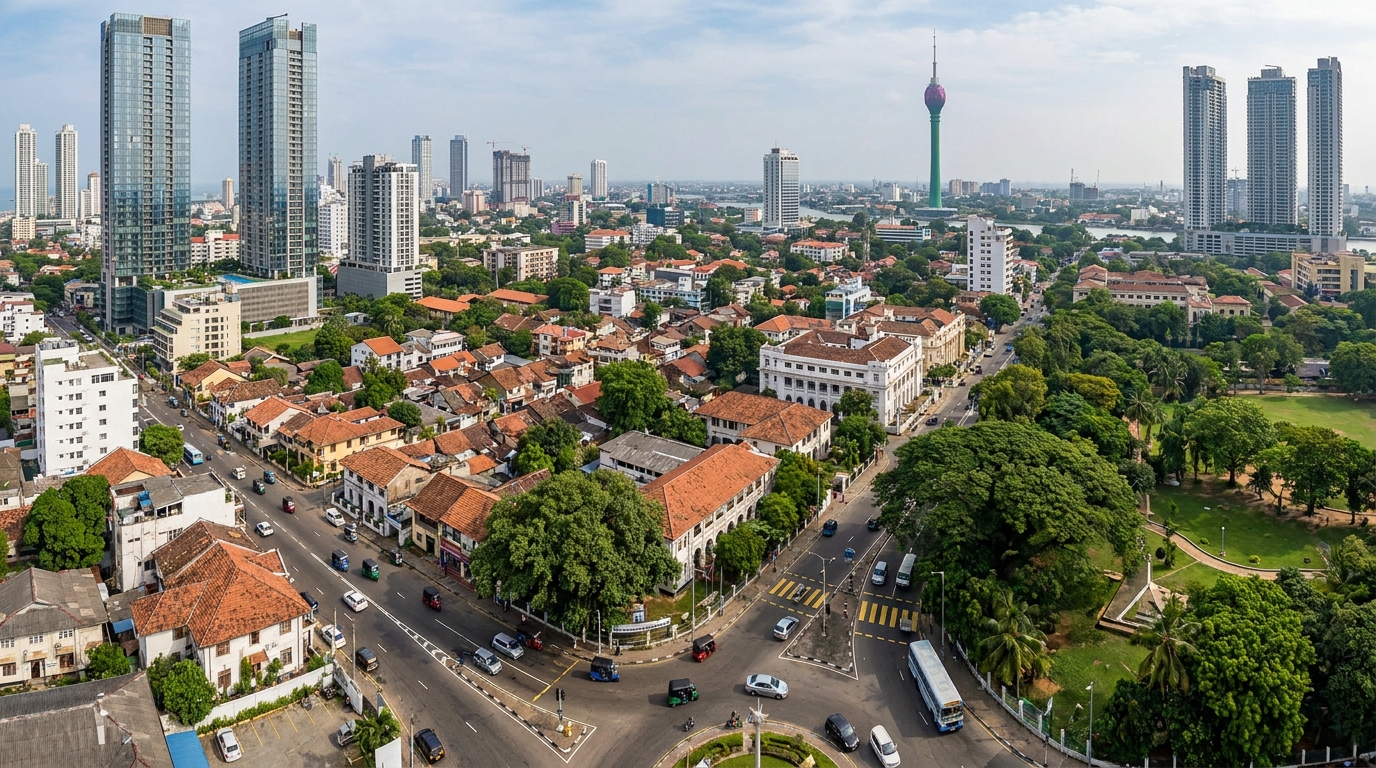
In a new commentary published by The Morning on 21 August 2026, Sri Lankan urban planner Dr Sarath Mataraarachchi argues that the country’s towns and cities are being reshaped by thousands of individual development decisions – and that those decisions need to be considered together rather than one project at a time.

This is not a new government policy or announcement. It is an expert analysis of a problem already visible across Sri Lanka.
Mataraarachchi points to several examples.
In Colombo and its suburbs, more high-rise housing is being constructed as land becomes scarce and development becomes denser.
Along established corridors through Dehiwala, Mount Lavinia, Nugegoda and Maharagama, traditionally residential areas have gradually acquired apartments, restaurants, shops and offices.
Around Kottawa and Homagama, improved transport connections and access to the Expressway have encouraged housing subdivisions and commercial development.
And in destinations such as Galle, Kandy and Negombo, tourism and commercial growth increasingly have to coexist with housing, traffic, heritage and environmental pressures.
The important point is that there is nothing inherently wrong with any of those developments.
Sri Lanka needs new homes, businesses, transport connections and investment.
The concern is what happens when hundreds of individually sensible decisions combine.
A house becomes a shop. Another plot becomes apartments. Agricultural land is divided for housing. A wetland is filled. More cars arrive. Parking spills onto roads. Land prices rise. Infrastructure has to serve more people.
Over 10 or 20 years, the cumulative result can be a completely different town.
Mataraarachchi’s argument is therefore less about stopping development and more about managing it: deciding how housing, transport, infrastructure, environmental protection and private investment fit together before the consequences become expensive or impossible to reverse.
Sri Lanka wants to Welcome 5 Million Tourists a year by 2030
Why this matters for foreigners?
If you live in Sri Lanka for several years, you start noticing how quickly a place can change.
A residential road gets busier. Houses become cafés, shops or offices. Empty land becomes apartments. A new road makes an overlooked suburb suddenly much easier to reach. In popular tourist areas, villas, restaurants and hotels appear where relatively little existed before.
For foreigners, these changes are easy to dismiss as simply part of a developing country becoming more developed.
But they can have very practical consequences.
They affect traffic, flooding, rents, property values, water and electricity demand, noise, green space and ultimately whether an area remains somewhere you actually want to live.
This matters particularly for foreigners making long-term decisions in Sri Lanka.
Choosing somewhere to stay for a six-month assignment is one thing. Buying a home, retiring here, opening a business or investing in property for the next ten years is something very different.
The neighbourhood you choose today may not be the neighbourhood you find yourself living in five or ten years from now.
And that is why the way Sri Lanka manages its urban development deserves more attention from the expat community.
Sri Lanka’s Economy in 2026: What expats should know
One of the strongest examples of why planning matters in Sri Lanka is flooding.
Wetlands around Colombo are not simply empty land waiting to be developed. They absorb and store water and form part of the metropolitan area’s natural flood-management system.
The World Bank has previously documented how urban development, inadequate drainage and the loss of wetlands increased Colombo’s vulnerability to flooding. More recent World Bank reporting says improvements to drainage and wetland conservation under the Metro Colombo Urban Development Project strengthened flood protection for roughly 2.5 million residents.
Development does not only create risks.
It creates opportunities too.
The growth around Kottawa and Homagama demonstrates how improved transport and Expressway access can encourage housing, commercial activity and land development.
For residents, better connections can make previously inconvenient areas practical places to live.
For investors, improved accessibility can increase demand.
But there is an important distinction between infrastructure that exists and infrastructure that is merely proposed.
Sri Lankan property is sometimes marketed around future roads, transport projects or other developments.
What should expats and investors do now?
There is no new regulation requiring foreigners to take immediate action.
Instead, this story should change how long-term residents and investors investigate locations.
One useful starting point is the Urban Development Authority.
The UDA publishes development plans covering locations across Sri Lanka, including areas within Colombo and other provinces.
It has also introduced MY ZONE UDA, an official digital planning platform.
For areas currently covered in Colombo and Gampaha districts, users can access zoning classifications, permitted land uses, development regulations and building-height restrictions. The UDA says coverage will be expanded as further development plans are prepared and implemented.
For someone considering buying land or developing property, that information can be considerably more useful than simply asking what neighbouring plots are currently being used for.