


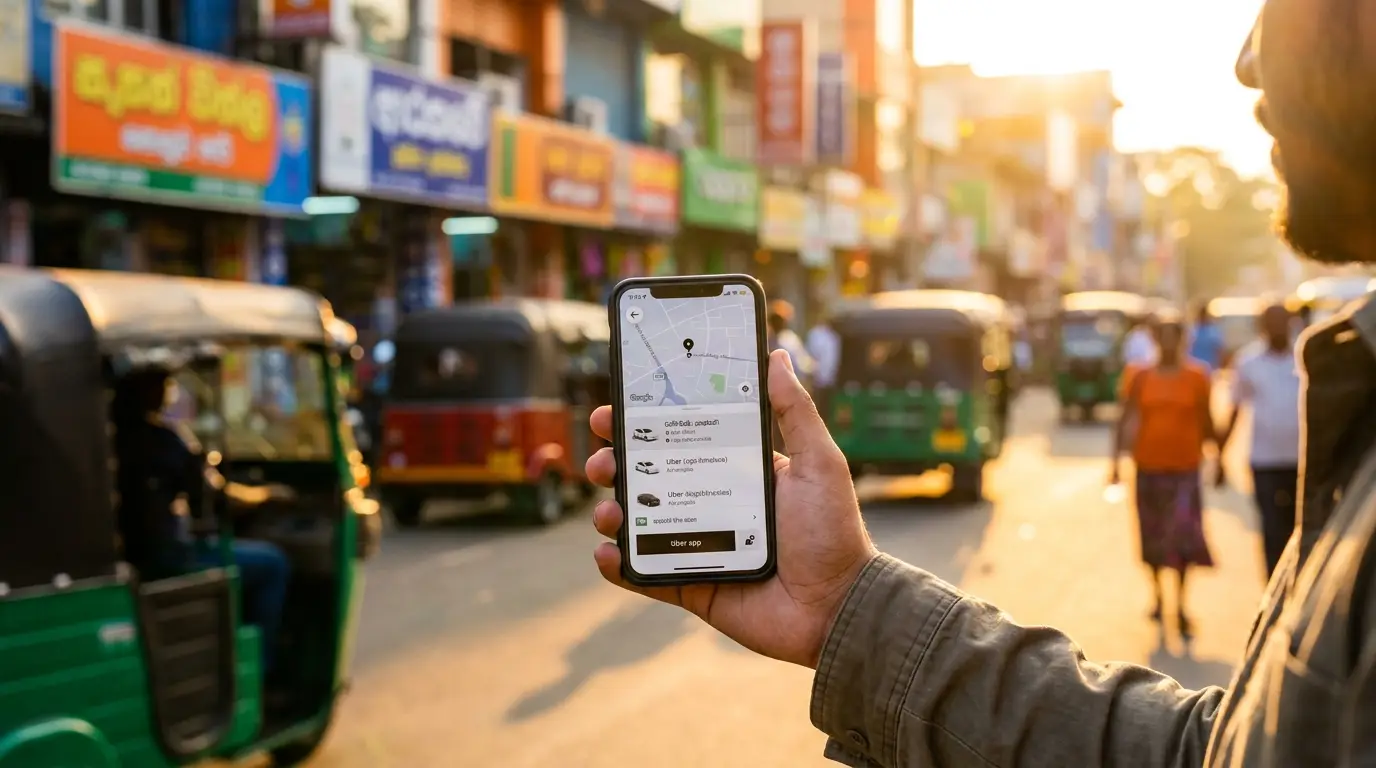
Getting around Sri Lanka becomes considerably easier once you understand the country’s transport system. In Colombo and several other major urban areas, ride-hailing apps have already removed one of the most common frustrations for foreign visitors and residents: working out what a journey should cost and negotiating with a taxi or tuk-tuk driver.

Now that convenience is expanding further inland.
Uber has launched its ride-hailing service in Kurunegala, giving residents and visitors another app-based option for booking local transport. For foreigners travelling through the North Western Province, living in the area or heading towards destinations such as Dambulla and the Cultural Triangle, this is a small announcement with potentially significant practical benefits.
Kurunegala is not primarily an international tourism destination in the way that Galle, Kandy or Ella are. Its importance is different: it is a major regional city and transport junction connecting several parts of the island.
App-based competition can give passengers another benchmark when deciding what a journey should cost. That is particularly valuable for foreigners because street-hired tuk-tuk prices are not always immediately obvious to someone unfamiliar with the area.
However, do not assume Uber will always be the cheapest option.
Prices can change according to vehicle availability, demand, distance and other conditions. Uber has previously explained that its fares can reflect both journey time and distance as well as supply and demand.
The sensible approach is therefore to treat the price displayed in the app as a useful reference rather than assuming every journey will have a fixed standard price.
Understanding transport in Sri Lanka
Sri Lanka’s transport system is unusual from a foreigner’s perspective because highly traditional and highly digital transport options operate alongside one another.
You can travel across the country extremely cheaply by public bus, take some of Asia’s most scenic railway journeys, negotiate directly with a neighbourhood tuk-tuk driver or book transport through a smartphone.
Ride-hailing has become an increasingly important part of that mixture.
Uber launched in Sri Lanka in 2015 and introduced intercity services in 2018, allowing app users to request longer-distance journeys to destinations around the country.
For foreigners, app-based transport offers three particularly useful features: price visibility, location tracking and a digital journey record.
Those advantages become even more valuable outside familiar tourist areas, where a visitor may not know local landmarks or typical transport prices.
Tips
1. Install more than one transport app.
Keep Uber and at least one alternative on your phone. Driver availability can vary considerably by location and time.
2. Use the map pin carefully.
Sri Lankan addresses are not always interpreted as precisely as UK, European or North American addresses. Moving the pickup pin to the correct entrance can prevent confusion.
3. Check the vehicle before getting in.
Match the registration number and vehicle details against those shown in the app.
4. Allow extra time for important journeys.
An app showing service in a city does not guarantee that a driver will immediately be available near you.
5. Use the app price as useful local information.
Even if you eventually use another taxi or tuk-tuk, checking an app can give you a useful indication of the approximate cost of the journey.