

If you have been living in Sri Lanka, travelling around the island or simply following local news over the past year and a half, you have probably heard the words Clean Sri Lanka more than once.

At first, the name seems fairly self explanatory. You might assume it is a campaign to collect rubbish, clean beaches, improve recycling and make towns and public spaces look better.
That is certainly part of it.
But Clean Sri Lanka has become something much bigger.
Since its official launch on 1 January 2025, the programme has developed into an umbrella for projects covering everything from railway stations, public toilets and waste management to road safety, libraries, environmental protection, accessibility and even integrity within the public service. (presidentsoffice.gov.lk)
For foreigners living in Sri Lanka, this is worth understanding because many of the areas being targeted are exactly the ones that affect everyday life here. Transport, sanitation, waste collection, roads, public spaces, local towns and government services all influence how practical and comfortable it is to live in the country long term.
So what exactly is Clean Sri Lanka, how much money is being spent on it, what has actually been delivered, and nearly two years after its launch, can we see the results?
Clean Sri Lanka is not simply a cleaning campaign
The easiest mistake to make is to take the word “clean” literally.
The government’s definition is much broader.
The official Clean Sri Lanka framework now covers four areas: environmental sustainability, social sustainability, governance sustainability and economic sustainability.
Environmental sustainability includes issues such as water, biodiversity, energy, emissions, waste management and the circular economy.
Social sustainability covers areas including community participation, inclusion, health and wellbeing.
Governance sustainability includes ethics, transparency, accountability, risk management and cooperation between institutions.
Economic sustainability includes green employment, sustainable industries, green investment and entrepreneurship. (cleansrilanka.gov.lk)
This means that cleaning a polluted beach and improving accountability within a government office can, somewhat unusually, both sit underneath the same national programme.
The broader meaning becomes even clearer when you look at how the government itself talks about Clean Sri Lanka.
In the 2026 Budget speech, the programme was described as extending beyond the physical environment to issues such as drugs, organised crime, bribery and corruption, inefficient public services and respect for law and order. (media.gov.lk)
In other words, the word “clean” is being used both physically and conceptually.
For foreigners living here, that distinction is important. A programme that improves beaches or rubbish collection affects the physical environment around you. A programme that genuinely improves transparency or public service efficiency could affect completely different parts of life, from dealing with government offices to running a business or managing property matters.
That also explains why the projects appearing under the Clean Sri Lanka name can sometimes seem completely unrelated to each other.
So what does Clean Sri Lanka actually do?
This is where the scale of the programme becomes easier to understand.
Some initiatives are exactly what you would expect from something called Clean Sri Lanka. There are projects connected with waste management, coastal areas, forests, waterways and public sanitation.
Others are much less obvious.
The programme has funded or supported work involving railway stations, road safety, facilities for people with disabilities, public libraries, small town development, health education and public sector integrity.
Environmental projects have included the creation of an urban forest near the Kelani Bridge in Peliyagoda and work connected with reservoirs, rivers and coastal areas. (presidentsoffice.gov.lk)
One government progress update stated that surveys of around 20 major reservoirs had already been completed. It also reported that work had begun on a study of pollution across the Kelani River basin and that 44 of a planned 100 small coastal parks had been completed, with the remaining parks intended to follow. (presidentsoffice.gov.lk)
These may sound like national environmental projects rather than specifically expat issues, but their effects can be very local.
For foreigners living around Colombo, improved waterways, drainage, waste management and urban green spaces can directly affect the environment around their homes. On the south and west coasts, where many foreign residents choose to live, cleaner beaches, better managed coastal areas and improved public spaces affect everyday quality of life as much as they affect tourism.
They can also influence how attractive a town or neighbourhood feels for long term living. A place may have beautiful villas and restaurants, but poor rubbish collection, drainage problems or badly maintained public areas can quickly change the reality of living there.
Railway stations are becoming one of the most visible parts of Clean Sri Lanka
One of the best examples is the Dream Destination programme, which aims to upgrade 100 railway stations around the country.
If you regularly travel around Sri Lanka by train, this is probably one of the parts of Clean Sri Lanka you are most likely to notice.
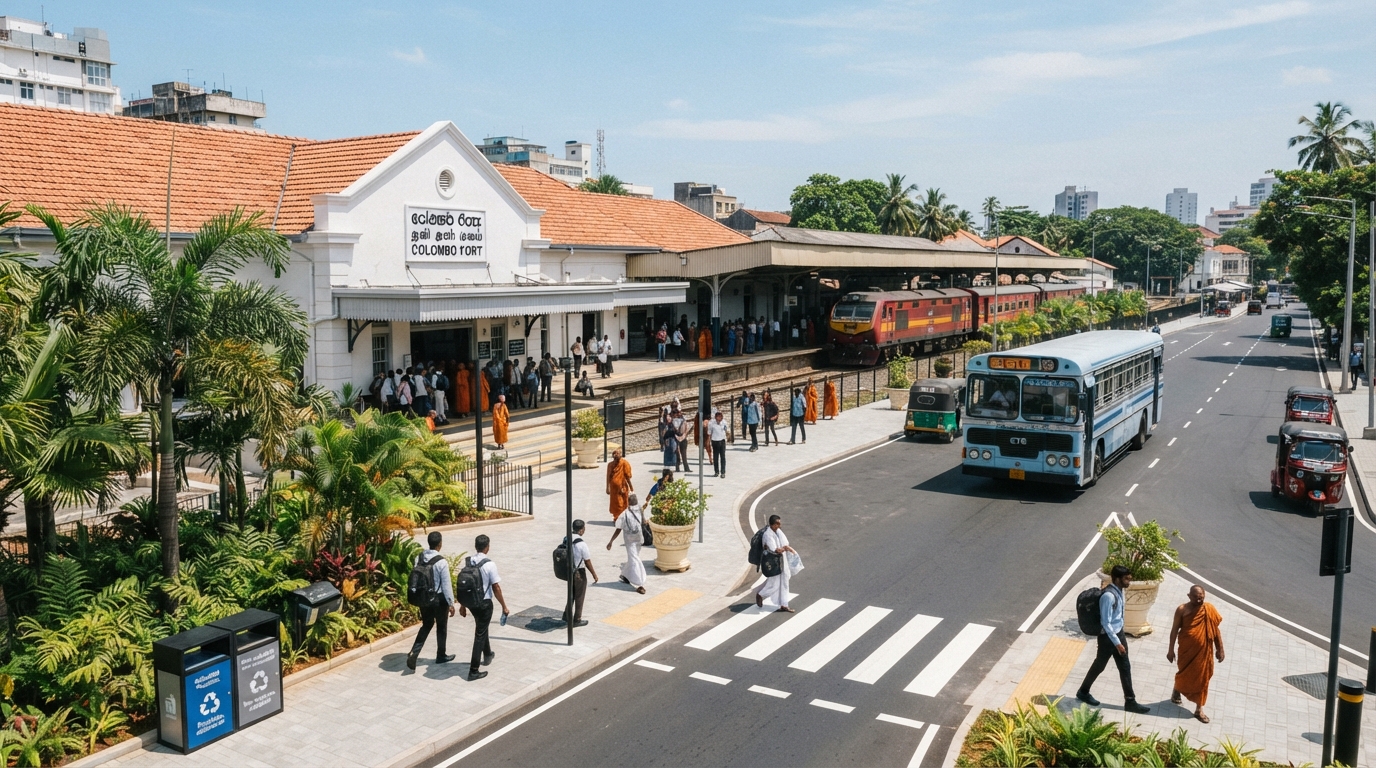
On 10 September 2026, the modernised Bambalapitiya Railway Station reopened after a five month renovation project.
According to the Clean Sri Lanka programme, the Rs. 60 million project was funded by the Dawoodi Bohra community and included improvements to the main station buildings, platforms, pedestrian footbridge, CCTV system, cafeteria and sanitation facilities. (cleansrilanka.gov.lk)
Other railway projects have also been progressing, including work at stations such as Polonnaruwa and Higurakgoda.
For expats, this is more than cosmetic improvement.
Many foreigners living in Colombo, the south coast and hill country use trains for work trips, weekends away or simply because they prefer not to drive. Better toilets, safer platforms, improved lighting, cleaner facilities and more usable stations can make public transport considerably easier to rely on.
This is particularly relevant for people who live in Sri Lanka without owning a car. If public transport becomes cleaner, safer and more comfortable, living outside Colombo without depending entirely on private transport becomes more realistic.
There is also another aspect to these railway projects.
Clean Sri Lanka is not always simply a case of the government paying for a project and a government department building it. Some initiatives involve businesses, community organisations and other private partners providing funding or participating in implementation.
That public private model appears repeatedly across the programme.
Public toilets may sound like a small issue. They are not.
For anyone who travels around Sri Lanka regularly, particularly outside the major cities and hotels, finding a clean and usable public toilet can still be surprisingly difficult.
The government has identified this as both a public health issue and a tourism infrastructure problem.
During 2025, Rs. 327 million was provided for 29 sanitation projects administered through local authorities. According to a Cabinet decision published in June 2026, construction had been completed on 16 of those projects at that stage, while the remaining projects were expected to follow. (cabinetoffice.gov.lk)
A further Rs. 150 million was approved for 2026 to implement 26 sanitation projects across 24 local government areas. (cabinetoffice.gov.lk)
There is also a much larger programme involving fuel stations.
An agreement between the Presidential Secretariat, Ministry of Energy and four major fuel suppliers was announced in May 2025 with the aim of establishing 540 modern public sanitation facilities at selected fuel stations over three years.
The original schedule envisaged 100 facilities in 2025, 200 in 2026 and another 240 in 2027. (presidentsoffice.gov.lk)
This is often discussed in the context of tourism, but the benefits are just as relevant to foreign residents.
Anyone living in Sri Lanka and travelling around the island by car faces the same problem. Families travelling with young children, older relatives, pregnant women and people with medical or mobility needs are especially affected by the lack of reliable roadside facilities.
For expats who regularly drive between Colombo and the south, travel into the hill country or explore more rural parts of Sri Lanka, a network of properly maintained toilets at fuel stations could make everyday domestic travel significantly easier.
But there is an important word there: maintained.
Building the facilities is only the first part of the job. Their long term usefulness will depend on cleanliness, water supply, repairs and regular management after they open.
Clean Sri Lanka is moving into towns, roads and public transport
The programme is also being used to fund projects that would not normally be associated with environmental cleaning at all.
In June 2026, Cabinet approved an estimated Rs. 581 million from Clean Sri Lanka funding for projects in 23 towns under the first stage of the Mithuru Purawara programme. The idea is to identify an essential development need in selected smaller towns and complete the work during 2026. (cabinetoffice.gov.lk)
This could become particularly relevant to the expat community.
Foreigners settling in Sri Lanka are not restricted to Colombo or the country’s established tourist centres. Many choose smaller coastal towns or regional locations because they want more space, lower living costs or a quieter lifestyle.
In those places, relatively basic infrastructure can make a surprisingly large difference. Drainage, pavements, sanitation, waste collection, transport connections and the general condition of a town centre can affect whether an area feels suitable for visiting occasionally or practical enough for everyday living.
These improvements can also influence how attractive different areas become for tourism and property investment. That does not mean a Clean Sri Lanka project will automatically increase property values, but better public infrastructure can certainly change the wider environment surrounding a property.
Road safety could matter enormously to foreign residents
Road safety is another major part of the programme.
The Take Care, Surekemu Magathota programme began in 2025 and is planned to continue between 2026 and 2028. The expanded version is intended to involve 100 schools each year, working with the Sri Lanka Police Traffic Management and Road Safety Division and the Ministry of Education. Cabinet approved the use of Rs. 833 million from Clean Sri Lanka provisions for the programme over that period. (cabinetoffice.gov.lk)
For foreigners who settle in Sri Lanka, road safety often becomes a very real part of everyday life very quickly.
Living here means sharing roads with buses, tuk tuks, motorcycles, pedestrians, cyclists and animals, often on roads with limited pavements or pedestrian crossings.
For foreign parents, road safety around schools may be particularly important. For retirees and older residents, simply crossing a busy road can be difficult. For anyone riding a scooter, driving themselves or travelling regularly by tuk tuk, safer road behaviour matters far more than it might appear from a government programme announcement.
The challenge will be measuring whether education programmes ultimately change what happens on the roads.
Public transport is becoming part of the programme too
Public transport projects have also appeared under the Clean Sri Lanka umbrella.
Ten low floor buses were purchased using Clean Sri Lanka funding as part of Colombo urban transport pilot operations. In August 2026, Cabinet reported that another 112 low floor buses were planned for operation in September through Lanka Metro Transit. (cabinetoffice.gov.lk)
Low floor buses are particularly important because public transport accessibility remains difficult for many people.
Older foreign residents, people with disabilities, anyone with limited mobility and parents travelling with pushchairs could all benefit if accessible buses become more widely available.
There is also a wider question here.
Many foreigners arrive in Sri Lanka assuming they will need a car, driver or tuk tuk for almost every journey. If public transport gradually becomes easier to use, it could change how practical it is to live in Colombo and other urban areas without depending on private transport.
That would be a meaningful quality of life improvement, rather than simply a transport statistic.
It is also funding libraries and community projects
Another unexpected example is the Arunu Dora mobile library programme.
The project is aimed particularly at people in rural areas who cannot easily reach established public libraries.
A pilot involving 10 local authorities in three Western Province districts began in 2025. The programme is now planned to provide mobile libraries to 22 local authorities during 2026 and 100 during 2027. (mpclg.gov.lk)
This is not necessarily a project that will directly change everyday life for most foreign residents.
It does, however, demonstrate something important about the programme itself. Clean Sri Lanka is being used not only to improve physical infrastructure but also to support community services and broader social development.
Then there is the money
With such a wide collection of projects, one of the obvious questions is how much Clean Sri Lanka is costing.
For 2025, Rs. 5 billion was allocated to the programme.
The 2026 Budget then allocated another Rs. 6.5 billion, bringing planned allocations for the two years to Rs. 11.5 billion.
But there is an important distinction between money allocated and money actually spent.
Information released by the Presidential Secretariat following a Right to Information request showed that Rs. 2.65 billion was spent during 2025.
Between January and the end of March 2026, another Rs. 282.38 million had been spent.
That brought recorded expenditure from the beginning of the programme to 31 March 2026 to approximately Rs. 2.93 billion.
The date matters.
It would be misleading to compare that Rs. 2.93 billion figure with the full allocations for both 2025 and 2026 and suggest that it represents total expenditure up to today. The RTI information only covered expenditure to the end of March 2026, while the programme has continued since then.
However, the same disclosure also provides useful information about the speed of implementation.
Clean Sri Lanka planned 62 projects during 2025. According to the RTI information, 28 were completed during that year while 34 continued into 2026. Another 28 new projects were also being implemented during 2026.
That does not necessarily mean the 34 projects failed. Some major infrastructure and environmental projects naturally take longer than one year.
It does, however, show why judging Clean Sri Lanka simply by the number of programmes announced gives an incomplete picture.
For residents, including foreigners, the amount allocated matters far less than whether the projects eventually turn into services and infrastructure people can actually use.
There is another side to Clean Sri Lanka that many foreigners may not know about
Clean Sri Lanka is also being used as a framework for changing behaviour inside government institutions.
In July 2026, the Presidential Secretariat introduced National Integrity Week under Clean Sri Lanka.
Its stated objectives included strengthening integrity throughout the public service, providing more transparent and accountable services, preventing bribery and corruption, preventing misuse of public resources and improving public confidence in government institutions. (railway.gov.lk)
This could potentially be one of the most significant parts of the programme for long term foreign residents, even though it is much less visible than a renovated railway station.
Foreigners living in Sri Lanka may need to interact with government institutions for visas, driving licences, company matters, property related processes, local authority approvals, taxes and other administrative requirements.
Anyone who has spent a significant amount of time living abroad knows that the quality of these interactions can have a major effect on how easy or difficult life in another country feels.
If Clean Sri Lanka’s objectives around transparency, accountability and public service efficiency result in faster, clearer and more predictable government services, expats could experience the programme in ways that have absolutely nothing to do with cleaner streets.
For foreign business owners and investors, this could matter even more. More transparent processes and more consistent administration can reduce uncertainty when dealing with licences, approvals and public institutions.
But this is also an area where we need to be careful.
The existence of an integrity campaign is not evidence that corruption has already fallen or that public services have already become significantly more efficient.
There is an important difference between an objective and an outcome.
That distinction applies throughout Clean Sri Lanka.
What could Clean Sri Lanka actually change about everyday expat life?
When you look across all of these projects, the potential impact on foreigners living in Sri Lanka falls broadly into three areas.
The first is the infrastructure people physically use.
Railway stations, buses, toilets, roads, town centres and public spaces are part of everyday life regardless of nationality. Improvements here can make Sri Lanka easier to navigate and more comfortable to live in.
The second is the environment around where people choose to live.
Waste collection, drainage, beaches, waterways, pollution and public spaces all contribute to quality of life. They are particularly relevant in areas attracting growing numbers of foreign residents, including coastal towns where rapid development can put pressure on existing infrastructure.
This can also become important when deciding where to rent or buy property. Foreign buyers often concentrate heavily on the house, apartment or land itself, but the wider infrastructure surrounding it matters just as much. Poor drainage, unmanaged rubbish or inadequate roads do not stop being problems because a property behind the gate is beautiful.
The third area may ultimately be the most important for foreigners who plan to stay long term: how effectively public institutions work.
A cleaner beach is easy to photograph.
A government office that processes something transparently and efficiently is far less visible, but for a resident or business owner it may be much more important.
So, is Clean Sri Lanka actually working?
Nearly two years after its launch, this is becoming the more useful question.
There are clearly projects that have moved beyond announcements.
Railway stations have been renovated. Sanitation projects have been completed. Coastal parks have been developed. Transport and community projects are underway.
At the same time, the RTI figures demonstrate that implementation does not always move as quickly as headline allocations or project announcements might suggest.
There have also been questions about how the programme fits within Sri Lanka’s existing administrative structures.
In May 2026, the Centre for Policy Alternatives, a Sri Lankan public policy organisation, raised concerns about both Clean Sri Lanka and the separate Praja Shakthi programme. CPA argued that aspects of their implementation could raise questions about administrative autonomy, constitutional structures and the role of devolved and local government institutions. Those are CPA’s stated concerns rather than findings that the programmes have violated constitutional rules.
That debate matters because Clean Sri Lanka has become so broad.
Once a programme starts covering environmental policy, transport, sanitation, education, public administration, local authorities and community development, questions about how projects are selected, funded, monitored and integrated with existing institutions become increasingly important.
For residents, the most useful way to judge the programme may therefore be much simpler.
Was the project announced?
Was it funded?
Was it completed?
Does it work?
And is it still working several years later?
The real test comes after the ribbon cutting
There is another issue that deserves more attention.
Building something is only the first part of the job.
Sri Lanka does not simply need renovated toilets, stations, parks and public facilities. It needs them to remain clean, safe and functional several years after they open.
That may ultimately become one of the best measures of whether Clean Sri Lanka has worked.
A modern toilet that becomes unusable after a year does not solve a sanitation problem.
A renovated railway station that is not maintained gradually returns to the same condition.
A coastal park needs continued management.
Waste management systems need regular collection, enforcement and public cooperation.
Water pollution cannot be solved by a one off cleaning event if the original sources of pollution continue.
This is particularly relevant for expats deciding whether Sri Lanka works as a long term home rather than simply as a holiday destination.
Visitors might see a newly renovated facility once.
Residents see what happens to it after one year, three years and five years.
That is why maintenance may ultimately tell us more about the success of Clean Sri Lanka than the number of opening ceremonies.
What should we watch during the rest of 2026 and into 2027?
There is now enough happening under Clean Sri Lanka to start measuring progress against previously announced plans.
The expansion of public sanitation facilities is worth following closely, particularly the 540 facility programme at fuel stations.
The Dream Destination railway programme has a target of 100 stations, making it possible to track how many actually reach completion and what standard of renovation is delivered.
The mobile library programme is expected to expand substantially in 2027.
The road safety programme is scheduled to continue through 2028.
Small town development, coastal projects, transport improvements and environmental programmes are also continuing.
For expats, it will be particularly interesting to watch what happens outside the most obvious tourist and central Colombo areas.
If improvements in sanitation, transport, public spaces, waste management and local infrastructure spread into smaller towns, they could gradually change which parts of Sri Lanka are considered practical places for foreigners to live.
And alongside all of this sits the much harder to measure ambition of creating more transparent, accountable and efficient public institutions.
Clean Sri Lanka is much bigger than cleaning Sri Lanka
If you thought Clean Sri Lanka meant volunteers collecting rubbish from beaches, you were not entirely wrong.
You were simply seeing one small piece of it.
The programme has grown into a broad government framework connecting environmental protection, public infrastructure, transport, sanitation, social projects and institutional reform.
Some of those changes are already visible.
Others remain projects, allocations or long term ambitions.
For expats, the effects may eventually appear in very ordinary parts of life: the railway station you use, the condition of the road into your town, whether you can find a clean toilet during a long drive, how rubbish is managed near your home, whether public transport is accessible and how straightforward it is to deal with government institutions.
Those things may not sound dramatic individually.
Together, however, they can significantly influence how easy, comfortable and practical Sri Lanka feels as a place to live rather than simply a place to visit.
That is why the question surrounding Clean Sri Lanka is gradually changing.
At the beginning, the important question was: What is Clean Sri Lanka supposed to do?
Nearly two years later, there is enough money committed and enough projects underway to ask something more useful:
What has actually been delivered, has it improved everyday life, and will those improvements still be there five or ten years from now?
For Sri Lankans and foreigners who have chosen to make the country their home, that will ultimately be the measure that matters.