


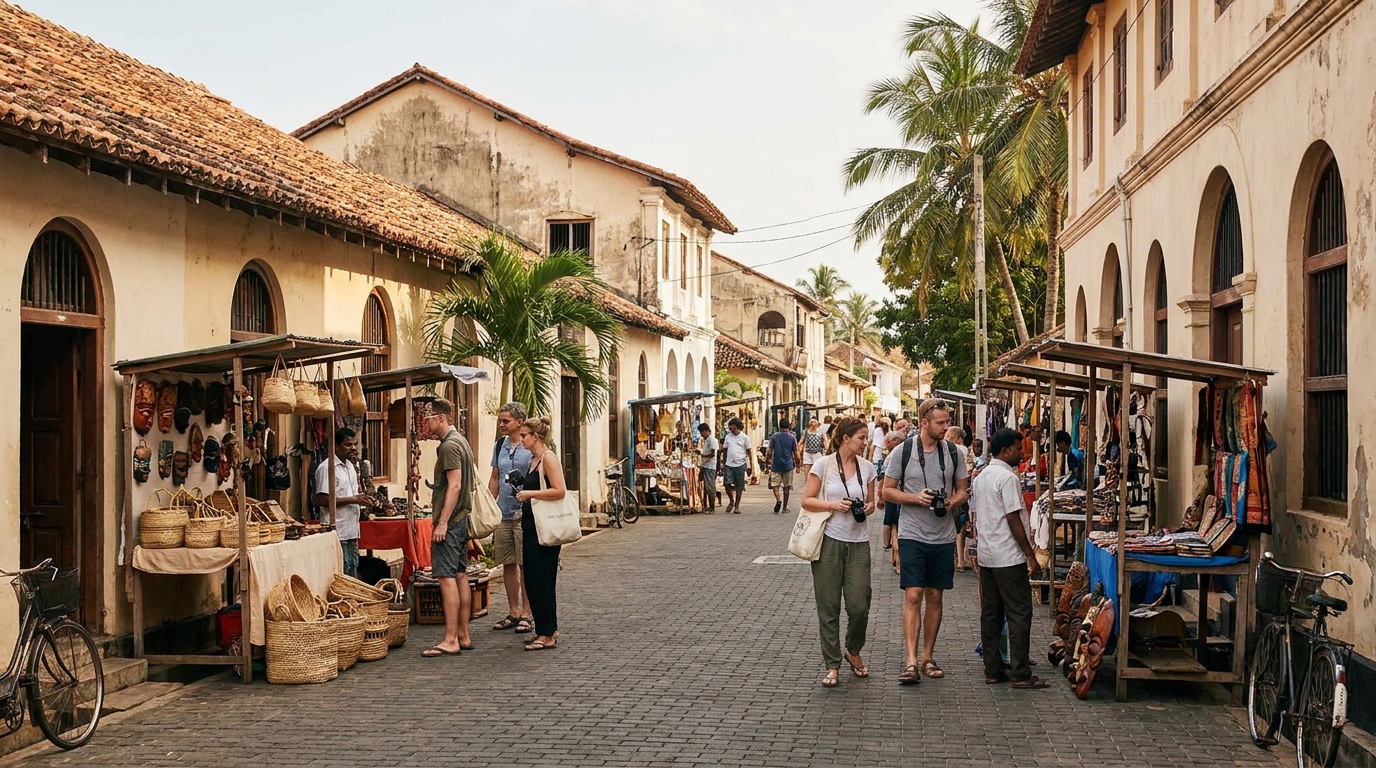
A dispute involving small traders inside Galle Fort may seem like a very local issue. But for expats, business owners and foreign investors, it highlights a much bigger question: what happens when one of Sri Lanka’s most desirable tourism locations becomes increasingly expensive to operate in?

Galle Fort has limited commercial space, strict heritage protections and strong demand from tourism businesses. That combination creates opportunities, but it also puts pressure on the people and businesses operating there.
For foreigners considering property or business investment in Galle, this story is particularly relevant. It shows why location alone does not determine whether an investment will succeed. Operating costs, seasonality, local authority charges, permitted use and competition for commercial space can all affect profitability.
There is no immediate change affecting foreign residents, visas or property ownership. Instead, this is a useful indication of the commercial pressures developing inside Galle Fort and what investors should consider before committing money to the area.
Small traders operating at the Court Square Market inside Galle Fort are facing significantly higher charges for using the municipal space.
From January 2026, the weekend rental charge increased from Rs.60,000 to Rs.120,000 following changes introduced under the Galle Municipal Council’s 2026 budget.
Around 35 vendors have traditionally operated from the market, selling handmade clothing, handicrafts, food products and drinks. The total rental charge is shared between the traders operating on a particular weekend.
This arrangement becomes more difficult during quieter periods. When fewer vendors participate, those who remain must contribute more towards the rental cost while potentially serving fewer customers.
The traders also have other operating expenses, including transport, canopies, tables and chairs. Some have said that during particularly quiet trading periods, their costs can be higher than their sales.
Sri Lanka Targets $9 Billion in Foreign reserves by end of 2026
Another concern raised by the vendors is competition for the space itself. They say larger organisations sometimes book Court Square, particularly during stronger tourism periods, preventing the regular traders from operating there.
The Galle Municipal Council says the higher charges are necessary because the council needs to generate more of its own revenue. Galle Mayor Sunil Gamage has said that around 40% of municipal expenditure currently has to be funded through locally generated income, while financial support from the central government is expected to decline.
The dispute therefore comes down to two competing pressures: the council’s need to generate revenue from valuable public space and the ability of small businesses to continue operating there.
Sri Lanka wants to Welcome 5 Million Tourists a year by 2030
Galle Fort is not an ordinary property market because it combines heritage protection, tourism demand and limited commercial space within a tightly controlled area.
The Fort is a UNESCO World Heritage Site, which means that buildings, renovations, signage and changes to the streetscape may be subject to additional rules and approvals. A property that appears suitable for a restaurant, shop, guesthouse or office may not automatically be permitted to operate in that way.
The market is also shaped by the Fort’s popularity with tourists, residents and international visitors. This can create strong demand for well-located properties, particularly those with historic character, visible street frontage or access to busy pedestrian areas. At the same time, that demand can push up rents, purchase prices and operating costs.
Space is limited, and new commercial opportunities inside the Fort are not created easily. Existing businesses therefore compete for a relatively small number of suitable locations. This can make the area attractive for established operators, but more difficult for smaller businesses or investors entering the market for the first time.
For foreign investors, the main point is that buying or leasing a property inside Galle Fort is only one part of the decision. The property’s permitted use, renovation requirements, access, utilities, local authority charges, staffing costs and seasonal income all need to be considered before assessing whether the investment is financially viable.
Galle Fort has something that developers cannot simply create more of: extremely limited space inside a globally recognised historic location.
The Old Town of Galle and its Fortifications has been a UNESCO World Heritage Site since 1988. UNESCO describes it as an exceptional example of a fortified European settlement adapted to South Asian conditions.
That heritage status also means development is much more tightly controlled than in an ordinary Sri Lankan town.
UNESCO notes that the Department of Archaeology exercises significant control over the Fort, while Urban Development Authority rules also apply. The long term management challenge is specifically described as maintaining Galle as a living city while accommodating modern uses without damaging its historic character.
For property investors, this distinction is crucial.
You cannot analyse an investment inside Galle Fort in the same way you might analyse a modern villa development in Weligama, Ahangama or elsewhere along the south coast.
Scarcity can support property values and commercial demand, but restrictions can also make renovation, redevelopment and changes of use considerably more complicated.
Sri Lanka’s Tourism Expansion: What expats need to know
The council’s position is particularly interesting from an investment perspective because it reflects a broader issue affecting Galle Fort: there is only a limited amount of commercially useful space within a highly desirable and tightly regulated destination.
The Fort attracts visitors because of its heritage character, walkability, architecture and concentration of tourism businesses. Those same features also restrict how much new commercial space can be created. Heritage rules, conservation requirements, narrow streets, limited parking and the physical layout of the Fort all place practical limits on expansion.
The council says space inside the Fort is limited and that municipal authorities need to generate greater income from available assets. From the council’s perspective, increasing charges may be a way to capture more value from a location that attracts traders, visitors and commercial events.
That does not automatically mean commercial rents across Galle Fort will rise. Private property rents are determined separately, and landlords may take account of factors such as the condition of the building, the length of the lease, permitted use, foot traffic, seasonality and the tenant’s ability to pay.
It would therefore be misleading to use this single municipal rental decision as evidence of a Fort-wide increase in private rents. A higher charge for a public market space does not necessarily translate directly into higher rents for a restaurant, shop, gallery or guesthouse operating from privately owned premises.
What it does show is that commercially useful space inside the Fort has considerable economic value. The council’s decision suggests that public authorities are also aware of the demand for access to the area and may look for ways to increase revenue from that demand.
Restaurants, boutique hotels, cafés, galleries, shops and tourism businesses are competing for access to a geographically restricted destination. They are not all competing in exactly the same way, but they are generally relying on the same underlying advantages: visitor numbers, heritage appeal, walkability and the reputation of Galle Fort as a premium tourism location.
This creates opportunities for businesses that can attract customers consistently and manage their costs carefully. It also creates risks for operators whose business models depend on high visitor numbers during only a few months of the year.
A business may appear successful during the peak tourism season but struggle during quieter periods if rent, staff, utilities, maintenance, licensing, transport and other fixed costs remain high. The market traders’ experience is a reminder that revenue can fluctuate while many expenses continue regardless of how busy the location is.
For investors, scarcity is attractive, but only when the numbers still work. A limited supply of commercial space can support strong rents and property values, but it can also make entry more expensive and reduce the margin for error.
Investors should therefore look beyond the prestige of the address. They should examine the permitted use of the property, the remaining lease term, renewal conditions, maintenance obligations, heritage restrictions, access arrangements and the likely level of demand outside the busiest periods.
They should also consider whether the business would remain viable if visitor numbers fell, operating costs increased or the property could not be used for the purpose originally expected.
A prestigious address is not enough. The investment still needs a realistic business model, reliable cash flow and enough financial flexibility to withstand the quieter periods.
Sri Lanka Tourism Revenue Falls: What Expats need to know
Could Galle Fort become more commercialised?
This is another issue worth watching, particularly as Galle Fort continues to attract more visitors, higher-value businesses and international attention.
The vendors claim that larger businesses are increasingly able to secure the market area at times when small traders would normally operate. If that pattern continues, regular traders could find themselves with fewer opportunities to sell, even though they have traditionally formed part of the Fort’s commercial life.
This does not prove that Galle Fort is undergoing wholesale commercial displacement. The current dispute is focused on market access and rising operating costs, rather than a confirmed policy to remove small traders or replace them with larger businesses.
However, the tension is familiar in successful heritage destinations around the world.
As visitor numbers and commercial values increase, independent businesses can find themselves competing against operators with significantly more capital. Larger companies may be able to pay higher rents, organise bigger events, secure more prominent locations or absorb quieter trading periods more easily than small, owner-operated businesses.
That does not automatically make larger businesses unwelcome. Investment can bring employment, improve buildings, expand the range of services available to visitors and help maintain historic properties. The concern is whether commercial growth remains balanced or whether it gradually makes the area unaffordable for the smaller businesses that helped establish its identity.
For visitors and residents, that can gradually change the character of a destination.
Part of Galle Fort’s appeal is precisely its mixture of historic buildings, independent cafés, galleries, boutiques, restaurants, residents and local traders. These different uses create a living neighbourhood rather than a purely commercial attraction.
If commercial pressure removes too much of that diversity, the Fort risks losing some of the character that makes it valuable in the first place. A destination can become more polished and profitable while also becoming less distinctive, less accessible to local entrepreneurs and less connected to the community that surrounds it.
This is also relevant for property owners, investors and business operators. A more commercialised Fort may create opportunities for premium hospitality, retail and event businesses, but it could also lead to higher rents, stronger competition and greater scrutiny over how properties are used. Heritage rules, municipal charges, licensing requirements and community expectations may all become more important as commercial activity expands.
That is why heritage management and commercial development have to work together.
The challenge is not to prevent investment or keep Galle Fort unchanged. It is to ensure that new investment does not gradually push out the independent businesses, residents and local traders that give the Fort its character.
What should expats and investors do now?
Foreign residents do not need to take any immediate action because of the Court Square rental increase. The change affects traders using a particular municipal market space and does not alter visa rules, foreign property ownership rights or the general ability of foreigners to live in Galle.
Anyone considering buying, leasing or opening a business inside Galle Fort should, however, treat the story as a reminder that due diligence here must extend beyond the property itself.
Galle Fort is a protected heritage area with limited space, strict planning considerations and a commercial environment that can change as tourism demand, municipal policy and operating costs develop. A property that appears attractive on paper may not produce the expected return once rent, licences, renovation costs, staffing, utilities, taxes and seasonal demand are taken into account.
Before signing a lease or purchasing an investment property, establish exactly what activities are permitted at the premises. This should include checking whether the intended use is allowed under the relevant planning, zoning and heritage requirements, as well as whether any additional approvals are needed for signage, alterations, outdoor seating, kitchens, accommodation or changes to the building’s layout.
Do not assume that because a building physically could become a restaurant, boutique hotel, shop or guesthouse, permission will automatically be granted. A previous commercial use does not necessarily guarantee that a new operator can continue the same activity, expand it or make structural changes.
Prospective tenants should also clarify who is responsible for obtaining approvals and paying related costs. These responsibilities should be recorded clearly in the lease, together with the permitted use, lease term, renewal rights, rent increases, maintenance obligations and any restrictions imposed by the landlord, municipal authorities or heritage regulations.
The Urban Development Authority currently provides specific planning procedures relating to development of properties within Galle Fort. Depending on the property and intended work, approvals involving planning and heritage authorities may therefore become important.
Investors should also examine the practical operating conditions before committing funds. This may include checking access for deliveries, parking and loading restrictions, waste collection arrangements, electricity and water capacity, insurance requirements, staff accommodation and the effect of tourist seasonality on revenue.
Foreign investors should obtain professional advice before committing capital, particularly where renovation or commercial conversion forms part of the investment plan. A Sri Lankan lawyer, qualified architect, planning consultant, tax adviser or other relevant professional may be able to identify restrictions and costs that are not obvious from the property listing or initial discussions with an agent.
The wider lesson is that investing in Galle Fort requires more than finding a well-located building. Investors need to understand the regulatory position, the full cost of operating there and whether the proposed business can remain viable if rents, municipal charges or competition increase.
The dispute over Court Square is not a major policy change for foreigners, but it tells us something important about Galle Fort.
This is a heritage destination with limited space, valuable commercial opportunities and increasing competition over how that space is used. As tourism grows, the pressure on public areas, market spaces and commercially viable properties is likely to increase. That pressure can create opportunities for businesses, but it can also make operating in the Fort more expensive and less predictable.
For visitors, there is also a cultural question. Small traders, craftspeople and family businesses form part of the experience that makes historic destinations interesting. Visitors often come to Galle Fort not only for its architecture and ocean views, but also for its independent shops, local food, handmade products and informal street-level atmosphere.
If rising costs force smaller traders out, the Fort could become more commercially polished but less distinctive. On the other hand, public authorities still need enough revenue to maintain roads, public spaces, drainage, waste collection, security and heritage buildings. Preserving the character of the Fort while generating enough income to maintain it is not straightforward.
The issue also raises questions about how public space should be managed. Should regular small traders receive priority because they contribute to the Fort’s identity? Should larger organisations be allowed to book the most valuable spaces during busy periods? Or should the council focus primarily on maximising revenue? The answer will affect both the local business community and the visitor experience.
For investors, the lesson is simpler.
Galle Fort can offer opportunities precisely because it is difficult to replicate. Its history, architecture, location and international reputation create demand that newer developments may struggle to match. But scarcity does not remove risk. In many cases, it increases it.
Heritage restrictions, renovation costs, planning approvals, permitted commercial uses, lease conditions, insurance, staffing, utilities and seasonality all need to be understood before buying or leasing a property. A building may appear suitable for a restaurant, guesthouse, shop or office but still face restrictions that affect how it can legally be used.
Operating costs also deserve close attention. A property can have an excellent location and strong visitor traffic but still produce disappointing returns if rent, municipal charges, maintenance, staffing and renovation expenses are too high. Businesses that depend heavily on weekend visitors or peak tourism months may also face long periods of weaker income.
The strongest investment is not necessarily the property with the most impressive location or highest advertised nightly rate. It is the one where the legal structure, permitted use, renovation requirements and realistic annual numbers have all been properly investigated.
The Court Square dispute is therefore worth watching even for people who have no connection to the market. It reflects the wider challenge facing Galle Fort: how to protect its heritage and local character while making enough money to support the infrastructure and businesses that keep the area active.
For foreigners, the practical message is to treat Galle Fort as a specialised market rather than a straightforward tourism investment. The location may be highly attractive, but the rules, costs and operating realities require careful due diligence.
ExpatsLanka will continue monitoring developments affecting Galle, Sri Lanka’s south coast and the wider property and tourism markets. Subscribe to ExpatsLanka updates for practical news and analysis for foreigners living, investing and doing business in Sri Lanka.