


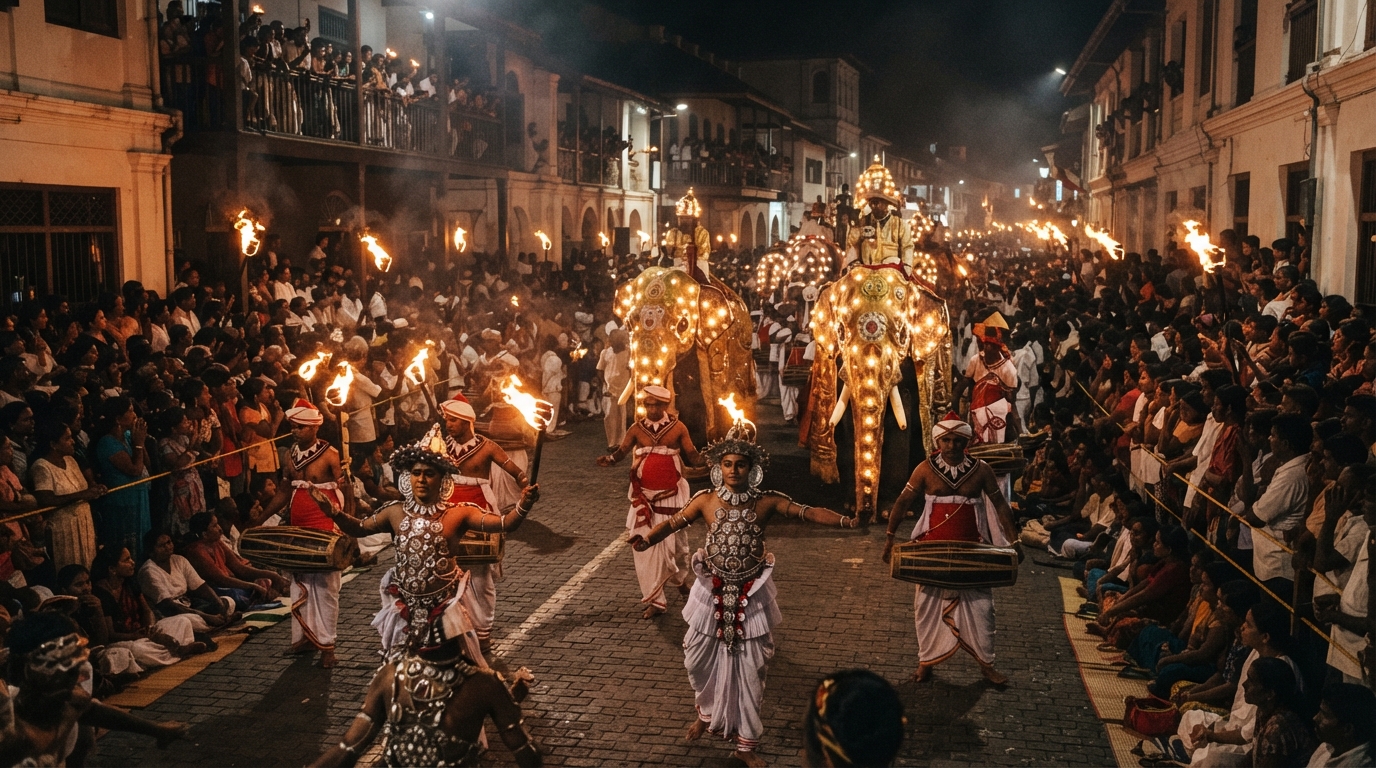
There are festivals you watch, and there are festivals you experience.

The Kandy Esala Perahera belongs firmly in the second category.
For several nights each year, the centre of Kandy changes completely. Roads close, thousands of people gather along the streets, drums echo through the city and long processions of dancers, musicians, torchbearers and ceremonially dressed elephants move through the historic centre.
For visitors, it can be one of the most memorable nights of a trip to Sri Lanka. But to really appreciate the Perahera, it helps to understand what you are watching, because this is much more than a colourful parade.
What is the Kandy Esala Perahera?
The Kandy Esala Perahera is one of Sri Lanka’s most important Buddhist festivals and one of the country’s best known cultural events.
It takes place annually in Kandy, usually during July or August, and is closely connected with the Sri Dalada Maligawa, better known in English as the Temple of the Sacred Tooth Relic.
The temple houses what Buddhists venerate as a Sacred Tooth Relic of the Buddha and has enormous religious significance in Sri Lanka.
The Perahera brings together Buddhist traditions, customs associated with Kandy’s historic devales, Kandyan dancing, drumming, fire performances, ceremonial costumes and elephants.
Although international visitors often describe it as a festival or procession, for Sri Lankans it carries much deeper religious and historical significance.
What is it actually like to experience?
Photographs don’t quite prepare you for the noise.
You often hear the procession before you properly see it.
The cracking of ceremonial whips announces its approach. Then come drummers, dancers, torchbearers and performers, appearing in groups as the procession slowly makes its way through Kandy.
Traditional Kandyan drumming becomes almost hypnotic when dozens of performers are playing around you.
There are dancers wearing elaborate traditional costumes, performers carrying fire, musicians and elephants dressed in illuminated ceremonial coverings.
The procession is long and deliberately ceremonial. This isn’t a quick parade passing through the city in twenty minutes.
Different groups appear one after another, each forming part of a much larger ritual procession.
At the heart of the Dalada Maligawa procession is the Maligawa Tusker carrying a ceremonial casket associated with the Sacred Tooth Relic.
The actual Sacred Tooth Relic does not travel through the streets.
There isn’t just one Perahera
One of the most useful things to know when planning a visit is that the Kandy Esala Perahera isn’t a single night.
The festival develops over a series of evenings.
The first five major nighttime processions are known as the Kumbal Peraheras.
These are followed by five Randoli Peraheras, which become increasingly elaborate as the festival progresses.
The final Randoli Perahera is the climax.
It is generally the biggest and most elaborate procession and consequently attracts some of the largest crowds.
The wider festival eventually concludes with the traditional water cutting ceremony, known as Diya Kapeema, followed by the Day Perahera.
This gives travellers an important choice.
You don’t necessarily have to attend the final night.
If your main objective is to experience the atmosphere, dancing, drumming and procession, attending an earlier night can still provide an extraordinary experience.
If this may be your only opportunity to see the Kandy Esala Perahera and you want to witness it at its most elaborate, one of the later Randoli nights is the better choice.
Five processions become one
Another detail that many visitors don’t realise is that what you see moving through Kandy is actually a combination of several ceremonial processions.
The procession of the Sri Dalada Maligawa takes precedence.
It is followed by processions associated with four historic devales dedicated to Natha, Vishnu, Kataragama and Pattini.
Understanding this changes the way you see the event.
What can initially look like one enormous parade is actually a carefully structured religious procession containing different traditions, participants and ceremonial roles.
The atmosphere starts long before the procession arrives
The experience isn’t limited to the moment the dancers appear.
By late afternoon, Kandy begins to feel different.
People start claiming places along the procession route. Families arrive carrying food and drinks. Security increases. Streets become progressively busier and eventually sections of the city are closed to normal traffic.
Some spectators wait for hours.
As darkness arrives, anticipation builds until the sound of the procession can finally be heard approaching through the city.
This waiting is part of the experience, but it is also something international visitors should plan for.
If you expect to arrive shortly before the procession, find a good position and leave immediately afterwards, you may be disappointed.
Why the darkness is part of the experience?
One thing photographs rarely communicate properly is just how different Kandy feels once darkness falls during the Perahera.
This is fundamentally a nighttime procession, and the darkness is part of its character.
As daylight disappears, much of the visual impact comes from fire and light. Torchbearers move through the streets carrying burning torches, illuminated ceremonial costumes emerge from the darkness and elephants appear covered in elaborate cloth and lights.
Combined with the sound of drums, chanting, cracking whips and thousands of spectators lining the streets, the effect can be extraordinary.
But the darkness also has a practical side that visitors should understand.
Once the procession is underway, parts of central Kandy can be very dark and extremely crowded. You may be walking through unfamiliar streets with thousands of other people, temporary barriers, closed roads and changing pedestrian routes.
For that reason, it is worth knowing exactly where your viewing area is before the evening begins and, just as importantly, how you will walk back to your accommodation afterwards.
This is another strong argument for staying within walking distance of the procession route rather than relying on a tuk tuk or car.
If you are attending with children, be particularly careful. Agree on a meeting point before entering the crowds and keep younger children close, especially when leaving at the end of the procession.
A small phone torch can be useful when walking away from the main viewing areas, although it should obviously not be used in a way that distracts performers or other spectators.
The darkness isn’t simply an inconvenience to prepare for. It is part of what makes the Kandy Esala Perahera so visually powerful. Fire, illuminated elephants, traditional costumes, music and movement all appear against the night rather than in daylight.
That contrast is one of the reasons seeing the Perahera in person feels very different from watching videos or photographs of it.
Where should you watch the Perahera?
There are essentially two ways to experience it.
The first is to watch from the public areas along the procession route.
This is the more local experience and can be fascinating. You’ll be sitting or standing among Sri Lankan families and devotees who may have arrived many hours earlier.
The disadvantage is exactly that.
Getting a good position can require considerable waiting, and the crowds can become extremely dense.
The second option is reserved seating.
Temporary seating is normally available at various locations overlooking the procession route, while some hotels, restaurants and buildings offer viewing from balconies and terraces.
It costs more, but for many international visitors it is considerably easier.
Families travelling with young children, older visitors and anyone who doesn’t want to spend several hours securing a roadside position should seriously consider reserved seating.
However, location matters.
A seat being advertised as a “Perahera seat” doesn’t automatically mean it offers an excellent view. Before paying, find out exactly where it is, whether the view is obstructed and how easily you will be able to reach and leave the location once road closures are in place.
Stay in central Kandy
This is one occasion when paying more for the right hotel location can be worthwhile.
Under normal circumstances, a hotel several kilometres outside central Kandy might be perfectly convenient.
During the Perahera, that calculation changes.
Road closures, traffic restrictions and enormous numbers of visitors can make short journeys surprisingly difficult.
If attending the festival is one of the main reasons for your visit, staying within walking distance of the historic centre can remove a considerable amount of stress.
Ideally, spend at least two nights in Kandy rather than arriving on the afternoon of the procession and leaving the following morning.
It gives you time to visit the Temple of the Tooth separately and experience Kandy when you aren’t navigating thousands of other spectators.
Visit the Temple of the Tooth as well
Watching the Perahera without visiting the Sri Dalada Maligawa means missing much of the context behind it.
The Temple of the Sacred Tooth Relic is one of the most important Buddhist sites in Sri Lanka.
Visit during the daytime, preferably separately from the evening procession.
Remember that it is an active place of worship rather than simply a tourist attraction.
Visitors should wear clothing covering their shoulders and knees and remove footwear before entering the temple complex.
Photography restrictions and access arrangements can change, so follow instructions given by temple staff.
Prepare for a long evening
The Perahera can be magnificent.
It can also be hot, crowded, noisy and tiring.
Both things can be true.
Wear comfortable clothing and footwear. Carry water, but don’t bring unnecessary bags or valuables. Expect security checks and follow instructions from police and officials.
Most importantly, allow plenty of time.
Once roads begin closing, moving around central Kandy becomes much harder.
The same applies after the procession.
Thousands of people don’t disappear when the final performers pass. They all begin leaving at roughly the same time.
If your accommodation is within walking distance, you’ll probably appreciate that decision considerably more at the end of the night than at the beginning.
Should you take children?
Yes, but with some planning.
Children often find the dancers, drummers, lights and elephants fascinating, but the combination of crowds, noise and a late finish can become overwhelming.
For families with younger children, reserved seating makes much more sense than waiting for hours along the roadside.
Ear protection can also be useful for very young children because the drumming and cracking of ceremonial whips can be extremely loud at close range.
Parents should also agree on what to do if anyone becomes separated. In crowds of this size, relying on mobile phones alone isn’t always enough.
An important conversation about elephants
It would be incomplete to describe the Kandy Esala Perahera without addressing one of its most controversial aspects.
Elephants have historically played an important ceremonial role in Sri Lankan religious processions and remain a major part of the Perahera.
For many Sri Lankans, their participation is connected with longstanding religious and cultural traditions.
At the same time, the use of captive elephants in festivals has attracted significant criticism from animal welfare organisations and some travellers.
Visitors may therefore have very different reactions to seeing elephants taking part.
You don’t need to ignore the issue to appreciate the wider cultural significance of the Perahera. It is better to understand that both perspectives exist and decide for yourself whether attending the event fits with your own views.
Remember that you are watching a religious tradition
This is perhaps the most important thing to understand.
The Kandy Esala Perahera is spectacular, but it doesn’t exist simply to entertain tourists.
Many of the people around you are not attending because it is on their Sri Lanka itinerary. They are there because the event has genuine religious meaning.
Treating it with that understanding makes the experience much more interesting.
Watch the rituals. Notice the different groups. Listen to the drumming. Observe how Sri Lankan families experience the event.
You will see considerably more than if you approach it simply as a parade.
Is the Kandy Esala Perahera worth planning a trip around?
If you are already travelling in Sri Lanka during Perahera season, yes.
In fact, this is one of the relatively few events for which changing an itinerary by a day or two can genuinely be worthwhile.
Sri Lanka has no shortage of cultural performances aimed primarily at tourists. The Kandy Esala Perahera is something very different.
You aren’t sitting in a theatre watching a shortened demonstration of Kandyan dancing.
You are standing in the middle of Kandy while a centuries old tradition unfolds through the streets around you.
There will be crowds. There will be waiting. Your hotel may cost more than it would at another time of year. Getting around the city will be less convenient.
But that inconvenience is partly a consequence of witnessing something that still matters deeply to the place where it happens.
And that is precisely what makes the Kandy Esala Perahera worth experiencing.