


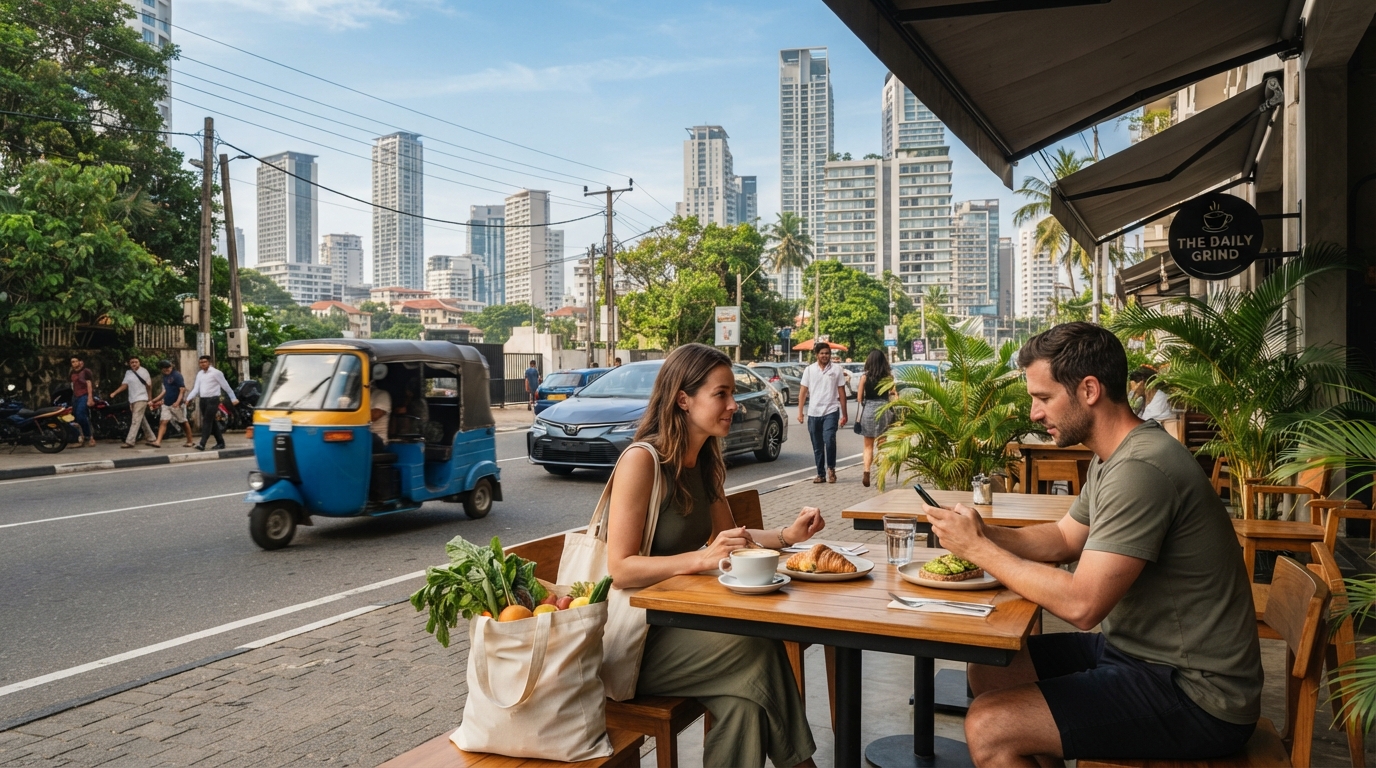
If you are considering moving to Sri Lanka in 2026, one of the first questions you are likely to have is how much it actually costs to live here. For anyone researching the cost of living in Sri Lanka as a foreigner, Colombo is a useful place to start. As the country’s commercial capital and one of its most expensive places to live, it provides a good benchmark for understanding what a comfortable expat lifestyle in Sri Lanka can cost.

Colombo offers foreigners one of the widest choices of modern apartments, private hospitals and healthcare, international restaurants, supermarkets, gyms, cafés, coworking spaces and other services that can make settling into life in Sri Lanka easier. That convenience comes at a price. The cost of living in Colombo can be considerably higher than in smaller Sri Lankan cities and towns, particularly when it comes to accommodation, eating out and maintaining a more international lifestyle.
Cost of renting an apartment in Colombo as an expat
For most expats, accommodation will be the largest single monthly expense. Apartment rental prices in Colombo vary significantly depending on the area, size and age of the property, whether it is furnished, and the facilities provided by the building. A modern apartment with air conditioning, 24 hour security, backup power, parking, a swimming pool and a gym will naturally sit in a different price range from a simpler apartment without these facilities.
At the lower end of the Colombo rental market, it is possible to find furnished studios and simpler one bedroom apartments from around LKR 100,000–180,000 per month. However, someone moving to Sri Lanka as a foreigner and looking for a modern, well furnished apartment in a desirable part of Colombo should realistically expect to spend more.
For a good furnished one bedroom apartment, a more useful working range is approximately LKR 180,000–300,000 per month, while apartments in newer or premium developments can easily reach LKR 300,000–450,000 or more per month. Two bedroom apartments commonly move into the LKR 250,000–550,000+ range, with premium developments costing considerably more.
Location has a major influence on how much it costs to rent an apartment in Colombo. Areas popular with foreigners and expats, including Colombo 2, Colombo 3, Colombo 5 and Colombo 7, generally command some of the higher rents, particularly for newer buildings offering 24 hour security, parking, backup generators, gyms and swimming pools.
For our calculation of the monthly cost of living in Colombo for a foreigner, we will use approximately LKR 350,000 per month for rent. This assumes one person renting a modern, furnished one bedroom apartment in a good Colombo location, with air conditioning, security and good residential facilities.
This figure is not intended to represent the cheapest way of living in Sri Lanka as an expat, nor are we assuming a top end luxury apartment. Instead, it gives us a realistic accommodation benchmark for a foreigner who wants to live comfortably in Colombo without deliberately searching for the lowest possible rent.
There is another important expense to consider when calculating the cost of moving to Sri Lanka. The monthly rental price does not necessarily represent the amount you will need to secure an apartment.
Long term apartment rentals in Colombo may require several months’ rent in advance together with a refundable security deposit, and the exact terms vary between landlords. Building or maintenance charges may also be included in the advertised rent or charged separately.
A foreigner budgeting LKR 350,000 per month for accommodation in Colombo should therefore not assume that LKR 350,000 is all they will need when signing the lease. Depending on the rental agreement, the initial amount required to move into an apartment can run into several months’ rent before you have even collected the keys.
For anyone calculating how much money they need to live in Sri Lanka, this distinction matters. Your monthly cost of living and the amount of money you need when first moving to Colombo are two different figures and should be budgeted separately.
Cost of utilities in Sri Lanka: electricity and water
Electricity is one of the household expenses that can vary significantly when calculating the cost of living in Colombo, particularly for foreigners accustomed to using air conditioning regularly. Sri Lanka uses a progressive domestic electricity tariff, meaning the amount you pay increases as your monthly consumption rises. Under the tariff structure in force in 2026, a household using around 180 kWh per month would pay approximately LKR 6,420, while consumption of 200 kWh can result in a bill of around LKR 10,350. For a foreigner renting a modern one bedroom apartment in Colombo, regular use of air conditioning, hot water, a refrigerator, washing machine, television, laptops and other appliances can quickly increase electricity consumption, and heavier use of air conditioning can push the monthly bill considerably higher.
Water is generally a much smaller household expense. The amount paid will depend on consumption and, in an apartment, how water charges are handled by the individual building or management company. For a single person, water is unlikely to have the same impact on the monthly budget as electricity, but it should still be included when calculating utility costs in Sri Lanka. As a practical budget for the comfortable Colombo lifestyle you should allow approximately LKR 10,000–20,000 per month for electricity and water combined. Anyone researching how much utilities cost in Sri Lanka or how much electricity costs in Sri Lanka with air conditioning should remember that actual costs will depend heavily on personal consumption, particularly the amount of air conditioning used.
Internet and mobile costs in Sri Lanka
For foreigners living in Colombo, internet and mobile data are relatively affordable compared with accommodation and other major monthly expenses. The amount you spend will depend largely on whether you need basic internet for everyday use or a faster, higher-data connection for remote work, video calls and streaming. Current home internet packages in Sri Lanka vary considerably: Dialog, for example, offers home Wi-Fi packages from around LKR 1,593 per month for 65GB and LKR 3,693 for 175GB, including taxes, while SLT-Mobitel offers fibre packages ranging from LKR 2,690 plus tax for an 80GB Fibre Starter package to LKR 5,900 plus tax for unlimited fibre at 100 Mbps. Mobile data in Sri Lanka is also inexpensive, with Dialog currently offering 30-day packages including 25GB for LKR 1,545, 40GB for LKR 1,995 and 60GB for LKR 2,495, including taxes. For a foreigner researching internet costs in Sri Lanka, particularly a remote worker or digital nomad, it is worth checking fibre or 4G availability at the apartment before signing a long-term lease, as the best option will depend on the building and location. For the comfortable Colombo lifestyle you should budget approximately LKR 7,000 per month for home internet and mobile data combined, providing enough flexibility for a reliable home connection and a reasonable mobile data package.
Cost of groceries in Sri Lanka
The cost of groceries in Sri Lanka depends considerably on what you eat, where you shop and how much of your diet consists of imported products. Local fruit, vegetables, rice and other Sri Lankan staples can still be relatively inexpensive, but meat, fish, dairy products and imported food can make a supermarket shop considerably more expensive than many foreigners expect.
In Colombo supermarkets, a whole chicken costs around LKR 1,350 per kg, while chicken breast can range from approximately LKR 1,780 to LKR 2,250 per kg depending on the cut. Beef is considerably more expensive, with beef cubes around LKR 4,150 per kg and premium cuts reaching approximately LKR 4,500 per kg. Fish prices vary widely depending on the type: tuna can cost around LKR 2,740 per kg, medium prawns approximately LKR 2,490 per kg, seer fish slices around LKR 5,290 per kg, while imported Salmon can range from around LKR 7,000 to more than LKR 18,000 per kg, depending on the retailer, product and cut, with smoked and other speciality salmon products costing even more. Imported fruit, cheese, cereals, dairy products, sauces and familiar international brands can also add significantly to the monthly cost of food in Sri Lanka. For one foreigner living in Colombo, cooking regularly at home and buying a mixture of local and international products, a realistic monthly grocery budget in Colombo would be approximately LKR 60,000–90,000. Someone eating mainly Sri Lankan food and shopping at local markets can spend less, while an expat maintaining a diet based heavily on meat, imported food and international brands can easily spend more.
Cost of eating out in Sri Lanka: Colombo prices
Eating out in Colombo can vary considerably in price, from a quick lunch at a café to dining at one of the city’s international restaurants or five-star hotels. For foreigners living in areas such as Colombo 2, Colombo 3, Colombo 5 and Colombo 7, cafés and restaurants are likely to form a regular part of everyday life, and this can become a significant part of the monthly cost of living in Colombo.
For a useful everyday benchmark, a café such as Barista gives a good indication of what a simple breakfast or lunch can cost. A cappuccino is around LKR 620, while croissant sandwiches are approximately LKR 790–1,050. This puts a straightforward breakfast of a croissant and coffee at around LKR 1,400–1,700 per person. Current Barista lunch deals range from approximately LKR 1,500 for chicken rice with a drink to LKR 2,650 for pasta or lasagna with a drink.
More contemporary cafés can already be noticeably more expensive. At some of Colombo’s independent and speciality coffee shops, a coffee alone can approach or exceed LKR 1,000, before breakfast, a pastry or another meal is added.
Moving from cafés to restaurants changes the budget considerably. At a good mid-range Colombo restaurant, it is reasonable to allow approximately LKR 2,500–5,000 per person for lunch, depending on the restaurant and what you order. Beef, seafood and imported ingredients will generally push the bill towards the higher end of that range. Once a drink, coffee or dessert is added, a fairly ordinary restaurant lunch can easily cost several thousand rupees per person.
At higher-end restaurants, particularly international restaurants and restaurants inside Colombo’s major hotels, spending LKR 5,000–10,000 or more per person is entirely possible. Set lunches, premium seafood, imported meat and fine-dining menus can take the cost above this, while hotel brunches and special dining packages can exceed LKR 10,000 per person before alcohol is considered.
It is also important to look beyond the advertised price of an individual dish. Some restaurants add service charges and applicable taxes, so the prices shown on a menu do not always represent the amount you will eventually pay. Drinks, desserts and coffee can increase the final bill further.
Food delivery should also be included when calculating monthly food costs in Colombo. Ordering through food-delivery apps is extremely convenient and widely used in the city, but the final amount paid can be higher than simply looking at the restaurant’s menu price. Delivery and platform charges, together with the ease of ordering food several times a week, can turn what appears to be an occasional convenience into a noticeable monthly expense.
For someone living in Colombo as a foreigner, a useful way to think about eating-out costs in 2026 is approximately LKR 1,500–2,500 for a simple café breakfast or lunch, LKR 2,500–5,000 for a meal at a good mid-range restaurant, and LKR 5,000–10,000+ per person for higher-end dining.
These individual prices also demonstrate why monthly restaurant spending can vary so dramatically between expats. Someone who mainly cooks at home and goes out once or twice a week may keep the cost relatively modest. Someone who buys coffee regularly, has breakfast or lunch out several times a week, orders takeaway and visits better restaurants at weekends can spend considerably more. For the comfortable expat lifestyle you should allow approximately LKR 75,000–100,000 per month for restaurants, cafés and takeaway food.
Alcohol is not included in this figure. Someone who regularly orders wine, beer or cocktails when eating out should budget separately for this, as alcohol can increase the cost of restaurant and hotel dining considerably.
Transport costs in Sri Lanka: getting around Colombo
One of the practical questions when moving to Colombo as a foreigner is whether you need a car and how much transport costs in Sri Lanka. The answer depends heavily on how you choose to travel. Colombo has buses, trains, tuk-tuks, ride-hailing apps, rental vehicles and private drivers, which means your monthly transport budget can range from very little to several hundred thousand rupees.
For many foreigners, getting around Colombo without a car is entirely possible. Someone living centrally can use tuk-tuks for short journeys, PickMe or Uber cars when they want air conditioning and greater comfort, and buses or trains when the route is convenient. Renting a car, hiring a driver or buying your own vehicle are alternatives for those who want greater independence.
Tuk-tuk prices in Colombo
Tuk-tuks are one of the most convenient ways of making short journeys around the city and are likely to become part of everyday life for many foreigners living in Colombo.
Following the 2026 fare revisions, a useful reference point for metered three-wheelers is approximately LKR 110 for the first kilometre and LKR 90 for each additional kilometre. Actual street and app fares can differ, however, so this should be treated as a guide rather than a guaranteed fare.
Foreigners can hail tuk-tuks on the street, but apps can make the process considerably easier. Using PickMe means that you enter your destination into the app rather than having to explain it to the driver or negotiate the journey price.
PickMe and Uber prices in Sri Lanka
PickMe and Uber in Sri Lanka provide an alternative for foreigners who do not want to own a car. PickMe offers different vehicle categories, including tuk-tuks, smaller cars, standard cars, minivans and vans, allowing you to choose according to the journey and your budget.
An air-conditioned car is more expensive than a tuk-tuk but can be considerably more comfortable in Colombo’s heat, heavy rain and traffic. Depending on distance, demand and traffic conditions, an app-based car journey across Colombo can easily cost around LKR 1,500–3,000, while shorter journeys can cost considerably less.
This means the monthly cost of transport in Colombo depends not only on how often you travel but also on which vehicle you normally select. Someone who mainly uses tuk-tuks and occasionally books a car will spend much less than someone taking several air-conditioned car journeys every day.
For a comfortable Colombo lifestyle, you should allow approximately LKR 40,000–70,000 per month for everyday transport. This assumes regular use of PickMe or Uber, a mixture of tuk-tuks and cars, no personally owned vehicle and no regular long-distance private travel.
Public transport in Colombo
For foreigners looking for the cheapest way to get around Colombo, buses and trains are considerably less expensive.
Following the July 2026 fare revision, the minimum normal bus fare is LKR 34, while semi-luxury and luxury services start at LKR 51 and LKR 66 respectively.
Train travel is also inexpensive. As an indication of the difference between public and private transport, travelling from Colombo Fort to Galle can cost approximately LKR 240 in third class or LKR 500 in second class.
Using public transport in Sri Lanka can therefore reduce monthly expenses substantially. We are not assuming daily bus and train travel in our comfortable-expat calculation, but foreigners happy to use public transport could spend considerably less than our LKR 50,000 monthly allowance.
Renting a car in Sri Lanka
Foreigners who want more independence without purchasing a vehicle can consider renting a car in Sri Lanka, either for occasional trips or on a longer-term basis.
For self-drive car rental in Sri Lanka, a realistic starting point in 2026 is around LKR 6,000–8,000 per day for a small basic car. Automatic compact cars commonly used by foreigners can cost around LKR 8,000–12,000 per day, while hybrids, larger cars and SUVs can cost considerably more. Some rental companies also charge higher rates to foreign visitors than to Sri Lankan residents.
Longer rentals can reduce the effective daily rate, so anyone planning to keep a car for several weeks or months should ask for a monthly quotation rather than simply multiplying the daily rental price by 30.
The advertised rental price is not necessarily the full cost of renting a car in Sri Lanka. Fuel is generally additional, and rental agreements may include a security deposit, mileage allowance, excess-mileage charges and specific insurance conditions. Before booking, check what insurance is included, the excess payable in the event of an accident, whether there is a daily or monthly mileage limit and who is responsible for damage.
For someone researching car rental in Sri Lanka for foreigners, it is therefore worth comparing the complete rental agreement rather than choosing a vehicle based solely on the advertised daily rate. A LKR 6,000–8,000 car can still cost considerably more once fuel and other expenses are included.
Driving in Sri Lanka as a foreigner
If you intend to drive yourself, you must also make sure that you have the correct permission to drive legally in Sri Lanka as a foreigner.
Eligible foreign visitors can obtain a temporary Sri Lankan driving licence at Bandaranaike International Airport using a valid foreign driving licence. Current fees start at approximately LKR 15,000 for a licence valid for up to one month, with the cost increasing according to the period required.
The correct licence category is also important if you intend to drive a motorcycle or scooter.
Scooter and motorcycle rental in Sri Lanka
A scooter can be another relatively inexpensive option for foreigners who want independent transport. Current rental prices for a small automatic scooter are approximately LKR 2,000–3,500 per day or LKR 35,000–60,000 per month, before fuel.
Scooter rental in Sri Lanka is particularly common in coastal and tourist areas. In central Colombo, however, heavy traffic means some foreigners may find tuk-tuks and ride-hailing cars more convenient for everyday travel.
Anyone renting a scooter or motorcycle should ensure that their driving licence or temporary permit covers the appropriate vehicle category.
Hiring a private driver in Sri Lanka
Foreigners who do not want to drive themselves can also hire a car with a driver in Sri Lanka. This is particularly common for longer journeys and travelling around the island.
A standard car with a driver can cost approximately US$60–100 per day, depending on the vehicle, distance and arrangement. Longer-term car-and-driver arrangements can reach approximately LKR 200,000–350,000 per month.
When comparing prices, check what is actually included. Fuel, mileage, driver’s working hours, overtime, accommodation and meals for the driver on overnight journeys can affect the final cost.
A private driver is therefore considerably more expensive than relying on PickMe and tuk-tuks, but it can be relevant for expat families, businesspeople or foreigners who travel frequently outside Colombo.
Cost of owning a car in Sri Lanka
Buying your own vehicle provides greater independence, but the cost of owning a car in Sri Lanka goes considerably beyond the purchase price.
A realistic budget needs to include fuel, insurance, servicing, repairs, tyres, annual licensing, parking and depreciation.
Fuel is already a significant running expense. As of September 2026, Petrol 92 is LKR 399 per litre, Petrol 95 LKR 475 per litre and Auto Diesel LKR 382 per litre.
Because buying and running a vehicle creates a very different budget from using taxis and tuk-tuks, we will not include car ownership in our standard monthly cost of living in Colombo calculation. Anyone planning to buy a car should calculate this separately.
How much does it cost to travel around Sri Lanka?
Your transport budget may also include travelling outside Colombo. One of the advantages of living in Sri Lanka as a foreigner is being able to explore the island, but the cost depends enormously on how you travel.
Public transport remains inexpensive. Following the July 2026 bus fare revision, a normal inter-provincial bus from Colombo to Galle costs approximately LKR 496, while Colombo to Kandy costs approximately LKR 521. A second-class train from Colombo Fort to Galle costs approximately LKR 500.
The same journey by private car or with a driver can cost tens of thousands of rupees.
This means that travelling around Sri Lanka on a budget is very achievable if you are comfortable using buses and trains, while frequent private drivers, taxis and rental cars can make domestic travel a substantial lifestyle expense.
Colombo airport transfer costs
Bandaranaike International Airport is outside central Colombo, so anyone living in Colombo as an expat should also consider the occasional cost of getting to and from the airport.
PickMe and other ride-hailing services can be used for airport journeys, while the airport also operates an official taxi service with air-conditioned vehicles and destination-based fares. The amount paid will depend on where in Colombo you are travelling, the vehicle selected and current demand.
How much should an expat budget for transport in Colombo?
There is no single answer to how much transport costs in Colombo because the available options cover very different budgets.
Someone using buses, trains and occasional tuk-tuks can keep transport costs extremely low. A foreigner who regularly uses PickMe, Uber and tuk-tuks but does not own a car should realistically allow around LKR 40,000–70,000 per month. Renting a vehicle, employing a private driver or owning a car moves transport into a substantially higher budget category.
For the single foreigner living comfortably in Colombo, you should allow LKR 50,000 per month for local transport. This provides enough flexibility for regular tuk-tuk and app-based car journeys without assuming that you need to use the cheapest form of transport every time you leave home.
Healthcare costs in Sri Lanka for foreigners
Sri Lanka has both public and private healthcare, but many foreigners living in Colombo choose private hospitals and clinics for routine medical care because of the convenience, access to specialists and availability of English-speaking medical professionals.
The cost of private healthcare in Sri Lanka is relatively affordable for routine treatment. A private doctor or specialist consultation can typically cost several thousand rupees, although fees vary considerably depending on the doctor and speciality. Routine blood tests and diagnostic services are also available privately, while dental treatment and more extensive investigations can add significantly to the cost.
For example, current consultation fees at private hospitals can range from approximately LKR 2,000–8,000+, depending on the specialist. Basic health-screening packages can start from under LKR 10,000, while more comprehensive private health checks can cost tens of thousands of rupees.
The more important financial consideration is unexpected treatment. Scans, emergency care, surgery and private hospital admission can quickly create much larger bills. Foreigners considering moving to Sri Lanka should therefore look separately at suitable health or international medical insurance rather than relying only on the relatively low cost of routine appointments.
Private health insurance calculation premiums depend heavily on age, level of cover, medical history and whether the policy provides treatment only in Sri Lanka or internationally.
This guide provides general information and does not constitute legal advice. Rental and lease arrangements vary, so obtain independent Sri Lankan legal advice where appropriate.











Comments 4