

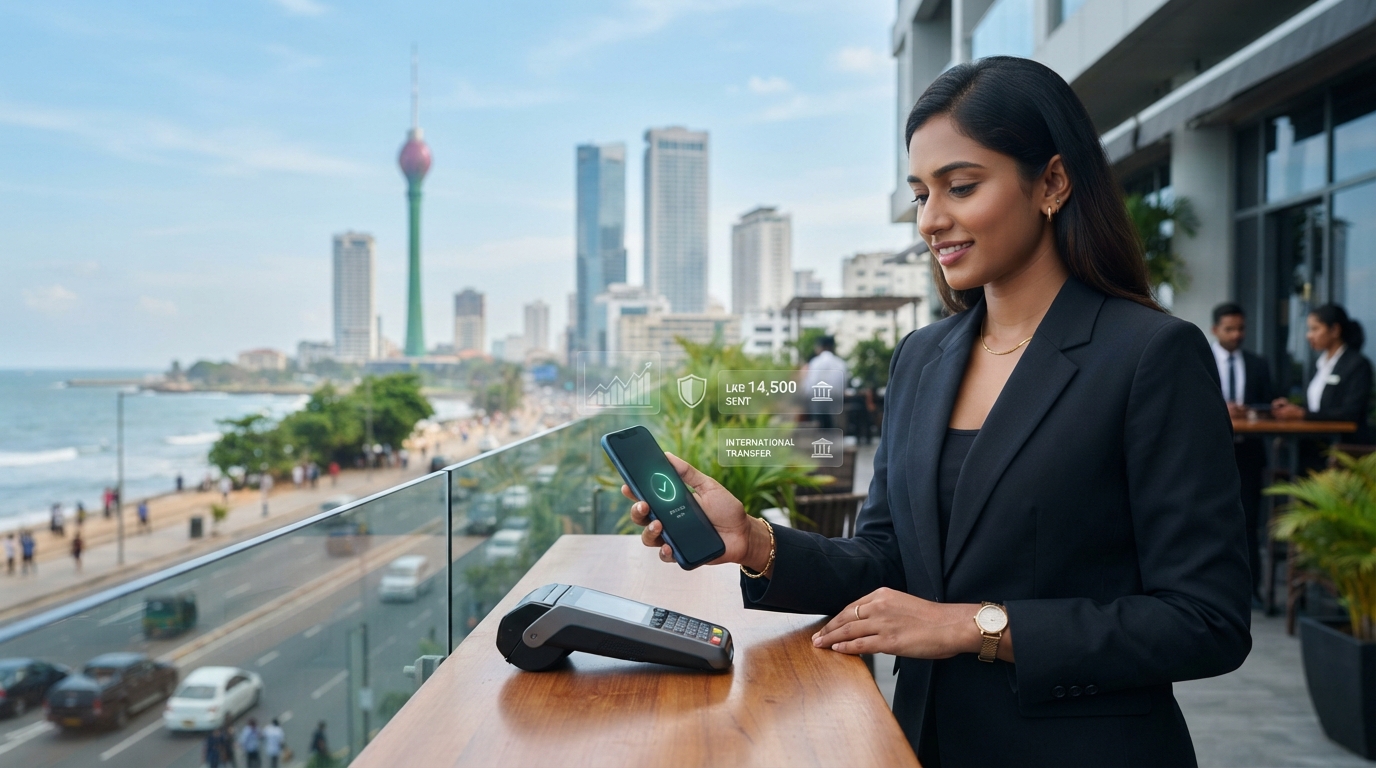
Sri Lanka is accelerating its digital finance ambitions. Here is what the 2026 FinTech Festival could mean for expats, investors and foreign residents.

Sri Lanka will hold its inaugural FinTech Festival on 2 and 3 November 2026 at Shangri La Colombo, bringing together government representatives, banks, financial institutions, technology companies and fintech businesses.
At first glance, this might appear to be an industry event with little relevance to the average foreign resident.
However, the subjects being discussed are closely connected to some of the financial frustrations foreigners encounter in Sri Lanka: transferring money internationally, paying local businesses, dealing with different banking systems, making larger investments and navigating a financial system that remains more dependent on cash and conventional banking processes than many Europeans, Australians or Americans are accustomed to.
The festival will cover cross border payments, remittances, digital identity, artificial intelligence in finance, digital assets, cybersecurity, tourism payments and financial inclusion.
Importantly, the festival itself does not introduce new banking rules or payment services. Expats should therefore not expect immediate changes in November.
Its significance lies elsewhere.
It provides another indication of the direction in which Sri Lanka’s financial infrastructure is moving, and that direction is increasingly digital.
For foreigners who live, invest, retire, work remotely or own property in Sri Lanka, that could become considerably more important over the next several years.
The announcement was made at a press conference attended by Deputy Minister of Digital Economy Eranga Weeraratne, Secretary to the Ministry Waruna Sri Dhanapala, Chief Advisor to the President on Digital Economy Dr Hans Wijayasuriya, FinTech Forum Chairman Channa de Silva and Vice Chairman Conrad Dias.
The programme begins on 2 November with CEOs Night, intended primarily for senior representatives from banking, fintech, government and technology.
The main Sri Lanka FinTech Expo follows on 3 November and is expected to attract more than 500 participants. It will include presentations, expert discussions and an exhibition of financial technology and payment solutions.
The subjects are particularly interesting from an international perspective. Discussions are expected to include cross border payments and remittances, digital assets and tokenisation, artificial intelligence in finance, digital identity, financial inclusion, SME finance, tourism payments, cybersecurity and fraud prevention.
Those topics tell us considerably more about the importance of the festival than the event itself.
How Sri Lanka’s Healthcare System Actually Works
What does this mean for foreigners?
The real story is not the festival
Sri Lanka holding a fintech conference will not suddenly transform how foreigners bank in the country.
The more important question is whether the ideas being discussed eventually translate into better infrastructure, regulation and commercially available services.
There is reason to pay attention.
Sri Lanka has already been developing its digital payment infrastructure for several years. The Central Bank has a Financial Technology Regulatory Sandbox, which provides a controlled framework through which eligible financial innovations can be tested before wider implementation.
Digital payments are also becoming substantially more important.
Central Bank reporting shows that the Common Electronic Fund Transfer Switch, known as CEFTS, accounted for 55% of the total value of retail payments in 2025, compared with 50% in 2024. The Central Bank attributed growth partly to increasing online transfers and expansion of digital payments to government institutions through GovPay.
This means the festival is not occurring in isolation. It sits within a much broader transformation of Sri Lanka’s payment infrastructure.
Daily life for foreign residents
For many expats, one of the most noticeable differences between Sri Lanka and countries such as the UK or Australia is the uneven adoption of digital payments.
In Colombo and established tourist areas, paying electronically is increasingly straightforward. Move outside those areas and cash can still be essential.
Sri Lanka is actively trying to reduce that dependence.
The Central Bank has been running digital payment promotion programmes around the country, including campaigns in Hambantota, Nuwara Eliya, Dambulla, Kurunegala, Trincomalee and, most recently, Jaffna.
For foreigners, wider adoption could eventually mean fewer occasions when cash is necessary, easier payments to smaller businesses and more digital interaction with government services.
That matters particularly to people spending several months each year in Sri Lanka who do not want to organise their financial life around cash withdrawals and local banking visits.
Cross border payments could be particularly important
This is arguably the area expats should watch most closely.
Foreign residents frequently move money between Sri Lanka and another country.
That could mean transferring retirement income, bringing money into Sri Lanka for living expenses, funding a business, receiving overseas income or transferring capital for an investment.
Cross border payment integration is already developing.
In March 2026, the Central Bank highlighted the increasing connection between Sri Lankan payment systems and foreign payment networks. Visitors from countries including India and China can already use compatible home country payment applications through LANKAQR at participating Sri Lankan merchants.
The important question for British, European, Australian and American residents is whether similar integrations eventually become available to them.
There is currently no announcement from the festival that this will happen.
But the explicit inclusion of cross border payments, remittances and tourism payments on the agenda makes this an area worth monitoring.
Digital nomads and internationally paid workers
Sri Lanka’s ambitions are also relevant to remote workers.
A digital nomad may earn in pounds, euros, Australian dollars or US dollars while spending primarily in Sri Lankan rupees.
The easier it becomes to move between international and domestic payment systems, the more practical Sri Lanka becomes as a long term remote working destination.
However, payment technology and immigration or tax status are separate issues.
Using an overseas account, digital wallet or international payment service does not change a person’s Sri Lankan visa conditions or determine their tax obligations.
Will digital payments in Sri Lanka make travel easier for tourists?
Over time, tourism may actually be one of the areas where financial technology becomes most visible.
A tourist who can arrive in Sri Lanka and pay easily using familiar international payment systems faces less friction than someone who must repeatedly withdraw cash or determine which cards will be accepted.
The fact that tourism payments have been specifically included in the FinTech Festival programme suggests that the visitor payment experience is being recognised as part of the country’s wider digital finance strategy.
What should expats do now?
Foreigners living or investing in Sri Lanka should monitor developments in four areas: cross border payment integration, digital banking services available to non citizens, government digital payment platforms and any changes to identification or verification procedures.
When transferring substantial sums into Sri Lanka, particularly for property or business investment, keep complete records showing the origin of the funds, transfer instructions, bank confirmations and the purpose of the payment.
Do not assume that a new fintech service can bypass existing banking, foreign exchange, tax or investment regulations simply because the transaction is digital.
For regulatory information, check announcements from the Central Bank of Sri Lanka and relevant government authorities rather than relying exclusively on information provided by financial apps or intermediaries.
ExpatsLanka Tips
1. Keep your international and Sri Lankan banking options open.
Do not rely on a single card, bank account or payment provider when living between countries.
2. Keep evidence of international transfers.
For major purchases and investments, maintain a clear record showing where funds originated and how they entered Sri Lanka.
3. Watch cross border payment developments.
This is one of the areas most likely to have a direct practical impact on expats if Sri Lanka expands integration with international payment networks.
4. Separate convenience from regulation.
A payment becoming technically easier does not mean foreign exchange, tax, property or investment rules have changed.
5. Treat new financial platforms carefully.
Before placing substantial funds with an unfamiliar fintech company, establish who regulates it, which institution holds the money and what protections apply if something goes wrong.
Frequently Asked Questions
What is the Sri Lanka FinTech Festival 2026?
It is a new national fintech event organised by the FinTech Forum Sri Lanka in collaboration with the Ministry of Digital Economy. It will take place at Shangri La Colombo on 2 and 3 November 2026.
Does the FinTech Festival change banking rules for foreigners?
No. The festival itself does not introduce new banking regulations or change the rules governing foreign residents.
Could digital payments become easier for tourists in Sri Lanka?
Potentially. Sri Lanka is already expanding digital payments, while cross border and tourism payments are among the subjects being discussed at the festival. However, no new universal payment system for Western visitors has been announced.
Will this make transferring money to Sri Lanka cheaper?
Not necessarily. Better cross border payment infrastructure could increase competition and efficiency over time, but transfer costs depend on providers, exchange rates, banking charges and regulation.
Does this affect foreigners buying property in Sri Lanka?
Not directly. Sri Lanka’s property ownership rules remain separate. However, improvements to banking, digital identity and cross border payments could eventually make parts of the financial process surrounding investment more efficient.
Where can expats find official information about financial regulations?
The Central Bank of Sri Lanka is the primary source for information about regulated banks, payment systems, financial regulation and official notices. Information about the November event itself is available through the Sri Lanka FinTech Festival.
Sri Lanka is trying to build a financial system that is more digital, internationally connected and less dependent on cash. The growth of electronic payments, expansion of government digital payment infrastructure, development of cross border connections and continued work on fintech regulation show that this process is already underway.
For expats, retirees, digital nomads and investors, the most interesting developments will be the practical ones: whether international payments become easier, whether foreigners gain access to better digital banking services, whether tourism payments improve and whether moving legitimate investment capital into the country becomes more efficient.
Those are the developments ExpatsLanka will be watching as Sri Lanka’s digital finance strategy progresses.















Comments 1