

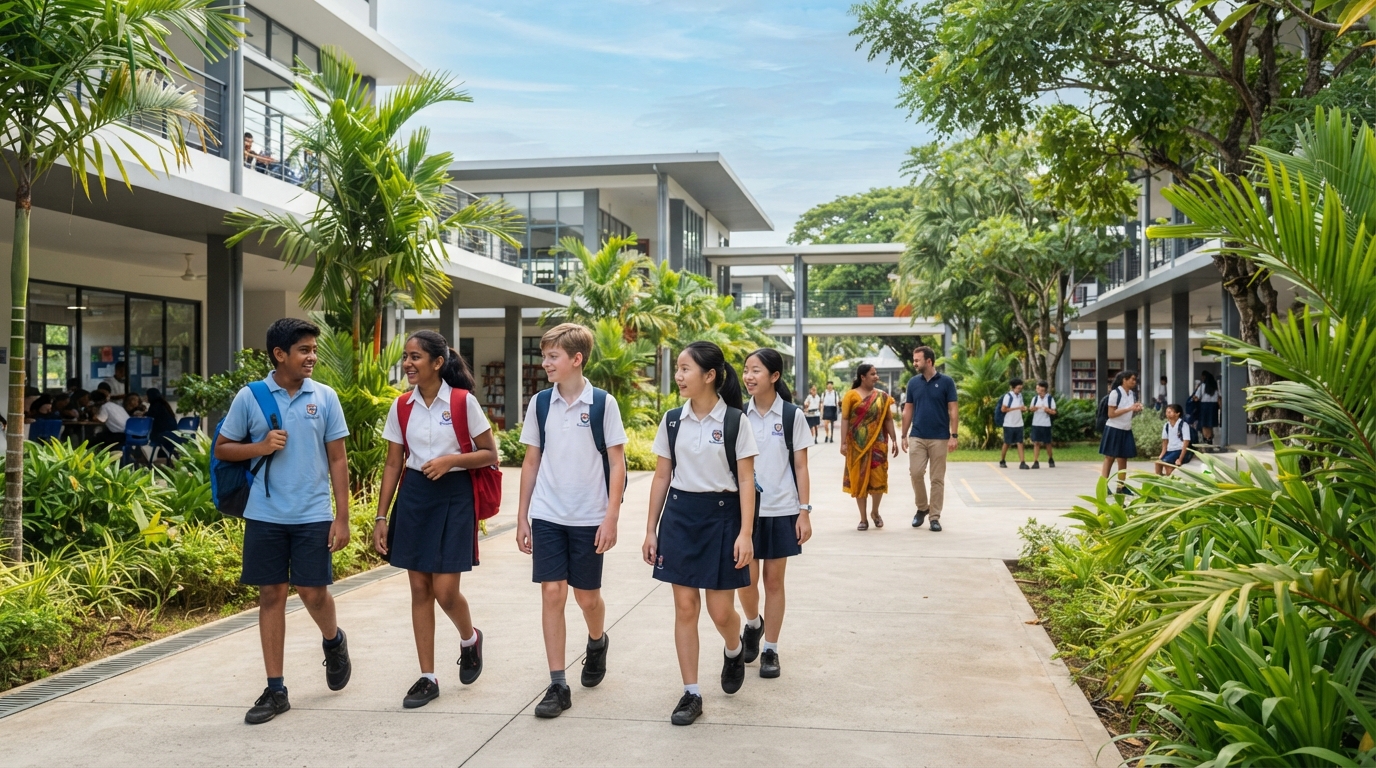
For families considering moving to Sri Lanka with children, choosing a school can influence almost every other decision they make. Where you live, how far you are prepared to commute each day and, for families with more than one child, the overall cost of living can all depend on the school you choose.

Sri Lanka has a well-established international school sector, particularly in Colombo and the surrounding areas. However, the term international school covers a surprisingly wide range of educational systems.
Depending on the school, children may follow the English National Curriculum, Cambridge International programmes, Pearson Edexcel qualifications, the International Baccalaureate, an Australian secondary qualification or a combination of different international pathways.
There are also options for families looking for an American curriculum or American High School Diploma, although these are considerably more limited than British-system education in Sri Lanka.
For parents researching international schools in Sri Lanka, the starting point should therefore not simply be which is the best school?
A more useful question is:
Which curriculum, school and location will work best for your child and your family’s longer-term plans?
That is particularly important for internationally mobile families whose children may eventually return to their home education system or continue to university in another country.
How much does it cost to live in Colombo in 2026 as an expat?
Understanding international education in Sri Lanka
One of the first things parents discover when researching international schools in Colombo is that there is no single international curriculum.
Two schools may both describe themselves as British international schools while following somewhat different academic pathways.
A school may follow the English National Curriculum during the earlier years and then prepare students for Cambridge IGCSE and Cambridge International A Levels.
Another may follow a British-style curriculum but use Pearson Edexcel for International GCSE and International Advanced Level qualifications.
Another school may follow the International Baccalaureate throughout.
These distinctions become increasingly important as children approach examination years.
Parents should therefore look beyond the word international and establish exactly:
- which curriculum is taught at each stage
- which examination board is used
- which qualifications students ultimately receive
- how easily a child can transfer into and out of the system
- whether those qualifications fit the child’s intended university destination
How to Rent an Apartment in Colombo as a Foreigner: Expat Guide 2026
The main international curricula available in Sri Lanka
English National Curriculum and British education
British education has a strong presence among international schools in Sri Lanka.
The English National Curriculum broadly structures education through year groups and key stages, eventually leading, in many international schools, to IGCSE followed by A Levels.
However, British curriculum does not automatically tell you which examinations a student will sit.
Two names parents will encounter repeatedly in Sri Lanka are Cambridge International Education and Pearson Edexcel.
Both provide internationally recognised British qualifications, but they are separate examination systems.
This distinction is particularly important when comparing British schools in Sri Lanka.
Cambridge International
Several established schools offer the Cambridge pathway.
Depending on the school, this can begin with Cambridge Primary and Lower Secondary and progress through Cambridge IGCSE or O Level to Cambridge International AS and A Level.
For families coming from another Cambridge international school, remaining within the same pathway may make transferring between countries easier, particularly during the secondary years.
Pearson Edexcel
Pearson Edexcel is another major international examination system used extensively by schools in Sri Lanka.
Students can progress towards Pearson Edexcel International GCSE and International Advanced Level qualifications.
Again, parents should look at the school’s complete pathway rather than simply seeing British curriculum in its description.
International Baccalaureate
The International Baccalaureate (IB) provides a different educational pathway from the traditional British IGCSE and A Level system.
The Overseas School of Colombo currently states that it is the only school in Sri Lanka authorised to offer the complete IB continuum, consisting of the Primary Years Programme, Middle Years Programme and Diploma Programme.
The PYP covers the primary years, the MYP continues through Grades 6–10 and students can then progress to the two-year IB Diploma Programme in Grades 11 and 12.
For families moving regularly between countries, the international continuity of the IB can be an important consideration.
Australian curriculum: SACE
Sri Lanka also has an Australian senior-secondary option.
Gateway College offers the South Australian Certificate of Education (SACE International) as an alternative pathway during the senior secondary years.
Students completing SACE receive an Australian Tertiary Admission Rank (ATAR), which can be used for university applications.
Gateway introduced SACE in Colombo and has subsequently expanded the programme to some of its other campuses.
American curriculum and US High School Diploma options in Sri Lanka
Families moving from the United States should pay particular attention to this area because American schools in Sri Lanka are much less common than British-system schools.
That does not mean American families have no suitable options.
The Overseas School of Colombo is particularly relevant to internationally mobile American families even though it follows the International Baccalaureate rather than an American curriculum.
OSC is accredited by the US-based Middle States Association of Colleges and Schools as well as the Council of International Schools. It also has its own High School Diploma graduation requirements alongside the IB pathway.
Students transferring into OSC can have previous credits reviewed against the school’s graduation requirements.
There are also online and blended American High School Diploma programmes accessible from Sri Lanka. These should be considered separately from physical international schools in Colombo, particularly because accreditation, transferability of credits, university recognition and the amount of in-person teaching can differ considerably.
For an American family, the important question is therefore not simply “Is there an American school in Colombo?” but whether the chosen school provides a pathway that allows the child to transfer successfully back into the US system or progress to an American university.
International schools in Colombo and the surrounding area
Most of the widest choice of established international education is concentrated in Colombo and Greater Colombo.
These are some of the schools foreign families are most likely to encounter during their research.
The Overseas School of Colombo – Battaramulla
The Overseas School of Colombo (OSC) is particularly relevant to internationally mobile families looking for an IB education.
OSC offers the complete International Baccalaureate continuum from age three through Grade 12:
Primary Years Programme → Middle Years Programme → IB Diploma Programme
The school states that it is the only school in Sri Lanka authorised to offer all three programmes.
The Primary Years Programme covers Early Years through Grade 5, the Middle Years Programme covers Grades 6–10 and the Diploma Programme covers Grades 11–12.
OSC is also accredited by the US-based Middle States Association of Colleges and Schools and the Council of International Schools.
For families arriving from an American school, OSC publishes equivalencies between its grade structure and US and UK year groups, which can make initial comparisons easier.
The school is located in Battaramulla rather than central Colombo, which should be considered carefully when deciding where the family will live.
The British School in Colombo – Colombo 8
The British School in Colombo is one of the most obvious options for families specifically looking for British education in Sri Lanka. The school follows the English National Curriculum, eventually leading to IGCSE and A Level qualifications.
At Sixth Form level, students are prepared for A Level courses offered through Cambridge Assessment International Education. For parents moving from the UK or another British international school, the familiar year-group structure and progression through IGCSE and A Levels may make transition easier. Admissions can include review of previous school records and assessments, and the school advises that some year groups may operate waiting lists when they reach capacity.
Colombo International School – Colombo 7
Colombo International School (CIS) was established in 1982 and is located on Gregory’s Road in Colombo 7.
Its academic programme is based on the British education system.
Students progress towards Pearson Edexcel International GCSE and International Advanced Level qualifications.
Entry is available during the academic year subject to the school’s admissions process and availability. CIS states that applicants undergo assessment in English and Mathematics, with previous school reports also reviewed.
CIS also operates a school in Kandy following the same academic programme, which is useful for families considering living outside Colombo.
Elizabeth Moir School – Colombo 5
Elizabeth Moir School is another established option for families seeking a British-style education in Colombo.
The school follows a British-oriented academic programme and prepares students for Pearson Edexcel International GCSE and A Level qualifications.
For families comparing CIS and Elizabeth Moir, it is therefore useful to look beyond the fact that both offer Edexcel qualifications and compare their broader educational approach, subject choices, admissions, class environment, facilities, location and fees.
Wycherley International School – Colombo 7
Wycherley International School is particularly relevant to families specifically looking for a continuous Cambridge curriculum in Sri Lanka.
The school offers Cambridge programmes through the different stages of education, including Cambridge Early Years, Primary, Lower Secondary, O Level and Cambridge International AS and A Level.
The Colombo school is located on Bauddhaloka Mawatha in Colombo 7.
Wycherley also operates campuses outside central Colombo, including Dehiwala, which may be useful depending on where a family plans to live.
Stafford International School – Colombo 7
Stafford International School is another long-established British-system school in Colombo.
Its middle-school curriculum is based on the UK’s National Curriculum, with students progressing towards Cambridge IGCSE.
At Sixth Form level, Stafford offers both Pearson Edexcel International Advanced Level courses and selected Cambridge International AS/A Level options.
This is another example of why parents should not assume that a school uses the same examination board throughout every stage of secondary education.
Royal Institute International School – Colombo 5
Royal Institute International School in Havelock Town offers a Cambridge pathway from primary through senior secondary education.
Its Cambridge programme covers Primary, Lower Secondary, Upper Secondary and Cambridge Advanced, leading to Cambridge International AS and A Levels.
Royal Institute also offers other educational pathways, so parents should establish which programme their child would enter when enquiring about admission.
Gateway College – Rajagiriya
Gateway College Colombo is located in Rajagiriya and offers several international academic pathways.
Students can work towards Pearson Edexcel International GCSE qualifications and subsequently continue with UK Advanced Levels. Gateway also offers SACE International, the South Australian Certificate of Education, giving students an Australian senior-secondary alternative.
At Year 11, students can complete Edexcel International GCSEs or move into the SACE pathway. At senior level, the school provides several combinations of A Levels and other qualifications as well as SACE Stage 2. For families specifically interested in Australian education or university pathways, this makes Gateway particularly worth investigating.
Lyceum International School – Greater Colombo
Lyceum International School operates a large network of schools in Sri Lanka, including Nugegoda and other Greater Colombo locations.
Up to Grade 8, students follow Lyceum’s own curriculum. From secondary school, students can choose between national and international routes. The international pathway uses Pearson Edexcel, progressing through International GCSE and International Advanced Level. For expat families, it is important to check the exact programme and facilities at the individual Lyceum branch rather than assuming every campus offers precisely the same options.
Which international school is right for your child?
There is no single answer to this question.
A family’s nationality alone should not determine the school. Instead, think about where your child is coming from and, equally importantly, where they are likely to go next. A child who has spent several years following the English National Curriculum may benefit from remaining within a familiar British pathway. A student already studying Cambridge subjects may find a Cambridge school easier to transition into. An internationally mobile family already within the IB system may place greater value on continuing the IB continuum. An American family planning to return to the United States may want to examine credit transfer and graduation requirements particularly carefully. A family expecting a child to attend university in Australia may be interested in SACE and the ATAR pathway. The child’s age matters as well. Changing curriculum at age seven is very different from changing curriculum halfway through IGCSE, the IB Diploma or A Levels.
Changing curriculum during secondary school
This deserves particular attention from families with teenagers.
At primary level, differences between international curricula can often be managed relatively easily. Once students enter examination programmes, changing schools becomes more complicated. IGCSE subject combinations differ between schools. Cambridge and Edexcel syllabuses are not identical. A student moving into the IB Diploma has specific programme requirements. A Levels depend on subject availability and examination boards. If your child is approaching Years 10–13 or Grades 9–12, speak directly with the academic or admissions team before making assumptions about placement. Provide current school reports, transcripts and details of the curriculum and subjects already studied.
Ask specifically:
Which year or grade would my child enter?
Which subjects can transfer?
Will any previous work or credits be recognised?
Will changing examination boards create gaps?
Can my child continue the same subjects?
This is far more important than simply comparing school reputations.
Admissions to international schools in Sri Lanka
The admissions process differs between schools.
Typically, parents should expect to provide previous school reports and identification documents, and children may need to complete an assessment or interview.
For example, the British School in Colombo asks for an application, birth certificate, recent photograph, latest school progress report and identification or passport copies for both parents. The school states that its admissions process normally takes around four to five working days once the required documentation has been submitted, subject to assessment availability and places.
Colombo International School accepts entry during the year but assesses applicants in English and Mathematics and reviews previous reports.
OSC applies additional academic and language considerations for students entering the final years of the IB programme.
The important point for parents is to contact schools before making other major relocation decisions.
A school appearing on your shortlist does not mean that a place will necessarily be available in your child’s year group.
Apply before you choose where to live
For families moving to Colombo, it is worth deciding on the school before committing to a long-term apartment. The main international schools are spread across Colombo and its surrounding suburbs, and what looks like a relatively short distance on a map can become a significant daily journey once Colombo traffic is taken into account.
For example, the British School is in Colombo 8, while Colombo International School and Wycherley are in Colombo 7. Elizabeth Moir is in Colombo 5 and Royal Institute is in Havelock Town. Further east, Gateway College is in Rajagiriya and the Overseas School of Colombo is in Battaramulla.
This means that choosing an apartment simply because you like a particular neighbourhood may not work as well once the daily school journey is added to your routine. You might, for example, choose Colombo 3 for its restaurants, shops and central location, only to later enrol your child at a school in Battaramulla and find yourself travelling across the city twice a day.
For families with school-age children, it therefore makes sense to shortlist schools first and only then start looking seriously at where to live. The school does not necessarily have to be next to your home, but the daily journey should be realistic for both the child and the parents. In Colombo, that can be more important than choosing a particular postcode simply because you initially prefer the area.
School transport
School transport should be investigated at the same time as tuition fees and admissions.
Ask whether the school provides its own transport, which neighbourhoods are covered, how much it costs and approximately how long the journey will take from the area where you are considering living. Do not assess the journey purely by kilometres. A school may appear close on a map while the actual journey during morning and afternoon traffic is considerably longer. If the school does not provide suitable transport, you may need to arrange a private driver or organise daily transport yourself, which becomes another part of the family’s cost of living in Sri Lanka.
International school fees in Sri Lanka
For expat families, international school fees in Sri Lanka can become one of the largest household expenses after accommodation, particularly when two or more children attend school.
However, parents should not compare schools using tuition fees alone.
The true annual cost may include:
- application fees
- registration or admission fees
- tuition
- development or capital contributions
- refundable deposits
- examination fees
- books and learning materials
- technology charges
- uniforms
- meals
- school transport
- sports and extracurricular activities
- trips and residential programmes
Some of these are recurring costs while others are payable only when the child enters the school.
This means the first year of international school in Sri Lanka can cost considerably more than subsequent years.
We will examine the current fees of the major international schools separately because the cost should be compared on a like-for-like basis rather than using tuition figures alone.
International schools outside Colombo
Although the largest concentration of international schools is in and around Colombo, families do have options elsewhere.
Colombo International School operates a Kandy campus following the same British-based programme and Edexcel examination route as its Colombo school.
Gateway has campuses in Kandy and Negombo as well as Greater Colombo, and its SACE programme has expanded beyond Colombo.
Lyceum operates schools in several locations across Sri Lanka.
Other international and English-medium schools operate around the island, but the range of curricula, examination pathways and facilities becomes more limited once you move away from the main urban centres.
This is particularly important for families considering living on Sri Lanka’s south coast.
Galle, Weligama, Mirissa, Ahangama and the surrounding coastal areas can be attractive places for expat families to live, but parents should investigate schooling before committing to a location.
The choice of school may ultimately determine whether living full-time outside Colombo is practical for your family.
How much does it cost to live in Colombo in 2026 as an expat?
What should you ask an international school before applying?
A school tour should go beyond looking at classrooms, sports facilities and the campus.
Ask exactly which curriculum your child will follow now and which qualifications they will receive later.
For older children, ask about subject choices and examination boards.
Find out whether there are additional English-language programmes if your child needs them and what learning-support provision is available.
Ask about class sizes, teacher qualifications and turnover, safeguarding procedures, university counselling, extracurricular activities and school transport.
For an internationally mobile child, one of the most important questions is:
If we leave Sri Lanka in two or three years, how easily will my child be able to transfer into another school system?
That question can be more important than any league table.
Do not choose a school on reputation alone
Parents naturally ask about the best international schools in Colombo, but school choice is more individual than that question suggests.
A highly regarded IB school may not be the most practical choice for a teenager already halfway through a British examination pathway.
A Cambridge school may be an excellent fit for one child but less suitable for another who expects to return to an American high school.
A school with impressive facilities may create an exhausting daily commute from where the family intends to live.
And a school that initially appears affordable may become significantly more expensive once registration charges, transport, examinations and other compulsory costs are included.
Rather than searching for a universal best international school in Sri Lanka, compare schools according to the factors that matter to your child:
curriculum, continuity, qualifications, admissions, location, support, school environment and complete cost.
How to Rent an Apartment in Colombo as a Foreigner: Expat Guide 2026
Choosing an international school before moving to Sri Lanka
If you are moving to Sri Lanka with school-age children, start researching schools before choosing your home.
First establish which curriculum makes sense based on your child’s current education and likely future destination.
Then identify the schools offering that pathway and contact them about availability and placement.
Once you have a realistic shortlist, visit the schools if possible and understand the complete cost of attendance.
Only then should you make a final decision about where your family will live.
Sri Lanka offers considerably more choice in international education than many families initially expect, particularly in Colombo. But those choices are not interchangeable.
Understanding the difference between British, Cambridge, Edexcel, IB, American and Australian education pathways in Sri Lanka is the first step towards making a school decision that works not only for your child’s time in Sri Lanka, but also for whatever comes next.
- The Overseas School of Colombo (OSC) — Battaramulla
- The British School in Colombo — Colombo 8
- Colombo International School (CIS) — Colombo 7, with a separate Kandy campus
- Elizabeth Moir School — Colombo 5
- Wycherley International School — Colombo
- Stafford International School — Colombo 7
- Royal Institute International School — Colombo 5
- Gateway College — Rajagiriya, with campuses in Kandy, Negombo, Dehiwala and Ratmalana
- Lyceum International School — Nugegoda and multiple locations across Sri Lanka; the school currently lists 10 main branches.











Comments 2