

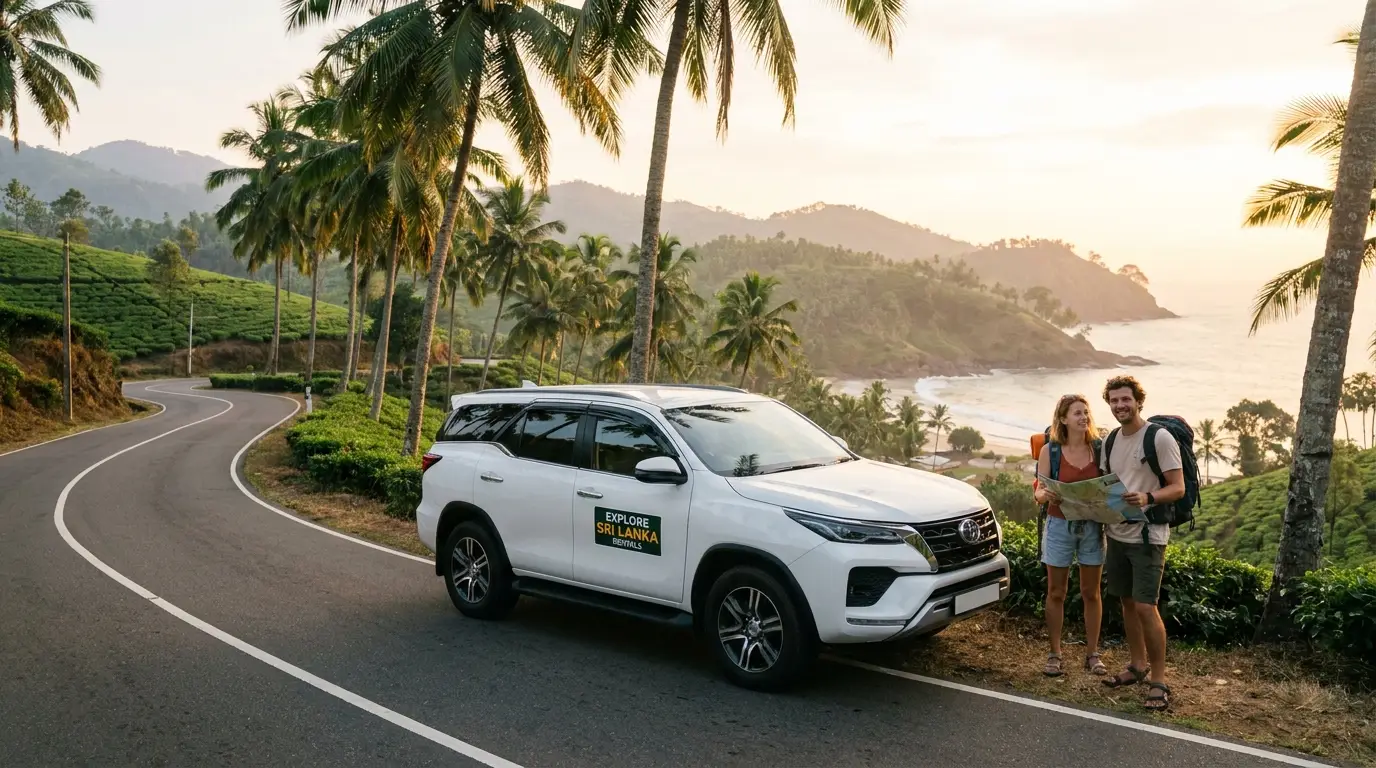
Driving in Sri Lanka gives you something public transport and organised tours cannot always offer: freedom. You can leave Colombo when you want, explore small coastal towns, stop at roadside fruit stalls, drive into the hill country and reach places that would otherwise require several buses, trains or tuk-tuks.

But driving here can also be one of the biggest adjustments for a foreigner. The rules themselves are not particularly difficult. The challenge is learning how traffic actually behaves. Buses overtake aggressively, tuk-tuks appear from unexpected places, motorbikes squeeze through small gaps, and pedestrians, dogs and occasionally larger animals may enter the road without much warning.
If you’re considering driving in Sri Lanka as an expat, this guide explains what you need to know before getting behind the wheel.
Can foreigners drive in Sri Lanka?
Yes. Foreign visitors and residents can legally drive in Sri Lanka, provided they have the appropriate driving authorisation.
Do not assume that simply carrying your driving licence from the UK, EU, Australia, United States or another country automatically makes you legal to drive. The exact route depends on your nationality, the licence you hold, and whether you are visiting Sri Lanka temporarily or living here longer term.
Sri Lanka’s Department of Motor Traffic (DMT) has procedures for issuing temporary Sri Lankan driving licences to foreign visitors and for dealing with foreign driving licences. Because licensing requirements and administrative procedures can change, check the current requirements before driving rather than relying entirely on information given by a rental company.
Getting your permit on arrival at the airport
As of August 2025, the fastest route for most visitors is a dedicated DMT counter in the arrivals hall at Bandaranaike International Airport (BIA), near the SPAR supermarket. It runs 24 hours a day, which means you can walk out of customs, apply, and drive away with a temporary licence the same day — no trip into Colombo required.
- Covers: cars, motorbikes and scooters
- Does not cover: tuk-tuks or heavy vehicles — for those, you’ll still need to go through the AAC or a DMT office
- What to bring: your full, valid home-country driving licence (at least a year old), your passport with a valid Sri Lankan visa or entry stamp, and a certified English translation if your licence isn’t in English (this is routinely required for Chinese and Japanese licences)
- Validity: up to five months
This is worth knowing before you land, since staff at the counter can be busy after larger flight arrivals — having your documents ready in advance speeds things up considerably.
International Driving Permit and Recognition Permit
For British travellers in particular, current UK government travel guidance states that you need a 1949 International Driving Permit (IDP) together with a Sri Lankan recognition permit when driving a hire vehicle.
Since March 2025, this has become the firm requirement at the Automobile Association of Ceylon (AAC): the AAC will only issue a Recognition Permit to travellers who already hold a valid IDP. A home-country licence on its own is no longer accepted there, even though it was in the past — so if you’re planning to go this route, sort out your IDP before you travel, not after you arrive.
The UK guidance advises travellers to obtain the IDP before travelling and then take their:
- UK driving licence
- International Driving Permit
- Two passport photographs
to the Automobile Association of Ceylon in Colombo to obtain the recognition permit. Rental companies will often help customers with the process. The AAC is also the route to take if you specifically want to drive a tuk-tuk, since the airport counter doesn’t cover that category.
Sri Lankan motor traffic legislation also contains provisions recognising qualifying International Driving Permits. Because different procedures can apply depending on the licence and permit you hold, confirm which route applies to you before driving. The AAC office in Colombo is open Monday to Friday only — there’s no weekend service, so factor that into your arrival plans if this is your intended route.
The safest approach is simple: never assume your foreign licence alone is enough.
Temporary Sri Lankan Driving Licence
Foreign visitors may also be able to obtain a temporary Sri Lankan driving licence through the Department of Motor Traffic, either at the airport counter above or at the DMT’s main office in Werahera (near Boralesgamuwa).
The Department currently publishes separate charges according to how long the temporary licence is required. As of 2026, the published fees for a foreign visitor are:
| Temporary licence period | Published fee |
|---|---|
| Up to 1 month | LKR 15,000 |
| More than 1 month, up to 2 months | LKR 21,000 |
| More than 2 months, up to 6 months | LKR 30,000 |
| More than 6 months, up to 12 months | LKR 45,000 |
A note on fees: different sources online quote different figures for what sounds like the same service, sometimes considerably lower than the table above. This is likely a mix of outdated pricing and different offices being described. Treat the table as a starting reference point and confirm the current fee directly with the DMT — or with your rental company, who will usually know the up-to-date figure — before you apply.
Extensions can be arranged at the DMT office in Werahera if you decide you need more time once you’re already in the country. If you’re heading there in person, note that the office keeps standard government hours (closed weekends and on Poya, the monthly full-moon public holiday), and payment is typically cash only.
What about expats living in Sri Lanka?
If you’re moving to Sri Lanka rather than visiting for a short holiday, it is worth investigating a full Sri Lankan driving licence instead of repeatedly relying on arrangements intended primarily for visitors.
The Department of Motor Traffic has procedures covering foreign nationals who already hold overseas driving licences. Your eligibility and the documentation required can depend on your immigration status, foreign licence, and individual circumstances. This is particularly important for people living in Sri Lanka on residence visas for work, investment, family, retirement or other long-term purposes.
In practice, the conversion process involves visiting the DMT head office in Werahera with your foreign licence, IDP, passport and residence documentation. Depending on your nationality and licence category, you may need to sit a written knowledge test and, in some cases, a practical driving test. Requirements and fees have been revised recently and vary by category, so confirm the current process and cost with the DMT directly rather than relying on older figures you might find online.
Once you’re past the temporary-permit stage and settled in for the long haul, converting is generally more practical than renewing a temporary licence every few months.
Sri Lanka drives on the Left
One thing British, Australian and some other foreign drivers will immediately find familiar is that Sri Lanka drives on the left-hand side of the road. Most vehicles are therefore right-hand drive.
For visitors from continental Europe, the United States, Canada and countries that drive on the right, this requires considerably more concentration during the first few days. Roundabouts, junctions and turning across traffic are where old habits can become dangerous.
What driving in Sri Lanka is actually like?
Knowing the official rules is only half the story. Sri Lankan traffic operates with a level of flexibility that can initially look chaotic to foreign drivers. You may encounter:
- Buses stopping suddenly
- Tuk-tuks pulling into traffic
- Motorcycles filtering between vehicles
- Pedestrians crossing outside designated crossings
- Vehicles overtaking on relatively narrow roads
- Dogs sleeping or walking near the road
- Bicycles with limited lighting at night
- Tractors and slow agricultural vehicles
- Vehicles temporarily stopping on the roadside
- Drivers using their horns frequently
In rural areas you may also encounter cattle, monkeys, peacocks and occasionally elephants.
The biggest mistake a foreign driver can make is expecting everyone else to behave exactly as drivers would in Europe. They won’t. You need to drive defensively and expect the unexpected.
The Horn means something different here
One of the first things you’ll notice is the amount of horn use. In many European countries, using the horn can sound aggressive. In Sri Lanka it is often simply communication.
A short beep can mean:
- “I’m overtaking.”
- “I’m beside you.”
- “I’m coming around this corner.”
- “Don’t pull out.”
- “I’m here.”
Once you’ve been driving here for a while, you begin to understand this informal language of the road.
Buses deserve extra space
If there is one type of vehicle you should treat particularly cautiously, it is the bus. Public buses can travel quickly and may overtake where a foreign driver would probably wait. The UK government’s Sri Lanka travel advice specifically warns that public buses are often driven fast and may rarely give way.
Do not compete with them for road space. If a bus is trying to overtake, your priority should be creating space and avoiding an unnecessary confrontation. Being technically entitled to your lane isn’t particularly useful if the alternative is having a bus several times the size of your car beside you.
Tuk-Tuks and Motorcycles
Three-wheelers are everywhere. They’re incredibly useful, but their size means they can fit into spaces cars cannot. Expect tuk-tuks to:
- Change position quickly
- Stop to collect passengers
- Emerge from small side roads
- Travel considerably slower than surrounding traffic
- Appear in gaps you didn’t realise were gaps
Motorcycles require similar attention. Always check your mirrors before turning or moving sideways, because a motorcycle may already be passing you.
Speed Limits
Always follow posted speed-limit signs. On Sri Lanka’s expressway network, the Road Development Authority states that the maximum speed is 100 km/h, while entry and exit ramps have a maximum of 60 km/h. Speed limits elsewhere vary according to the road and location.
Don’t treat the legal maximum as a target. On many Sri Lankan roads, traffic, pedestrians, animals, weather and road conditions make a much lower speed sensible.
Expressways are very different
If your first experience of driving in Sri Lanka is on the Southern Expressway or another expressway, you might wonder what everyone was warning you about. Expressways are generally much more controlled than ordinary roads. The difference becomes obvious when you leave them.
According to the Road Development Authority, motorcycles and three-wheelers are among the vehicles prohibited from using Sri Lankan expressways. Cars using the expressway must also meet appropriate safety and roadworthiness standards. The expressway emergency hotline is 1969.
Seat belts
Wear your seat belt, and make sure your passengers do too. The Road Development Authority specifically requires all passengers, including rear-seat passengers, to wear seat belts when travelling on expressways. Even where local driving behaviour may appear relaxed, don’t allow that to change your own safety standards.
Mobile phones
Do not use a handheld phone while driving. If you need navigation, set your destination before starting your journey and use a properly positioned phone holder. The Road Development Authority explicitly instructs drivers not to use mobile phones while driving on expressways.
Drinking and driving
The simplest rule for foreigners is: if you’re driving, don’t drink alcohol. Apart from the obvious safety risk, dealing with police, insurance companies and legal procedures after an accident is complicated enough without alcohol being involved.
Driving at night
If possible, avoid making your first long Sri Lankan drives at night. Night driving introduces additional hazards — pedestrians, cyclists, animals, vehicles with poor lighting, and badly illuminated sections of road. The UK Foreign Office warns that road accidents are frequent in Sri Lanka, particularly at night.
A journey that looks straightforward on Google Maps may feel very different after dark. For longer journeys, leaving early in the morning is often the better option.
Driving in heavy rain
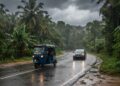
Sri Lanka’s tropical rain can be extremely heavy. Visibility can deteriorate within minutes, and water can accumulate quickly on roads. During monsoon periods, flooding and landslides can also result in road closures.
If visibility becomes poor, slow down significantly and avoid attempting to drive through floodwater when you cannot judge its depth or the condition of the road underneath.
Google Maps can be misleading
Google Maps is extremely useful in Sri Lanka, but don’t blindly follow every route it suggests. A road shown on the map may technically exist but turn out to be extremely narrow, poorly surfaced, unsuitable for your vehicle, steep, difficult to pass another car on, or effectively a small village lane.
When travelling longer distances, choosing the main road can sometimes be faster even when the map suggests a shorter alternative.
Travel times are longer than they look
This surprises many first-time visitors. A destination may only be 100 kilometres away, but that does not necessarily mean a one-hour drive. Outside the expressways, journeys can involve towns, buses, tuk-tuks, motorcycles, pedestrians and slow-moving traffic.
Always give yourself more time than you think you need. This is particularly important when driving to the airport.
Driving differs a lot by region
“Sri Lankan traffic” isn’t one single thing how you need to drive changes noticeably depending on where you are.
Colombo and the surrounding suburbs are dense, slow-moving, and can feel relentless. Expect heavy congestion at peak times, motorcycles lane-splitting aggressively between cars, and a near-constant stream of tuk-tuks weaving in and out. Patience matters more than speed here as you’ll rarely get anywhere fast regardless of how assertively you drive.
The hill country — around Kandy, Nuwara Eliya, Ella and the tea estate roads is a different challenge entirely. Roads are narrow, winding and full of blind hairpin bends, often with a sheer drop on one side and no barrier. Mist can roll in quickly at altitude and cut visibility with little warning, and during the monsoon these roads carry a real landslide risk. Overtaking is far more dangerous here than it looks, since you often can’t see what’s coming around the next bend.
The north and east (around Jaffna, Trincomalee, Batticaloa and the surrounding areas) tend to have noticeably better road surfaces and far less traffic than the south and west of the island, making for easier, more relaxed driving overall. Historically these regions have also seen more police and military checkpoints than elsewhere, so keep your documents within easy reach if you’re heading that way.
Adjusting your driving style to the region you’re in, rather than treating Sri Lanka as a whole, will make each of these stretches considerably less stressful.
Renting a Car in Sri Lanka
Self-drive cars are available, although many visitors choose to rent a vehicle with a driver instead.
Before accepting a rental vehicle, check:
- Tyres
- Brakes
- Headlights
- Indicators
- Windscreen wipers
- Mirrors
- Air conditioning
- Spare wheel
- Jack and basic tools
- Insurance documents
- Registration documents
Take photographs or a video of the vehicle before leaving the rental location. Record existing scratches, dents and other damage. You should also understand exactly what the insurance covers and what excess you would have to pay after an accident. Ask specifically whether the policy is comprehensive or third party only, and whether it covers a foreign driver using a temporary driving permit, as some policies may exclude this.
UK government travel advice recommends checking that your rental company is appropriately registered and ensuring the vehicle is roadworthy and properly insured.
Should you rent a car or hire a driver?
This depends on how comfortable you are.
Self-driving makes sense if you are confident behind the wheel, staying for several weeks or months, want independence, and are prepared to adapt to Sri Lankan traffic.
Hiring a driver makes sense if you are visiting for a short holiday, planning a fast-moving itinerary, or simply don’t want the stress of navigating unfamiliar roads.
For a two-week holiday, a driver can make the trip considerably easier. For an expat living here for months or years, learning to drive locally can give you much more independence.
What about driving a Tuk-Tuk?
Foreigners can rent and drive tuk-tuks, and this has become particularly popular with adventurous travellers. But don’t assume that because a tuk-tuk is small, it is automatically easy or safe to drive. Its handling is different from a car, and you still need the appropriate legal driving authorisation for the vehicle category and the airport counter doesn’t issue this, so you’ll need to go through the AAC or a DMT office instead.
Tuk-tuks are also not permitted on Sri Lankan expressways. If you have never driven one before, proper instruction before entering normal traffic is essential.
Motorcycles and Scooters
Motorcycles and scooters can look like an easy solution, especially in coastal towns. They also expose you to considerably greater risk. The UK government’s travel advice specifically notes that riding a motorbike in Sri Lanka can be particularly dangerous.
Always make sure your licence and driving authorisation cover the correct vehicle category, and wear a proper helmet.
What Should You Carry While Driving?
Keep your essential documents accessible. Depending on your circumstances, these may include:
- Passport or accepted identification
- Foreign driving licence
- International Driving Permit
- Sri Lankan recognition permit or temporary/local licence
- Rental agreement
- Vehicle registration documents
- Insurance information
You should also keep the rental company’s emergency number and your insurer’s contact details on your phone.
Police Checkpoints
You may occasionally encounter police or security checkpoints. Slow down, follow instructions, and stop when requested. Keep your documents organised so you can produce them without searching through luggage. The UK government’s travel guidance advises motorists to comply with instructions given by police or military personnel at checkpoints.
What happens if you have an accident?
First, make sure everyone is safe. If someone is injured, contact emergency services.
Where it is safe to do so, document:
- Vehicle positions
- Registration numbers
- Damage
- Road conditions
- Surrounding area
- Contact details of the other driver
Contact your rental company and insurer as soon as possible. The UK government advises drivers involved in a collision to remain at the scene with their vehicle for as long as it is safe to do so. If remaining there is unsafe or you feel threatened, report the incident at a local police station.
Useful emergency numbers:
- Police: 118 or 119
- Ambulance: 1990
- Expressway emergency: 1969
You Can’t Self-Drive into National Parks
This catches out a lot of visitors who’ve been happily self-driving everywhere else on the island. Places like Yala, Wilpattu, Udawalawe and Sri Lanka’s other national parks don’t allow you to bring your own rental car in through the gates. Instead, you need to enter in a licensed park jeep with an authorised driver-guide, arranged either at the park entrance or in advance through a tour operator.
This isn’t a formality, it’s enforced, and it exists for safety and conservation reasons as much as anything else. Park roads are unpaved, tracks aren’t signposted the way public roads are, and driver-guides know how to navigate around wildlife safely, including elephants and leopards at close range. If a safari is on your itinerary, park your own vehicle outside and book a jeep rather than assuming you can drive yourself in.
Animals on Sri Lankan roads
This is something foreign drivers often underestimate. Depending on where you are driving, you may encounter dogs, cows, monkeys, peacocks and other animals. In some parts of Sri Lanka there is also the possibility of encountering wild elephants.
Never approach a wild elephant in your vehicle simply to get a photograph. Keep your distance. An elephant can move much faster than many visitors expect and can severely damage a vehicle.
Parking
Parking can be informal compared with what you may be used to in Europe. In towns and tourist areas, hotels, restaurants and shops often have dedicated parking or someone who will help direct you.
Don’t automatically copy where other vehicles have parked. Check signs, avoid blocking entrances, and make sure your vehicle is not creating an obstruction.
Fuel stations
Fuel stations are widely available across populated areas and along major routes. For longer journeys into more remote areas, don’t wait until the tank is almost empty before looking for fuel. On expressways in particular, make sure you have enough fuel before entering.
Is driving in Sri Lanka dangerous?
It can be more challenging than driving in many European countries. That does not mean foreigners should never drive here. It means you need to change your driving style:
- Drive slower
- Leave more space
- Don’t assume someone has seen you
- Don’t insist on your right of way
- Expect motorcycles and tuk-tuks around you
- Give buses space
- Avoid unnecessary night driving
And don’t allow yourself to become overconfident after the first few days.
Our advice for first-time drivers
If you’ve just arrived in Sri Lanka, don’t collect a rental car from the airport after a long international flight and immediately attempt a five-hour drive across the country. Give yourself time to adjust.
If possible, spend your first day observing how local traffic works. Then start with shorter journeys before attempting routes through busy cities or mountainous areas.
Driving in Sri Lanka becomes considerably easier once you stop expecting the roads to operate exactly like the roads back home.
Having your own vehicle can completely change your experience of living in Sri Lanka. You are no longer planning your life around taxis, tuk-tuks or public transport. You can explore beaches, villages, markets, restaurants and parts of the island that many short-term visitors never see.
But independence comes with responsibility. Make sure you have the correct licence or permit, appropriate insurance and a roadworthy vehicle before you start driving.
Most importantly, adapt your driving to Sri Lanka rather than expecting Sri Lanka to adapt to the driving habits you brought with you. Once you understand that, getting behind the wheel can become one of the most useful parts of living on the island.
Licensing rules, fees and administrative procedures can change. Always confirm the latest requirements with Sri Lanka’s Department of Motor Traffic, the Automobile Association of Ceylon, and your vehicle rental or insurance provider before driving.