


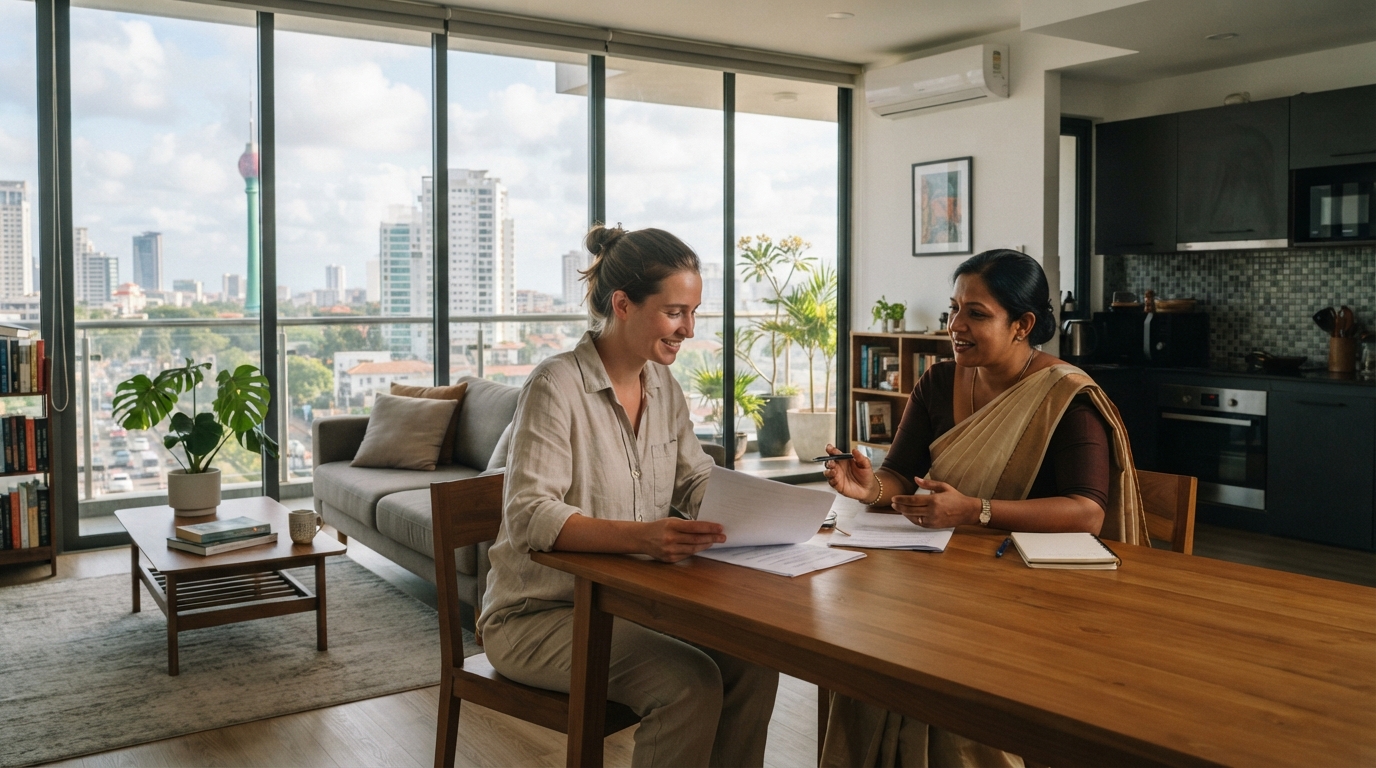
Renting an apartment in Colombo is generally a straightforward process, but the way rentals are arranged may be different from what you are used to in your home country. Before starting your search, it is useful to understand what you will need, how much money may be required upfront and what should be agreed before you sign a lease or make any substantial payment.

What documents do you need to rent an apartment in Colombo?
There is no single document list that every Colombo landlord will request.
At minimum, expect to provide identification such as your passport together with your contact details. Depending on the landlord, agent and circumstances, additional information about your immigration status, employment, business or intended length of stay may be requested.
Real-estate agents are also subject to customer-identification requirements, so foreigners should not be surprised if an established agent asks for identification and other information before completing a transaction.
Ask what documentation will be required early in the process so there are no delays once you find an apartment you want.
How much does it cost to rent an apartment in Colombo?
There is no single figure that accurately represents apartment rental prices in Colombo.
Rent depends on the location, building, apartment size, age, condition, floor, furnishings, view, parking and facilities provided.
At the lower end of the market, furnished apartments can sometimes be found from around LKR 100,000–180,000 per month, although foreigners looking for modern apartments in desirable central Colombo locations should realistically expect to spend more.
A good furnished one-bedroom apartment can commonly fall around LKR 180,000–300,000 per month, while apartments in newer or premium developments can reach LKR 300,000–450,000 or considerably more.
Two-bedroom apartments can move into approximately LKR 250,000–550,000+ per month, with premium developments exceeding this.
These figures should be treated as market ranges rather than fixed prices. Two apartments with the same number of bedrooms in the same Colombo district can have completely different rents.
A newer development with a swimming pool, gym, parking, 24-hour security, backup generator and modern furnishings will normally command considerably more than an older apartment without these facilities.
Best areas to live in Colombo for expats
Choosing where to live in Colombo as a foreigner should not be based on the apartment alone.
Colombo traffic means that a relatively short distance can sometimes become a long daily journey. Proximity to your workplace, children’s school, hospital, supermarket and the places you visit regularly can therefore be more valuable than having a larger apartment several kilometres further away.
Colombo 2
Colombo 2 has become an important area for modern high-rise apartment living, particularly around Union Place, Beira Lake and the wider central business district.
It can suit foreigners who want a central location, newer apartment developments and convenient access to restaurants, offices, shopping and other parts of central Colombo.
Some of Colombo’s premium residential towers are located here, so rents can also be high.
Colombo 3
Colombo 3, including Kollupitiya, is one of the most established locations for expats living in Colombo.
It offers convenient access to restaurants, cafés, supermarkets, hotels, offices and the seafront, with a mixture of older residential buildings and premium apartment developments.
The convenience of the location is reflected in rental prices.
Colombo 5
Colombo 5, including Havelock Town and surrounding areas, can provide a more residential environment while remaining relatively close to central Colombo.
There are modern apartment developments, supermarkets, private hospitals and restaurants nearby, with a broad range of rental options.
Colombo 7
Colombo 7, or Cinnamon Gardens, is one of Colombo’s best-known residential districts.
It is greener and generally less dominated by high-rise development than parts of Colombo 2 and 3. It can appeal particularly to foreigners who want a central residential location without feeling that they are living directly inside Colombo’s commercial centre.
Outside central Colombo
Do not automatically restrict your Colombo apartment search to Colombo 2, 3, 5 and 7.
Areas such as Rajagiriya, Battaramulla, Nugegoda, Dehiwala and Mount Lavinia can provide alternatives, sometimes with more space for the same budget.
The trade-off is often travel time.
An apartment that saves LKR 100,000 per month may not feel like good value if you subsequently spend several hours each week sitting in traffic.
Furnished or unfurnished apartment?
Many foreigners searching for long-term accommodation in Colombo choose furnished apartments, particularly when moving to Sri Lanka for a limited number of years.
However, furnished can mean very different things.
One apartment may genuinely be ready to move into, with beds, sofas, dining furniture, refrigerator, washing machine, air conditioning and kitchen equipment.
Another may technically be advertised as furnished while providing little more than basic furniture and appliances.
Do not rely entirely on the listing description or photographs.
During the viewing, establish exactly what will remain in the apartment and make sure important furniture and appliances are recorded in the inventory attached to your agreement.
For a longer stay, an unfurnished or partially furnished apartment may provide better value, particularly if you already own furniture or want to create your own home.
How much does it cost in Colombo?
Where to find apartments for rent in Colombo
You can find apartments for rent in Colombo through property portals, real-estate agents, property management companies, social-media groups and personal recommendations.
Online listings are useful for understanding what your budget buys before arranging viewings.
Compare several apartments in the same neighbourhood and, where possible, in the same building. This gives you a much better indication of the real market than looking at individual advertisements in isolation.
You may also see the same apartment advertised by several agents, sometimes at different prices or with different information.
Before progressing, establish who you are dealing with and whether they are authorised to represent the owner.
A good local agent can be useful for an expat because they can identify appropriate buildings, communicate with landlords and arrange several viewings.
However, using an agent does not replace proper checks or a properly prepared rental agreement.
Do you have to pay an estate agent when renting in Colombo?
Possibly.
Agent commission on apartment rentals in Colombo should be established before you agree to proceed with a property.
Some agents charge the tenant, some arrangements place the cost elsewhere, and commission structures can differ. A commonly encountered commercial arrangement is a fee equivalent to around one month’s rent, but you should not assume this automatically applies to every rental.
Before using an agent, ask:
- whether you will pay a commission
- how much it will be
- when it becomes payable
- whether taxes are added
- whether it is refundable if the transaction does not complete
Include any agent commission when calculating the total amount you need before moving into the apartment.
What to check when viewing an apartment in Colombo
A beautiful apartment can still be an inconvenient place to live.
When viewing an apartment, look beyond the furniture, swimming pool and balcony view.
Turn on the air conditioning where possible. Test taps and showers and check the water pressure. Look for damp, mould, water damage and evidence of previous leaks, particularly around windows, bathrooms and ceilings.
Check the condition of the refrigerator, washing machine, cooker and other appliances that are included.
Ask what happens during a power cut.
A building advertised as having a backup generator does not necessarily mean that every appliance or air-conditioning unit inside your apartment will continue operating.
Internet is another important consideration, particularly if you work remotely.
Do not simply ask whether the building has internet. Check which providers serve the apartment and whether fibre or the connection you require is actually available to that particular unit.
Also consider:
- hot water
- mobile signal
- noise
- parking
- building security
- lift reliability
- backup power
- swimming pool and gym access
- pest problems
- rubbish disposal
- building management
- nearby construction
If possible, visit the area at a different time of day before committing.
Traffic, construction, schools, restaurants, nightlife and places of worship can make an area feel completely different at different times.
Check the building as carefully as the apartment
When renting an apartment in Colombo, you are not simply choosing the individual unit. You are also choosing the building.
Look at the condition of lifts, corridors, parking areas and common spaces.
Ask how well the building is managed and how quickly problems are normally resolved.
In higher-rise buildings, backup power and lift reliability are particularly important.
A beautifully renovated apartment inside a poorly managed building may not provide the comfortable lifestyle you expected.
Ask what is included in the monthly rent
Never assume that the advertised rent represents your complete housing cost.
In condominium developments there may be a monthly management or maintenance charge covering security, lifts, common areas, swimming pool, gym and other facilities.
Sometimes this is included in the landlord’s advertised rent. In other cases it may be charged separately.
Electricity, water, internet and other utilities may also be the tenant’s responsibility.
Before comparing two apartments, establish:
Monthly rent + maintenance charges + utilities + any other recurring charges = your actual monthly housing cost.
An apartment with a slightly lower advertised rent is not necessarily the cheaper apartment.
Security deposit, advance rent and reservation payments
These terms are sometimes used interchangeably during property discussions, but they do not necessarily mean the same thing.
A security deposit is money held against obligations under the agreement, such as damage or unpaid bills, and should be refundable subject to the agreed conditions.
Advance rent is rent paid in advance for an identified future rental period.
A reservation payment is money paid to hold the apartment while the transaction progresses.
Before transferring money, establish exactly which type of payment you are making.
The agreement or receipt should state:
- how much has been paid
- what the payment represents
- whether it is refundable
- when it can be retained
- whether it will be credited against rent or the deposit
This distinction becomes particularly important where several months’ rent is requested before occupation.
How much money will you need before moving in?
Do not assume that renting an apartment for LKR 300,000 per month means you need LKR 300,000 to move in.
Depending on the agreed rental terms, your initial costs may include:
advance rent + security deposit + agent commission + stamp duty + legal/notarial costs + first utility or internet costs
The exact amount varies considerably between properties and landlords.
Before agreeing to an apartment, ask for a complete breakdown of the money required before you receive the keys.
This is particularly important for foreigners planning their moving-to-Colombo budget from overseas.
Stamp duty when renting an apartment in Sri Lanka
Under the current Inland Revenue Department schedule, the rate for an instrument relating to a lease or hire of property is LKR 10 for every LKR 1,000 or part thereof of the aggregate rent or hire payable for the term covered by the agreement. Where a lease exceeds 20 years, the calculation is limited to the aggregate payable for the first 20 years.
For example, if you rent an apartment for:
LKR 350,000 per month × 12 months = LKR 4,200,000
the stamp duty at LKR 10 per LKR 1,000 would be approximately:
LKR 42,000
This is separate from the monthly rent and security deposit.
Before signing, ask your lawyer, notary, landlord or agent to confirm the applicable stamp duty for your particular agreement and establish who is responsible for paying it.
Lease registration and other legal costs
A formal lease may also involve notarial and registration costs.
Sri Lanka’s Registrar General’s Department recognises leases as registrable instruments. Where registration applies, there can therefore be registration charges in addition to stamp duty.
Do not assume that an advertised monthly rental price includes the costs of preparing, notarising or registering the lease.
Before signing, ask for a breakdown of:
- stamp duty
- notarial or legal fees
- registration charges, where applicable
- who is responsible for each cost
For a substantial long-term rental, particularly where a large amount of money is being paid upfront, independent legal advice can be worthwhile.
Verify who owns the apartment before paying
Before transferring a substantial deposit or several months’ rent, establish that the person offering you the apartment is legally entitled to do so.
This is particularly important if the owner lives overseas and you are dealing with a relative, agent or property manager.
Where someone is acting for the owner, ask what authority they have to enter into the transaction and receive money.
For a significant lease, an independent Sri Lankan lawyer can verify ownership and relevant documents before you commit substantial funds.
Do not transfer a large amount of money simply because someone tells you that several other tenants are interested.
Can you negotiate apartment rent in Colombo?
Yes, rental terms can often be negotiated.
Your negotiating position will depend on the apartment, demand, how long it has been available, the length of lease you are offering and the payment terms.
But do not negotiate only on monthly rent.
If the landlord will not reduce the price, you might negotiate:
- a lower security deposit
- a different advance-payment schedule
- inclusion of the maintenance charge
- replacement of appliances
- additional furniture
- repairs before occupation
- professional cleaning
- better renewal terms
The objective is to negotiate the overall rental package, not simply to say that you reduced the advertised rent by LKR 10,000.
The apartment lease agreement
For a long-term rental, the terms should be properly documented.
Your agreement should clearly identify the landlord, tenant and apartment and record the rental period, monthly rent, payment dates, security deposit and any rent paid in advance.
It should also deal with:
- utilities
- maintenance charges
- repairs
- damage
- appliances
- landlord access
- notice periods
- early termination
- renewal
- rent increases
- subletting
- return of the security deposit
Do not rely on important promises made verbally during negotiations.
If the landlord has agreed to replace the washing machine, repair the air conditioning, provide furniture or include the maintenance charge in the rent, record it in writing.
Create an inventory and condition report
If you rent a furnished apartment, prepare an inventory.
Record the furniture, appliances and other items supplied with the property and their condition.
When you receive the keys, take dated photographs or video of the apartment.
Record existing scratches, stains, marks on walls, damaged furniture, chipped tiles, broken fittings and problems with appliances.
Send or otherwise record the condition information so there is evidence that it existed when you moved in.
This becomes particularly important when a substantial security deposit is held by the landlord.
Do not assume that an obvious existing defect will be remembered when you move out a year later.
Repairs and maintenance
Agree responsibility for repairs before you move in.
Your agreement should distinguish between normal responsibilities of the tenant and repairs that remain the landlord’s responsibility.
Ask what happens if:
- an air conditioner stops working
- the refrigerator fails
- the washing machine breaks
- there is a plumbing problem
- there is a water leak
- an electrical problem develops
Also establish who you contact when something goes wrong, particularly if your landlord lives outside Sri Lanka.
In a condominium, building management may deal with common areas and central building systems but not necessarily problems inside the individual apartment.
Understand the condominium rules
When renting an apartment in a condominium, you are not only dealing with your landlord. You will also be expected to follow the rules of the building.
Before signing, ask about any rules affecting:
- pets
- visitors
- parking
- deliveries
- swimming pool and gym use
- noise
- moving furniture
- access cards
- service lifts
- renovations
- short-term guests
If something is important to your lifestyle, establish whether it is permitted before you sign the lease.
Paying rent from overseas
If your income remains outside Sri Lanka, establish how the landlord expects rent to be paid.
The agreement should clearly identify the rent and payment currency, payment date and bank account or other agreed payment method.
If international transfers are involved, consider exchange-rate movements and bank or transfer charges.
Keep evidence of rental payments.
Where cash is used, obtain a proper receipt showing the amount, date and purpose of the payment.
What if you need to leave Sri Lanka early?
This is particularly important for expats.
Your circumstances may change. A work assignment can end, your visa situation may change, you may decide to move elsewhere in Sri Lanka or you may need to return home unexpectedly.
Before signing a long lease, understand what happens if you want to leave early.
Check:
- required notice
- early-termination provisions
- penalties
- what happens to advance rent
- whether your security deposit can be affected
- whether another tenant can take over the lease, if permitted
Do not wait until you need to leave to discover what your agreement says.
Renewal and rent increases
If you may want to remain in the apartment after the initial lease expires, discuss renewal before signing.
Check whether the agreement provides an option to renew and how much notice you need to give.
Also establish how the rent for a renewed period will be determined.
A renewal clause does not necessarily mean that the rent will remain unchanged.
Knowing the mechanism in advance gives you greater certainty when planning a longer stay in Colombo.
What happens when you move out?
The end of the tenancy deserves as much attention as the beginning.
Your agreement should state the notice required, the condition in which the apartment must be returned and how the security deposit will be dealt with.
Before handing back the keys, inspect the apartment with the landlord or their representative where possible.
Take final photographs, settle outstanding utilities and retain evidence of the payments.
If deductions are proposed from your security deposit, ask for them to be explained and documented.
Common mistakes foreigners make when renting in Colombo
The biggest rental mistakes are not always dramatic scams.
More often, they are ordinary decisions made too quickly.
Choosing an impressive apartment without considering the daily commute.
Agreeing to the advertised rent without asking whether maintenance is included.
Confusing advance rent with a refundable security deposit.
Paying money before establishing who owns the property.
Accepting a furnished apartment without an inventory.
Assuming that a backup generator powers the entire apartment.
Discovering after moving in that the internet connection is unsuitable for remote work.
Failing to establish who pays for repairs.
Signing a long lease without understanding what happens if you need to leave Sri Lanka early.
And perhaps most importantly, assuming that because the monthly rent is affordable, the entire rental arrangement is affordable.
How to rent an apartment in Colombo: step by step
Start by deciding how much you can comfortably spend each month and how much you are prepared to pay upfront.
Choose two or three areas based on where you will actually spend your time rather than simply selecting the most prestigious Colombo postcode.
Research current listings so you understand what your budget buys, and then view several comparable apartments.
When you find a suitable property, establish the complete monthly cost, including any maintenance charges and utilities. Confirm the deposit, advance rent, agent commission and other upfront expenses.
Check who owns the apartment or who is authorised to act for the owner.
Negotiate the rent and other commercial terms before the agreement is prepared.
Review the lease carefully, establish the applicable stamp duty and other legal costs and obtain independent advice where appropriate.
Before moving in, prepare an inventory and condition record, retain evidence of every payment and make sure any repairs or additions promised by the landlord have been properly recorded.
Renting an apartment in Colombo as an expat can be relatively straightforward when you understand the process. The best apartment is not necessarily the cheapest property or the building with the most impressive facilities. It is the apartment that works for your location, lifestyle and budget while giving you clear, properly documented rental terms and a realistic understanding of the complete cost of living there.
This guide provides general information and does not constitute legal advice. Rental and lease arrangements vary, so obtain independent Sri Lankan legal advice where appropriate.















Comments 2