

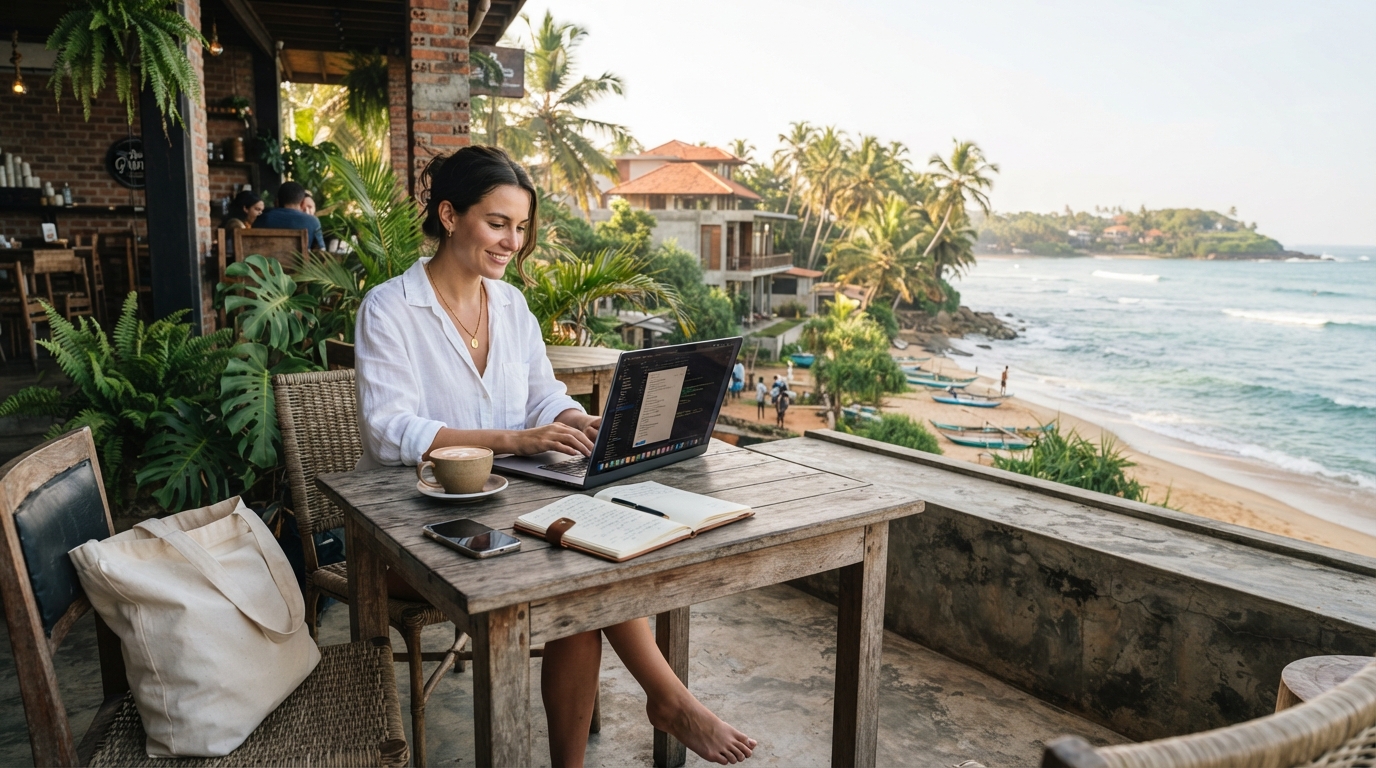
Sri Lanka now offers a dedicated Digital Nomad Residence Visa for foreigners who want to live in the country while continuing to work remotely.

The visa is intended for remote employees, freelancers and owners of businesses that are not registered in Sri Lanka and serve clients outside the country. The principal applicant must be at least 18 years old and meet the financial and documentary requirements set by the Department of Immigration and Emigration.
For people who previously relied on tourist visas while spending extended periods in Sri Lanka, this creates a specific immigration route designed around remote work and longer term residence.
Digital Nomad Visa
| Visa category | Digital Nomad Residence Visa |
| Validity | 1 year |
| Minimum age | 18 |
| Financial requirement | Minimum monthly income remittance of USD 2,000 |
| Eligible applicants | Remote employees, freelancers and qualifying overseas business owners |
| Spouse and dependants | Can be included |
| Additional dependant requirement | USD 500 additional monthly remittance for each dependant where the number of dependants exceeds two |
| Health insurance | Required |
| Police clearance | Required |
| Medical clearance | Required |
| Passport validity | Minimum 6 months |
| Government visa fee | USD 500 for a year or part thereof |
| Government recommendation | Recommendation from the Ministry of Digital Economy required |
Who is the nomad visa in Sri Lanka designed for?
The key principle is straightforward: you live in Sri Lanka, but your work remains based outside Sri Lanka.
For example, you could live in Galle while working remotely for a British company, spend a year in Colombo while running an Australian online business, or work from Weligama as a freelancer serving clients in Europe.
This does not mean that the visa should be treated as unrestricted permission to work within Sri Lanka. Anyone planning to take local employment, work for Sri Lankan clients or establish a Sri Lankan business should check which immigration and business rules apply to those activities.
Understanding the USD 2,000 requirement
This is one area where the wording of the official rules matters.
The requirement published by the Department of Immigration and Emigration is a minimum monthly income remittance of USD 2,000 for the principal applicant. It also requires proof of that remittance. That is more specific than simply saying that an applicant must “earn USD 2,000 per month”.
How do you prove the USD 2,000 monthly remittance?
The Department of Immigration and Emigration requires the principal applicant to demonstrate a minimum monthly income remittance of USD 2,000. However, the current Digital Nomad Visa guidance does not provide detailed instructions explaining exactly how that remittance must be evidenced.
This means there is an important distinction between what is officially confirmed and what should not yet be assumed.
The official requirement confirms that you must provide proof of the minimum monthly remittance. It does not currently state that an employment contract showing a salary of USD 2,000 or more is sufficient on its own. The requirement relates specifically to remittance, meaning evidence that the required funds have actually been transferred.
In practical terms, you should therefore be prepared to provide banking records that clearly identify the transfers, including the amount, date, currency, sender and receiving account. Depending on how the money is transferred, this could include bank statements, international transfer confirmations or other records issued by the financial institution processing the remittance.
Keep these records rather than relying only on payslips, invoices or an employment contract. Those documents may help establish the source of your income, but they do not necessarily prove that the required amount has been remitted.
At present, the published Digital Nomad Visa rules do not specify whether the USD 2,000 must be transferred into a particular type of Sri Lankan bank account, whether several transfers during a month can be combined to reach the threshold, or how applicants with irregular freelance or business income should demonstrate compliance.
Until Immigration publishes more detailed instructions, applicants should avoid assuming that proof of earnings and proof of remittance are interchangeable. If your financial arrangements are unusual, particularly if you are self employed, receive income through several platforms or accounts, or do not normally transfer USD 2,000 into Sri Lanka each month, it is sensible to confirm the acceptable evidence with the Residence Visa Division before structuring your application around it.
Can you bring your family?
Yes. A spouse and dependants can be included under the Digital Nomad Visa arrangements, subject to the applicable requirements and supporting documentation.
The financial rule for larger families is slightly unusual. According to the published criteria, where the number of dependants exceeds two, an additional USD 500 per month for each dependant is added to the remittance requirement.
Family applications may also require marriage certificates, birth certificates and other supporting documents establishing the relationship to the principal applicant.
How long can you stay?
The visa is issued for one year.
For someone planning to remain in Sri Lanka for that length of time, immigration is only one part of the preparation. Accommodation, banking, insurance, healthcare, internet access and potentially taxation become practical considerations rather than holiday planning.
Families will also need to think carefully about schooling and location. A place that works well for a holiday may not necessarily be the most practical place to live, work and study throughout the year.
How much does the visa cost?
The Department of Immigration and Emigration currently lists the Digital Nomad Residence Visa fee:
Main applicant: USD 500 per year
Spouse: USD 500 per year
Each dependant: USD 500 per year
The visa fee should not, however, be confused with the total cost of preparing an application. Applicants also need to obtain documents such as police and medical clearances and arrange international health insurance. Certification, translations or other document preparation may create additional costs depending on individual circumstances.
What documents will you need?
The published requirements include an application form, request letter, passport documentation, photographs, security clearance information, medical clearance, recent police clearance, international health insurance, evidence of the required remittance and a recommendation from the Ministry of Digital Economy.
Additional documentation is required when applying with family members.
Because some documents may take time to obtain and may have validity requirements, it is worth preparing the application in the correct order rather than collecting documents randomly.
What about tax?
A one year residence visa also raises an important question that should be considered separately from immigration: where will you pay tax?
Holding a Digital Nomad Visa does not by itself determine your tax position. Tax residency, the source and type of income, time spent in Sri Lanka and any applicable double taxation agreement may all be relevant.
For that reason, claims that the Digital Nomad Visa automatically makes foreign income tax free should be treated cautiously unless they are supported by current Sri Lankan tax legislation or official guidance.
Medical requirements and health insurance
Health requirements for the Digital Nomad Visa deserve particular attention because several different documents and procedures are involved. A medical clearance, the Health Protection Plan and private international health insurance are not the same thing.
1. Medical Clearance Report
The official Digital Nomad Visa document checklist includes a Medical Clearance Report as one of the documents required with the application.
However, the Digital Nomad Visa guidance itself does not explain in detail what form this report must take, whether a medical report obtained abroad will be accepted, which tests it must contain, or whether it must be issued through Sri Lanka’s Immigration Health system. This is therefore an area where applicants should be careful about arranging medical examinations abroad before confirming what Immigration will accept. There is, however, a separate health assessment system that applies generally to Sri Lankan residence visa applicants: the Health Protection Plan.
2. Sri Lanka’s Health Protection Plan
The Health Protection Plan, usually referred to as the HPP, was introduced by Sri Lanka’s Ministry of Health for residence visa applicants. Immigration states that residence visa applicants are required to undergo the HPP before submitting a new residence visa or renewal application, unless they fall within one of the specified exempt categories. Digital nomads are not currently listed among the published exemptions. The assessment is carried out through Sri Lanka’s Inbound Health Assessment Centre under a programme involving the Ministry of Health and the International Organisation for Migration. This is not a general medical examination designed to determine whether you are in perfect health. It is a focused public health screening.
Applicants are screened for four diseases:
Tuberculosis
Malaria
HIV/AIDS
Filariasis
The assessment includes blood sample collection and a chest X ray. Once laboratory results are available, the applicant has a consultation with a doctor. A positive screening result does not simply mean that an application is automatically rejected. The official HPP information states that applicants with positive screening results are referred for further testing and appropriate follow up through the Ministry of Health’s Immigration Health Unit and relevant national disease control programmes.
Where is the Health Protection Plan assessment completed?
Applicants register for the assessment through Sri Lanka’s official Inbound Health Assessment Programme. The current instructions say that applicants should apply for the Health Protection Plan within seven days of entering Sri Lanka. This is an important practical detail because it indicates that at least this part of the residence visa health process takes place after arrival in the country. An appointment is booked online and the applicant attends the Health Assessment Centre. You can register through the official Health Protection Plan portal: Sri Lanka Inbound Health Assessment Programme
What should you take to the appointment?
The current HPP instructions require:
your original passport,
any previous passports, if applicable,
a photocopy of the passport biodata page,
and a printed copy of your appointment confirmation.
There are separate arrangements where Immigration is already holding the applicant’s original passport.
Applicants do not need to fast overnight before the assessment.
What happens at the appointment?
The published process is relatively straightforward. After registration, the applicant completes counselling and consent forms and pays the assessment fee. Blood samples are then collected and a chest X ray is performed. Once the laboratory results are available, the applicant proceeds to a medical consultation. The medical certificate and Health Protection Plan documentation are then issued following completion of the assessment. The health assessment information is also transmitted to the Department of Immigration and Emigration through the Ministry of Health’s Immigration Health Unit. According to the HPP instructions, once the assessment has been completed, the applicant can proceed with the residence visa process.
How much does the Health Protection Plan cost?
The current published fee is USD 75 per person. Payment is made in Sri Lankan rupees and can currently be made by cash or card. This is an additional cost to remember when calculating the true cost of obtaining a Digital Nomad Visa. It is separate from the Digital Nomad Visa fee itself.
How long is the health assessment valid?
The Health Protection Plan health assessment is currently valid for one year. This becomes relevant if you later renew or extend your residence status because the HPP requirement applies to both new residence visa applications and renewals.
What is the Health Protection Plan card?
After completing the assessment, applicants receive an HPP card. The card provides access to certain services at Sri Lankan government health institutions, including outpatient services, emergency medical care, primary healthcare and treatment relating to diseases identified through the health assessment. However, its coverage is limited. The HPP does not provide access to non emergency hospitalisation or treatment in private hospitals. This is particularly important for Digital Nomad Visa applicants because the HPP should not be confused with the separate health insurance required for the visa.
3. International health insurance
The Digital Nomad Visa requirements separately state that applicants must have international health insurance covering medical care in Sri Lanka. This is not replaced by completing the Health Protection Plan. Think of the two requirements as serving different purposes. The HPP is part of Sri Lanka’s immigration health screening system. International health insurance is your own medical insurance coverage while living in Sri Lanka. The official Digital Nomad Visa guidance currently states that international health insurance is required, but it does not provide detailed minimum coverage levels, deductibles or a prescribed list of approved insurers. For that reason, applicants should check that their policy explicitly provides medical coverage in Sri Lanka for the relevant period rather than assuming that ordinary European, UK or other domestic health coverage will extend to a year of residence abroad. It is also worth checking the practical terms of the policy, including private hospital treatment, emergency treatment, outpatient care, medical evacuation, pre existing condition exclusions and the maximum period you are permitted to remain outside your home country. These may be important for your own protection even where Immigration has not published a minimum monetary coverage requirement.
Do not treat these requirements as interchangeable
This is probably the most important point for applicants. Completing the Health Protection Plan does not remove the requirement to have international health insurance. Similarly, buying international health insurance does not mean that you can skip Sri Lanka’s immigration health assessment. At present, there is also a small area of uncertainty in the published Digital Nomad Visa documentation. The DNV checklist specifically asks for a Medical Clearance Report, while the general residence visa rules separately refer to the Health Protection Plan. The official DNV document does not clearly explain whether the Medical Clearance Report is intended to be the medical certificate produced through the HPP process or whether Immigration expects an additional medical document. Until that is clarified by the authorities, applicants should not pay for an additional private medical examination abroad on the assumption that it will satisfy the requirement. Confirm the current procedure with the Residence Visa Division or Immigration Health Unit before arranging additional medical documentation.
Recommendation from the Ministry of Digital Economy
A recommendation from the Ministry of Digital Economy is one of the official requirements for Sri Lanka’s Digital Nomad Visa. The Department of Immigration and Emigration specifically includes this recommendation in its list of documents required from applicants. The official requirements confirm that the recommendation is necessary, but they do not currently explain whether an applicant must request it directly from the Ministry of Digital Economy or whether the recommendation is obtained as part of the application process through the Department of Immigration and Emigration. There is also no detailed public guidance setting out a separate application form for the recommendation, a specific list of documents that must be submitted to the Ministry, a separate fee, or a standard processing time. This is particularly relevant because Sri Lanka has been developing a Digital Nomad Visa Recommendation System intended to digitise the recommendation process. As the system and procedures develop, the way applicants obtain the Ministry recommendation may change. Until more detailed official guidance is published, the important point is simple: the Ministry of Digital Economy recommendation is a required part of the Digital Nomad Visa process, but the authorities have not yet published sufficiently detailed instructions explaining how an individual applicant obtains it.
Security Clearance Form
A completed Security Clearance Form is one of the documents required when applying for Sri Lanka’s Digital Nomad Visa. The form provides the Sri Lankan authorities with personal information needed to carry out the security checks connected with your application. It is separate from the Police Clearance Certificate and both documents are listed among the requirements for the Digital Nomad Visa. The official Digital Nomad Visa guidance states that applicants must submit a duly completed Security Clearance Form, but currently provides limited public information about the security clearance procedure itself.
What information will you need to provide?
The Security Clearance Form is intended to collect personal information that allows the relevant Sri Lankan authorities to verify your identity and conduct the necessary background checks. When completing it, make sure that your personal details correspond exactly with your passport and the information provided elsewhere in your Digital Nomad Visa application. Pay particular attention to your full name, passport details, nationality, date of birth and any other identifying information requested. Differences in spelling, dates or passport information between documents can result in additional questions and potentially delay the application. Where the form requests information about your personal history, addresses, employment or other background details, provide complete and accurate information rather than estimating dates or leaving relevant sections unanswered.
Is the Security Clearance Form the same as the Police Clearance Certificate?
No. They are two separate requirements. The Security Clearance Form is completed by you and submitted as part of the Digital Nomad Visa application so that the Sri Lankan authorities can conduct the required security checks. The Police Clearance Certificate is an official document obtained from the relevant authority in your home country or country of residence. For the Digital Nomad Visa, the police certificate must be no more than three months old. Submitting one does not replace the other.
Do you need to obtain security clearance yourself?
The published Digital Nomad Visa requirements ask applicants to submit the completed Security Clearance Form. They do not instruct applicants to independently obtain a separate Sri Lankan security clearance certificate before applying. Your responsibility is therefore to complete and submit the required form accurately. The subsequent security assessment is handled as part of the application process by the relevant Sri Lankan authorities. Applicants should be cautious about paying third parties who claim that a separate security certificate must be purchased unless this has been specifically requested by the Department of Immigration and Emigration for their application.
Is there a separate security clearance fee?
The official Digital Nomad Visa requirements do not currently identify a separate government fee specifically for the Security Clearance Form or security check. If an agent or intermediary quotes a separate charge for obtaining security clearance, ask exactly what the charge covers and whether it is an official government fee or a service fee charged by the intermediary.
How long does security clearance take?
There is currently no separate official processing time published specifically for the security clearance stage of the Digital Nomad Visa application. For that reason, applicants should not rely on unofficial claims that security clearance will always be completed within a particular number of days. The practical approach is to ensure that the Security Clearance Form is complete, accurate and consistent with the rest of your application. If additional information is requested during the assessment, respond promptly, as this may affect the overall processing time of your Digital Nomad Visa.
Passport requirements
To apply for Sri Lanka’s Digital Nomad Visa, you must have a valid passport with at least six months of remaining validity. As part of the application, you will need to provide a clear copy of the passport biodata page showing your photograph, full name, passport number, nationality, date of birth, issue date and expiry date. Make sure that the details entered throughout your application match your passport exactly, including the spelling and order of your names. The passport copy should be clear, fully visible and easy to read.
Visa duration and renewal
Sri Lanka’s Digital Nomad Visa allows the holder to live legally in Sri Lanka for up to 12 months and can be renewed annually. To extend the visa for another year, you will need to submit the documents required for the initial application again. In addition, Immigration requires proof of tax registration with Sri Lanka’s Inland Revenue Department when applying for an extension. This is an important condition to understand from the beginning. Although tax registration is specifically listed as an additional requirement at the extension stage, registration itself should not be confused with a conclusion about how much Sri Lankan tax you will ultimately owe. Your actual tax position will depend on the applicable Sri Lankan tax rules and your individual circumstances.
The visa fee also applies annually. The current official fee is USD 500 per year for the main applicant, USD 500 per year for a spouse and USD 500 per year for each dependant. The Digital Nomad Visa is also a multiple entry visa, meaning you can leave Sri Lanka and return during its validity rather than having the visa cancelled simply because you travel abroad.
Is the Digital Nomad Visa likely to suit you?
The visa is worth investigating if you are at least 18, can work entirely remotely, receive your income from outside Sri Lanka, can meet the required monthly remittance and want Sri Lanka to become a genuine temporary base rather than simply somewhere you visit for a holiday.
But the USD 2,000 requirement should not be the only factor in your decision. Before applying, you need to understand whether your particular working arrangement fits the visa conditions, what evidence Immigration expects, what bringing your family involves and whether spending most or all of a year in Sri Lanka could affect your tax position.
You should also consider the practical side of the move. Where will you live? How reliable is the internet there? What will a comfortable month actually cost? Can you access the healthcare you want? If you have children, where will they go to school? And is the lifestyle you experienced during a holiday still practical when Sri Lanka becomes the place from which you work every day?
Those questions are just as important as obtaining the visa.










Comments 1