

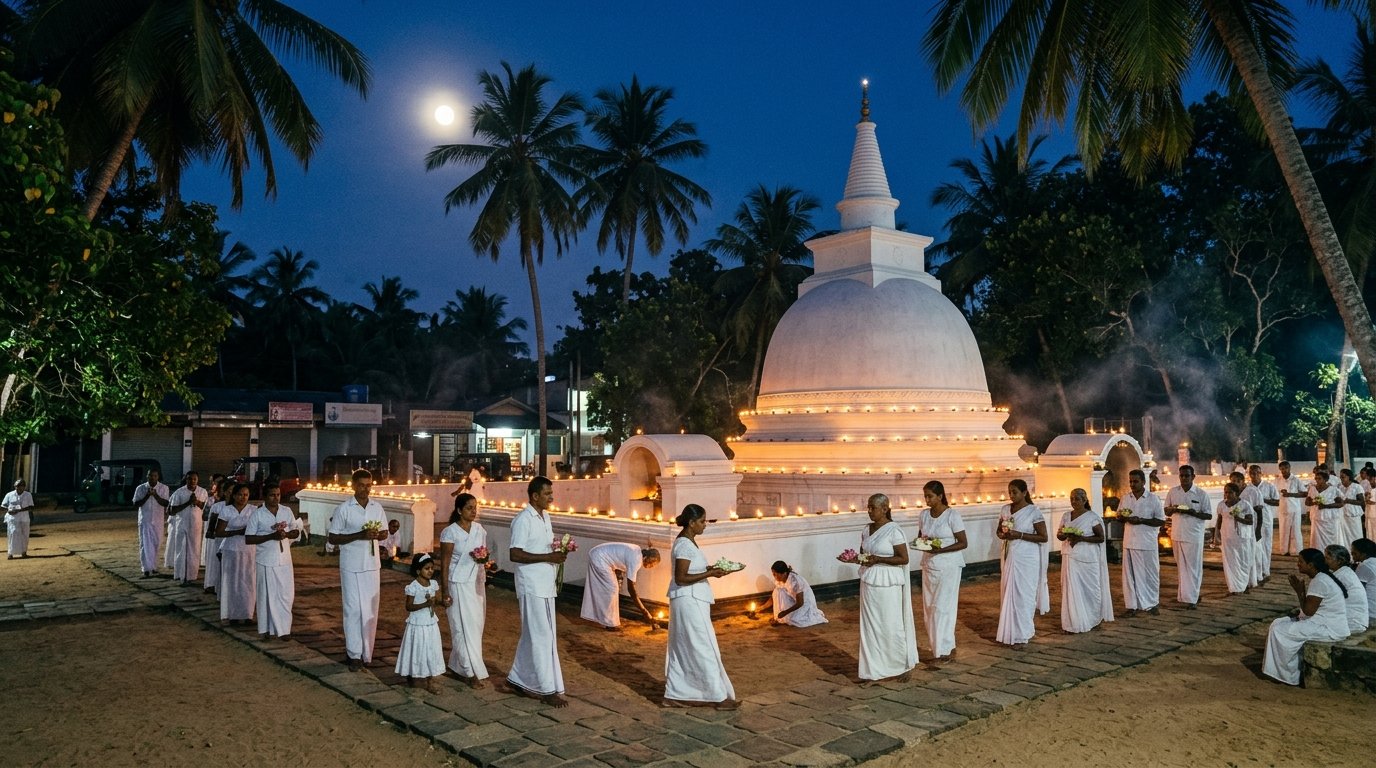
For many foreigners moving to Sri Lanka, one of the first unexpected discoveries is that every full moon is a public holiday. Known locally as Poya Day, this monthly Buddhist observance influences everything from banking and government services to employment, hospitality, retail and everyday life.

While in many countries the full moon passes largely unnoticed, in Sri Lanka it forms an important part of the national calendar. Understanding Poya days is essential not only for expats living on the island but also for foreign entrepreneurs, investors, property owners and anyone planning to establish a business in Sri Lanka.
What is Poya Day in Sri Lanka?
Poya is a Buddhist religious observance associated with the full moon. Each Poya day has its own name and religious significance, commemorating important events in Buddhist history and tradition.
Sri Lanka officially recognises Full Moon Poya days as public and bank holidays under the Holidays Act No. 29 of 1971. There are normally 12 Poya days each year, although some years may have 13, depending on the lunar calendar.
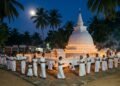
Many Sri Lankan Buddhists spend the day visiting temples, meditating, making religious offerings, participating in charitable activities and observing Buddhist precepts. People often wear white clothing as a symbol of simplicity and purity.
Some of the most significant Poya days include:
- Vesak Poya: commemorates the birth, enlightenment and passing of Gautama Buddha. It is one of Sri Lanka’s most important religious celebrations, featuring lanterns, illuminated displays and community events.
- Poson Poya: commemorates the introduction of Buddhism to Sri Lanka, with major celebrations in Anuradhapura and Mihintale.
- Esala Poya: commemorates several important events in Buddhist tradition, including the Buddha’s first sermon.
- Il Poya: associated with the beginning of the Buddhist missionary tradition.
- Unduvap Poya: commemorates the arrival of the sacred Bodhi tree sapling in Sri Lanka and traditionally marks the beginning of the Sri Pada pilgrimage season.
Although Poya is a Buddhist religious observance, the public holiday and applicable legal restrictions affect residents and businesses regardless of their nationality or religious beliefs. Sri Lanka Tourism+2
What is open and closed on Poya Day in Sri Lanka?
One of the biggest adjustments for foreigners living in Sri Lanka is remembering that a normal working day elsewhere may be a public holiday on the island.
Although Sri Lanka does not come to a complete standstill on Poya days, certain businesses and services are affected.
| Business or service | Poya Day operations |
|---|---|
| Government offices | Generally closed |
| Banks | Generally closed |
| Government schools | Closed |
| International schools | Depends on the school calendar |
| Supermarkets | Generally open, with certain restrictions |
| Liquor shops | Closed |
| Hotel bars | Alcohol sales prohibited |
| Restaurants and cafés | Many remain open |
| Meat shops | Closed |
| Shopping centres | Many remain open |
| Public transport | Operates, although schedules may vary |
| Private hospitals | Generally operational, with possible changes to appointments |
| Nightclubs and casinos | Subject to statutory closure restrictions |
| Tourist attractions | Opening hours vary |
Foreign residents should check opening hours in advance, particularly when planning appointments, shopping or administrative tasks.
Can you buy alcohol on Poya Day in Sri Lanka?
One of the most noticeable restrictions for foreigners is the prohibition on alcohol sales.
On Full Moon Poya days, licensed establishments are prohibited from selling alcohol. This affects liquor stores, restaurants, beach bars, hotels and resorts.
Foreign visitors are not automatically exempt from these restrictions, even when staying at an international hotel or luxury resort.
For restaurant and hotel owners, failure to comply with alcohol restrictions can result in legal action and potentially serious consequences for their operating licences.
Can you buy meat on Poya Day?
Another restriction that often surprises foreigners is the prohibition on animal slaughter for commercial sale and the sale of meat under sections 13 and 14 of the Holidays Act.
Butchers and dedicated meat stalls are required to close. Supermarkets may remain open while their fresh meat counters are unavailable.
Restaurants and hospitality businesses should establish which products they can legally offer and ensure that their operations comply with the applicable regulations.
For expat families, particularly those who regularly purchase fresh meat, planning grocery shopping around Poya days can prevent unnecessary inconvenience.
How Poya days affect businesses in Sri Lanka
Foreign entrepreneurs considering starting a business in Sri Lanka should incorporate Poya days into their operational and financial planning from the beginning.
Unlike seasonal celebrations, Poya holidays occur throughout the year, meaning their impact on business operations is recurring.
Employment regulations and staff salaries
Foreign business owners employing local staff need to understand their obligations under Sri Lankan employment law.
Under sections 7A and 7B of the Shop and Office Employees (Regulation of Employment and Remuneration) Act:
- Employees covered by the Act are entitled to a holiday on Full Moon Poya Day.
- Employees working their normal hours on Poya Day must receive at least 150% of their normal daily remuneration.
- When Poya Day coincides with certain existing statutory or weekly holidays, employers are not required under section 7A to provide an additional replacement holiday.
Different employment provisions may apply to workers covered by industry-specific Wages Board regulations. Business owners should confirm which legislation applies to their employees before establishing payroll policies.
For businesses operating seven days a week, including hotels, restaurants and tourist accommodation, these requirements should be included in annual staffing budgets.
Can a Foreigner Start a Business in Sri Lanka?
Impact on restaurants, bars and hospitality businesses
The hospitality sector is particularly affected by Poya Day restrictions.
A restaurant, beach club or resort that generates a substantial proportion of its revenue from alcohol sales may experience reduced income on these days while continuing to incur staffing and operational costs.
Consider a hypothetical restaurant generating LKR 200,000 in daily revenue, with 30% coming from alcoholic beverages.
Illustrative daily restaurant revenue
Normal trading day
LKR 200,000
Poya Day
LKR 140,000
Food and other sales
Alcohol sales
Potential annual revenue reduction over 12 Poya days
LKR 720,000
Illustrative scenario assuming unchanged non-alcohol sales and no recovery of revenue on other days. This is not a profit calculation or an industry forecast.
This example demonstrates why Poya days should be considered when preparing financial forecasts, particularly for foreign investors evaluating hospitality business opportunities in Sri Lanka.
However, Poya days can also create opportunities. Restaurants can develop alcohol-free menus, promote family dining, introduce vegetarian dishes or offer special wellness experiences.
Business Licences and Local Permits in Sri Lanka
Impact on property investors and villa owners
Foreigners investing in rental properties, holiday villas, boutique hotels and apartments should also consider how Poya days affect their operations.
Property managers may need to adjust staff schedules, arrange maintenance in advance and inform guests about local restrictions.
Providing guests with information about Poya days before their arrival can help prevent misunderstandings, particularly when visitors are unfamiliar with Sri Lankan culture.
Public holidays can also affect property transactions. Bank transfers requiring manual processing, meetings with lawyers, land registry searches and government approvals may need to be rescheduled.
Banking and financial transactions
As Poya days are official bank holidays, conventional banking services are generally unavailable.
Although ATMs, online banking and mobile banking services remain accessible, certain transactions requiring manual approval or business-day settlement may experience delays.
This is particularly relevant for businesses dealing with international payments, foreign investments, supplier invoices, salaries and property transactions.
Foreign business owners should avoid scheduling important financial deadlines without first consulting the Sri Lankan holiday calendar.
Importing, exporting and business administration
Companies involved in international trade may also experience disruptions when government departments, financial institutions and business partners are unavailable.
While essential logistics operations may continue, administrative approvals, documentation and certain customs-related processes could take longer.
Businesses working with international clients should communicate Sri Lankan public holidays in advance, particularly when overseas customers expect normal weekday operations.
How Poya days affect expats living in Sri Lanka
For foreigners living permanently or spending several months each year in Sri Lanka, Poya days gradually become part of everyday life.
Families may need to adjust childcare arrangements, school schedules, domestic staff working hours and shopping plans.
Those working remotely for overseas companies may find themselves working as usual while their local surroundings operate on a public holiday schedule.
Expats employing domestic workers, gardeners, drivers or other household staff should discuss holiday arrangements in advance and establish the employment conditions applicable to their particular situation.
For anyone applying for a visa extension, renewing documents, opening a bank account or dealing with government authorities, checking the holiday calendar can save an unnecessary journey.
Business Banking in Sri Lanka for Foreign Investors
Are Poya days good or bad for business?
The economic impact of Poya days depends largely on the type of business.
While alcohol-dependent businesses, entertainment venues and companies requiring access to government services may experience operational limitations, other sectors can benefit from increased domestic tourism and leisure activities.
Hotels, family attractions, wellness centres, transport providers and cafés may experience increased demand when local residents take advantage of public holidays, particularly when Poya falls close to a weekend.
For foreign entrepreneurs, the most effective approach is not to view Poya days solely as lost working days but to understand how local consumer behaviour changes and adapt accordingly.
A business model developed for another country will not necessarily operate in the same way in Sri Lanka.
Respecting local culture on Poya Day
Understanding Poya days is also an important part of integrating into Sri Lankan society.
Foreigners visiting Buddhist temples should dress modestly, cover their shoulders and knees, remove their shoes where required and behave respectfully.
Poya days offer an opportunity to experience Sri Lanka beyond its beaches, resorts and tourist attractions. Visiting a Buddhist temple, observing religious traditions or learning about community charitable activities can provide a deeper understanding of the country and its people.
Foreign residents are not expected to participate in religious practices, but respecting their significance is an important part of living in Sri Lanka.
Full Moon Poya dates in Sri Lanka for 2027
Expats and business owners planning ahead can use the following published Poya holiday dates.
| Poya Day | Date | Day |
|---|---|---|
| Duruthu | 22 January 2027 | Friday |
| Navam | 20 February 2027 | Saturday |
| Medin | 22 March 2027 | Monday |
| Bak | 20 April 2027 | Tuesday |
| Vesak | 19 May 2027 | Wednesday |
| Poson | 18 June 2027 | Friday |
| Esala | 18 July 2027 | Sunday |
| Nikini | 16 August 2027 | Monday |
| Binara | 15 September 2027 | Wednesday |
| Vap | 15 October 2027 | Friday |
| Il | 13 November 2027 | Saturday |
| Unduvap | 13 December 2027 | Monday |
The next remaining Poya holiday in 2026 is on: Tuesday 24th of November, and Wednesday 23rd December.
Dates should be checked against official government announcements, as amendments and additional holidays may be introduced.
Planning around Poya days as a foreign business owner
Foreign entrepreneurs establishing a business in Sri Lanka should consider the following:
- Include all Poya holidays in the annual business calendar.
- Account for applicable holiday pay when preparing staffing budgets.
- Adjust revenue forecasts to reflect trading restrictions.
- Inform international customers and guests about changes to services.
- Schedule important financial transactions and administrative appointments in advance.
- Develop alternative products and services suitable for Poya days.
- Monitor government announcements and Excise Department regulations.
Understanding Sri Lanka’s public holidays should form part of the research undertaken before starting a business or investing in an existing company.
Full Moon Poya days are an integral part of Sri Lanka’s cultural, religious and economic landscape. For expats, understanding these monthly holidays makes everyday life easier. For foreign investors and entrepreneurs, they represent an important consideration in employment, financial forecasting, operational planning and regulatory compliance.
Successfully living and doing business in Sri Lanka requires more than understanding its investment opportunities and legal framework. It also requires an understanding of the country’s culture, traditions and the way they influence everyday life.
Poya days are a particularly good example of how culture and commerce intersect in Sri Lanka.
Disclaimer: This article is intended for general informational purposes only and does not constitute legal, financial, employment or business advice. Regulations concerning Full Moon Poya days in Sri Lanka, including trading restrictions, alcohol sales, employee remuneration and business operations, may be subject to change. Expats, foreign investors and business owners are advised to verify current requirements with the relevant Sri Lankan authorities and seek professional advice where necessary. ExpatsLanka.com accepts no responsibility for decisions made or losses incurred based on the information provided in this article.