



Thinking about opening a business in Sri Lanka? From company registration and professional fees to licences, property rental, staff salaries and working capital, this guide explains what foreign entrepreneurs need to budget for before launching a business.

ExpatsLanka | Business & Investment | Updated 6 November 2026
Sri Lanka offers opportunities for entrepreneurs interested in tourism, hospitality, technology, consulting, wellness and other commercial ventures. But before establishing a company, one of the most important questions is: How much does it actually cost to start a business in Sri Lanka?
The answer depends on what kind of business you want to establish.
A small consulting company operating online will have very different financial requirements from a beachfront restaurant, boutique hotel or manufacturing operation.
The good news is that the official cost of registering a private limited company in Sri Lanka is relatively modest. However, the registration fee represents only a fraction of what many businesses need to become operational.
Foreign entrepreneurs must also consider professional fees, banking requirements, licences, premises, equipment, employees, taxation and the money needed to keep the business running until it becomes profitable.
There is also an important distinction between the amount required to register a company, the amount needed to launch and operate a business, and the investment thresholds associated with certain regulated activities or immigration categories.
This guide breaks down the principal costs of starting a business in Sri Lanka in 2026, with official government fees, practical budgeting advice and illustrative startup budgets.
1. How Much Money Do You Need to Start a Business in Sri Lanka?
There is no single minimum budget that applies to every business.
Some service-based businesses can operate with limited equipment and modest overheads. Others require substantial capital for premises, construction, specialised equipment or regulatory approvals.
Before calculating your startup budget, separate your expenses into three categories.
| Cost category | What it includes |
|---|---|
| Legal establishment | Company registration, incorporation documents, company secretary, legal advice and initial approvals |
| Business setup | Premises, deposits, renovation, equipment, furniture, technology and initial stock |
| Operating capital | Staff salaries, rent, utilities, marketing, insurance, accounting and unexpected expenses |
A company can be legally incorporated before it has sufficient money to operate successfully.
This is a particularly important distinction for foreign entrepreneurs considering a move to Sri Lanka.
For example, someone opening a small consulting company might need little more than legal registration, a computer, reliable internet access and appropriate administrative arrangements.
A person opening a restaurant, however, may need a substantial amount of money before serving their first customer.
And an entrepreneur establishing a hotel might need even greater capital to cover property arrangements, renovation, tourism licensing, staff and ongoing maintenance.
The sensible approach is to calculate the total cost of bringing the business to the point where it can generate revenue, then add a reserve for operating expenses and delays.
2. Company Registration Fees in Sri Lanka (2026)
The most common company structure for entrepreneurs establishing a locally incorporated business is a Private Limited Company (Pvt Ltd).
Registration is administered by the Department of the Registrar of Companies through the online eROC system.
Sri Lanka revised its company registration fees with effect from 6 July 2026, under Extraordinary Gazette No. 2496/03.
The revised government charges include:
| Government service | Fee excluding VAT |
|---|---|
| Approval of a company name | LKR 2,600 |
| Registration of a private limited company | LKR 5,200 |
| Registration of an annual return | LKR 7,900 |
The combined base fee for company name approval and private limited company registration is therefore LKR 7,800, before VAT and additional applicable charges.
The annual return fee is a recurring statutory expense, not part of the initial incorporation cost. Daily FT+1
Are there additional registration charges?
Yes.
Depending on the filing requirements, there may also be charges for the Articles of Association, director consent forms, company secretary consent, beneficial ownership declarations and other documents.
The Registrar’s older online incorporation schedule separately lists fees for Form 1, Form 18, Form 19 and the Articles of Association. However, parts of that guidance contain superseded charges and an outdated VAT rate.
Consequently, it would be misleading to present the LKR 7,800 figure as the total cost of incorporating a company.
For accurate planning, request an itemised cost breakdown from the company secretary or review the amounts generated by the current eROC system.
Official websites: Registrar of Companies and eROC company registration portal.
Beneficial ownership registration
Since 30 March 2026, companies must complete mandatory beneficial ownership submissions as part of the incorporation process.
This involves identifying the relevant beneficial owners and authorised person through the Registrar’s dedicated online portal using Forms BO1 and BO5.
The rules introduce additional administrative and compliance responsibilities, particularly for businesses involving overseas corporate shareholders or complicated ownership structures.
Foreign investors should confirm whether their incorporation provider includes beneficial ownership filings in its quoted service fee. Department of the Registrar of Companies
3. Professional Fees: Lawyers, Accountants and Company Secretaries
Government registration charges are only part of the legal setup expense.
Many foreign entrepreneurs engage professionals to ensure that the company is established correctly and that its ownership arrangements comply with Sri Lankan law.
Company secretary fees
A private limited company requires an appropriately qualified company secretary.
The secretary can assist with preparing incorporation documents, maintaining statutory records, handling Registrar filings and managing ongoing compliance requirements.
Company secretary fees are charged commercially and vary between providers.
Some offer a company formation package that covers initial registration and the first year of secretarial services. Others charge separately for incorporation and annual maintenance.
Before agreeing to a quotation, confirm whether it includes name reservation, the Articles of Association, director and secretary consent filings, beneficial ownership declarations, statutory registers and subsequent annual services.
Do not assume that a company registration package includes all of these items.
Legal fees
A lawyer may be needed to check foreign investment eligibility, draft shareholder agreements, review commercial leases or advise on property and sector-specific restrictions.
Legal costs depend largely on the complexity of the project.
A company owned by a single foreign shareholder may require less work than a joint venture involving multiple shareholders, substantial investment capital and a complicated commercial property lease.
For foreign entrepreneurs working with a Sri Lankan partner, a properly drafted shareholders’ agreement is particularly important.
It should address ownership percentages, voting rights, financial contributions, directors’ authority, profit distributions, share transfers and how disputes will be resolved.
Paying for independent legal advice at the beginning can help prevent expensive disagreements later.
Accounting and tax advice
An accountant can help establish bookkeeping procedures, explain tax responsibilities and identify filing requirements.
The cost will depend on the volume of transactions, number of employees, VAT registration status and the complexity of the business.
A small consulting company may have relatively straightforward accounts. A restaurant with numerous daily transactions, stock purchases, employees and suppliers will usually require more extensive bookkeeping.
Accounting should therefore be treated as an ongoing business expense rather than a one-time registration cost.
Budgeting advice: Obtain at least two itemised quotations from suitably qualified providers. Ask specifically which services are included, which charges are payable to the government and which fees recur each year.
4. Is There a Minimum Investment for Foreigners Starting a Business?
One of the most common misunderstandings is that every foreigner must invest a substantial fixed amount to establish a business in Sri Lanka.
That is not the case.
There is no single universal minimum investment applicable to every foreign-owned private limited company.
However, some business sectors have restrictions, and particular investment programmes have their own capital requirements.
The USD 5 million retail trading restriction
Sri Lanka’s foreign investment regulations restrict non-resident investment in retail trading where the capital contributed by non-residents is below USD 5 million.
This restriction is especially relevant to foreigners considering opening retail shops.
It does not mean that every foreign-owned company must invest USD 5 million.
For example, many eligible IT and consulting activities are not subject to the same retail trading threshold.
Certain other sectors, including travel agencies, education and freight forwarding, have foreign ownership limits unless appropriate higher approval is obtained. dfe.lk
Before deciding on a startup budget, check whether the proposed activity is open to foreign investment under the intended ownership structure.
What if you want a Sri Lankan business partner?
A joint venture may allow investors to combine capital and expertise. However, a local partner does not automatically eliminate applicable legal restrictions.
Any ownership arrangement must reflect genuine legal and commercial rights.
Avoid informal agreements in which someone holds shares on your behalf merely to circumvent foreign investment rules.
For more information, read our related article: Can Foreigners Own 100% of a Sri Lankan Company?
5. Board of Investment (BOI) Fees
Some foreign investment projects involve the Board of Investment of Sri Lanka (BOI).
The BOI administers different arrangements, including Section 16 and Section 17 investments.
Whether BOI involvement is necessary depends on the investment structure, sector and applicable requirements.
The BOI publishes the following fees.
| BOI service | Published fee |
|---|---|
| Section 16 investment application | USD 400 |
| Section 16 review of Articles of Association | USD 200 |
| Section 16 agreement processing | USD 100 |
| Section 17 investment application | USD 400 |
| Section 17 normal project agreement processing | USD 2,500 |
| Section 16 annual licence | USD 550 |
These figures exclude applicable taxes and other charges. They do not necessarily all apply to every project.
Section 17 projects can also attract significant annual fees, which vary by category and investment size. Board of Investment of Sri Lanka
A major investment project may therefore have regulatory costs that extend well beyond incorporation.
Not every small foreign-owned company is required to enter a Section 17 agreement.
Investors should confirm which BOI requirements actually apply rather than assuming that every company must pay the charges listed above.
6. Business Licences and Local Authority Fees
Registering a company does not necessarily provide permission to start trading.
The licences required depend on the business activity and its location.
A consulting company operating from an office may have different requirements from a restaurant, hotel, manufacturing business or wellness centre.
Restaurants and cafés
Possible expenses include local authority trade licences, public health approvals, food-related licences, fire safety requirements and permissions concerning the commercial use of premises.
The exact requirements depend on the establishment and the local authority.
Hotels, guesthouses and holiday villas
Tourism accommodation providers may need registration with the Sri Lanka Tourism Development Authority (SLTDA).
The process may involve inspections, documentation, relevant local authority approvals and other requirements.
Hotel and tourism businesses should also account for licence renewals and ongoing compliance.
Wellness and beauty businesses
Beauty salons, wellness centres and massage businesses may need local authority permissions, suitable premises and compliance with relevant public health or other sector requirements.
The precise services offered matter. An ordinary beauty treatment business can have a different regulatory position from a business offering medical or therapeutic procedures.
Import and export businesses
Commercial importers and exporters may face additional registration, customs, standards, tax and permit requirements depending on the goods involved.
Certain products may require specialist authorisation.
Before renting premises or purchasing equipment, confirm the approvals required for the actual services you intend to provide.
Licence costs can vary considerably. There is no reliable single national fee that covers every type of business across Sri Lanka.
7. Renting Commercial Property in Sri Lanka
For businesses requiring physical premises, rent can become one of the largest recurring expenses.
The cost depends on location, building condition, size, accessibility and the type of commercial activity.
A small office in a secondary location may have very different rental costs from a beachfront restaurant, central Colombo retail unit or established tourist property on the southern coast.
Location matters
Business premises in Colombo may be particularly relevant to companies serving corporate clients or requiring access to professional services.
Tourist destinations such as Galle, Weligama, Mirissa and Ella may attract entrepreneurs interested in accommodation, hospitality and visitor services.
However, a popular tourist location does not automatically guarantee a successful business.
Higher visibility and visitor numbers can come with higher rents, stronger competition and seasonal changes in demand.
Before choosing a location, investigate the customer base, access, infrastructure, surrounding businesses and year-round commercial potential.
What should you include in the rental budget?
The monthly rent is only one part of the financial commitment.
You may also need to budget for a security deposit, advance rent, legal review, utility connections, maintenance, repairs, renovations and equipment.
A landlord may require payment of several months’ rent in advance. The amount and terms should be negotiated and clearly documented.
Foreign entrepreneurs should also confirm that the premises can legally be used for the proposed business.
A property suitable for residential use is not automatically approved for a restaurant, hotel or other commercial operation.
Be careful with long-term leases
Some businesses, particularly hotels and restaurants, require substantial investment in buildings owned by somebody else.
Imagine spending a large amount renovating a leased property and then discovering that the lease contains inadequate renewal protection.
Even a profitable business can be financially vulnerable if its location is not securely controlled.
A commercial lease should clearly explain the duration, renewal rights, rent increases, repair responsibilities, permitted alterations, termination conditions and treatment of improvements.
Have an independent lawyer review the agreement before committing substantial funds.
8. Renovation, Furniture and Equipment Costs
Renovation expenses are frequently underestimated, particularly by foreign entrepreneurs who plan to transform an existing building into a hospitality business.
An attractive property may still need significant work before it can be used commercially.
Possible expenses include electrical upgrades, plumbing, air conditioning, kitchens, bathrooms, flooring, roofing, furniture and safety equipment.
A restaurant may need commercial refrigeration, cooking equipment, extraction systems, food storage and preparation areas.
A guesthouse may require beds, mattresses, linen, bathroom fittings, laundry equipment, outdoor furniture and reliable internet connectivity.
Are renovations cheaper in Sri Lanka?
Some labour and locally sourced materials may cost less than in certain overseas markets, but this does not mean that every renovation is inexpensive.
Imported equipment, specialised materials, custom furniture and high-quality finishes can be costly.
Availability also matters.
An item that is straightforward to purchase in another country may be difficult to source locally or expensive to import.
Building work can also take longer than anticipated because of weather, supplier availability, changes to project specifications or contractor scheduling.
For substantial projects, obtain written quotations and agree on payment stages before work begins.
Where possible, arrange independent inspection of completed work before releasing final payments.
Include a renovation contingency
For planning purposes, an initial contingency of 15–20% above the estimated renovation budget can be a reasonable starting assumption.
However, older buildings, structural issues and complex projects may require a larger reserve.
For example, if the initial renovation estimate is LKR 5 million, adding a 20% contingency produces a planning allowance of LKR 6 million.
This is not a forecast of what the renovation will actually cost. It is a method for allowing for uncertainty.
9. How Much Does It Cost to Employ Staff in Sri Lanka?
Businesses planning to employ local workers need to calculate more than basic salaries.
Staffing budgets should include gross wages, statutory employer contributions, leave entitlements, training, uniforms where necessary and other employment-related costs.
The exact salary depends on the role, location, qualifications and experience.
A qualified accountant, software developer or hotel manager will have different salary expectations from an entry-level service employee.
Rather than relying on generic salary estimates, obtain current information for the positions and locations relevant to your business.
EPF and ETF contributions
For employees covered by the statutory schemes, employers must account for Employees’ Provident Fund (EPF) and Employees’ Trust Fund (ETF) contributions.
The standard rates are:
| Contribution | Rate | Who pays? |
|---|---|---|
| EPF employer contribution | 12% | Employer |
| EPF employee contribution | 8% | Deducted from employee earnings |
| ETF | 3% | Employer |
The employer’s combined EPF and ETF cost is ordinarily an additional 15% of qualifying employee earnings. Employees Provident Fund+1
Example: Employee earning LKR 100,000 per month
Illustrative monthly employment cost
LKR 115,000
Total employer cost before other benefits and expenses
| Component | Amount |
|---|---|
| Gross monthly salary | LKR 100,000 |
| Employer EPF (12%) | LKR 12,000 |
| Employer ETF (3%) | LKR 3,000 |
| Total employer cost | LKR 115,000 |
The employee’s 8% EPF contribution is deducted from gross earnings; it is not an additional employer expense. Other employment costs may apply.
If a business employs five people at the same assumed salary, its monthly gross salary bill would be LKR 500,000.
Adding employer EPF and ETF contributions increases that to LKR 575,000 before additional employment expenses.
Over a year, that represents LKR 6.9 million.
This illustrates why staffing needs careful attention even when individual salaries appear affordable.
10. Business Banking and Foreign Currency Transfer Costs
Foreign investors need to consider how investment funds will enter Sri Lanka.
The relevant banking arrangements depend on the nature of the investment.
For qualifying non-resident share investments, an Inward Investment Account (IIA) is generally used to channel funds into the country in accordance with foreign exchange regulations.
A corporate operating bank account may also be necessary for the company’s everyday transactions.
What banking expenses should you expect?
Potential expenses include international transfer fees, receiving bank charges, currency conversion margins, account administration fees and fees associated with particular banking services.
The costs vary by bank, currency and transaction size.
For a substantial investment, the exchange rate can have a more significant financial effect than a small fixed transfer fee.
For example, a 2% difference in the effective exchange rate on USD 100,000 represents USD 2,000 in value.
It is therefore worth comparing the full cost of transferring investment funds rather than looking only at the advertised bank transfer charge.
Keep investment transfers properly documented
Money intended as share capital should be transferred and recorded in accordance with the applicable investment rules.
An informal payment to a business partner is not automatically recognised as an equity investment.
Keep records of payments, bank confirmations, share subscriptions, agreements and company approvals.
For more information, consult the Central Bank’s Department of Foreign Exchange.
11. Business and Investor Visa Costs
If you are planning to live in Sri Lanka while operating a business, immigration costs need to be considered separately from company registration.
Owning shares in a Sri Lankan company does not automatically grant permission to reside or work in the country.
A short-term Business Visa may be appropriate for qualifying meetings or negotiations, but it does not provide unrestricted permission to work or run everyday commercial operations.
The relevant employment or residence categories have their own eligibility criteria.
Sri Lanka Investor Visa
The Immigration Department publishes two investment thresholds for its Investor Visa programme.
| Investor Visa | Minimum qualifying investment |
|---|---|
| Five-year visa | USD 100,000 |
| Ten-year visa | USD 200,000 |
The published visa fee is USD 200 per year for the main applicant, with separate fees for qualifying family members. immigration.gov.lk
These figures must not be confused with company registration costs.
The USD 100,000 or USD 200,000 amount is a qualifying investment threshold, not merely a visa application fee.
Nor does it mean that every foreign-owned company requires this amount of capital.
An investor may be permitted to own shares in a Sri Lankan business without qualifying for an Investor Visa.
Anyone intending to move to Sri Lanka should investigate the appropriate residence category before committing to a business model that requires their physical presence.
Official information: Sri Lanka Investor Visa.
12. Taxes and Annual Business Operating Costs
Starting a business is not only about raising enough capital to open it.
Entrepreneurs must also budget for recurring financial and statutory obligations.
Corporate income tax
Sri Lanka’s standard corporate income tax rate is 30%, although different rates and rules can apply to certain activities and categories of income.
Corporate income tax is generally calculated on taxable income, not simply on the total amount received from customers.
Tax planning should therefore consider revenue, allowable expenses and the company’s specific activities.
Value Added Tax (VAT)
The standard VAT rate is 18%.
The Inland Revenue Department’s published general registration thresholds are LKR 15 million in taxable supplies for a quarter or LKR 60 million over a 12-month period, with separate rules for certain activities.
Some businesses, including commercial importers and exporters, may have additional registration obligations. ird.gov.lk
VAT is particularly important when setting prices or evaluating equipment and supplier costs.
Businesses should determine whether quoted prices include VAT and whether input VAT can be recovered under the applicable rules.
Annual company compliance
A registered company may incur recurring costs for its company secretary, accounting, tax returns, annual returns, financial statements, audits where required and beneficial ownership reporting.
The 2026 government fee for registering an annual return is LKR 7,900 before VAT.
This is only the government filing fee and does not include any professional charge for preparing or submitting the return. Daily FT
Other monthly expenses
Depending on the business, ongoing expenditure may also include electricity, water, internet, cleaning, security, maintenance, insurance, software, advertising, transportation, stock replenishment and bank charges.
A hotel or restaurant should budget for equipment replacement and periods of lower demand.
A digital business may spend less on premises but more on software subscriptions, marketing and specialist employees.
These costs should be included in the business’s monthly cash-flow forecast rather than treated as occasional surprises.
13. Example Startup Budgets for Three Types of Businesses
To understand how expenses fit together, it helps to compare different business models.
The following examples are hypothetical planning scenarios, not verified market quotations or estimates of what every comparable business will cost in Sri Lanka.
The amounts are chosen to demonstrate how a startup budget works. Actual costs should be established through local quotations, professional advice and a feasibility study.
Example 1: A Small Consulting or Digital Services Company
Imagine a foreign entrepreneur establishing a consulting business with minimal physical infrastructure.
The company will operate primarily online, use a modest workspace and initially have no full-time employees.
Example budget: Consulting business
Illustrative
| Expense | Planning allowance |
|---|---|
| Incorporation and initial professional services | LKR 200,000 |
| Laptop, equipment and software | LKR 350,000 |
| Website, branding and initial marketing | LKR 200,000 |
| Workspace and associated setup | LKR 150,000 |
| Six-month operating reserve | LKR 600,000 |
| Total | LKR 1,500,000 |
Hypothetical budget: LKR 1.5 million. Excludes owner living expenses, visa costs and any additional regulated investment requirements.
This model avoids substantial investment in physical premises, employees or stock.
However, the entrepreneur must still ensure that the company is eligible for foreign ownership, correctly registered and compliant with banking and taxation requirements.
If they intend to work from Sri Lanka, immigration eligibility is another essential consideration.
Example 2: A Small Café or Restaurant
Now consider an entrepreneur planning to open a modest café in a tourist destination.
This business requires premises, equipment, staff, stock and compliance with the relevant operating rules.
Before applying the following budget, a foreign investor would need to confirm whether the proposed business and ownership model are legally permitted, including any relevant retail trading restrictions.
Example budget: Small café
Illustrative
| Expense | Planning allowance |
|---|---|
| Incorporation, legal advice and initial approvals | LKR 400,000 |
| Lease deposit and advance rent | LKR 900,000 |
| Renovation and fit-out | LKR 2,000,000 |
| Kitchen equipment and furniture | LKR 2,000,000 |
| Opening stock and supplies | LKR 300,000 |
| Branding and launch marketing | LKR 200,000 |
| Operating reserve | LKR 2,500,000 |
| Total | LKR 8,300,000 |
Hypothetical budget: LKR 8.3 million. This does not establish that a foreigner can legally open the proposed café with this amount of investment.
Notice that the business requires considerably more money than the consulting company, even before the entrepreneur knows whether the café will attract enough customers.
The operating reserve is especially important.
A café may take time to establish a reputation, build repeat business and reach consistent revenue.
Tourist demand may also change throughout the year.
Example 3: A Small Guesthouse or Boutique Accommodation Business
Hospitality investments can involve substantial upfront costs, particularly if the entrepreneur is renovating a property.
Suppose an investor plans to lease an existing building and convert it into a small guesthouse.
Example budget: Small guesthouse
Illustrative
| Expense | Planning allowance |
|---|---|
| Company formation, legal work and approvals | LKR 600,000 |
| Lease deposit and advance payments | LKR 3,000,000 |
| Renovation and property improvements | LKR 8,000,000 |
| Furniture, linen and equipment | LKR 3,000,000 |
| Website, photography and marketing | LKR 400,000 |
| Initial supplies and operating setup | LKR 500,000 |
| Operating reserve | LKR 4,500,000 |
| Total | LKR 20,000,000 |
Hypothetical budget: LKR 20 million. Excludes property purchase, unexpected structural repairs and any project-specific capital or visa requirements.
This example shows how quickly accommodation startup costs can increase.
The legal right to operate the business, property lease terms and tourism registration should all be verified before committing to renovation expenses.
The actual cost could be substantially above or below this planning scenario, depending on the property’s condition, location, size and quality standard.
Comparing the three hypothetical budgets
Illustrative Startup Budgets
Millions of Sri Lankan rupees; these are scenario assumptions, not market averages.
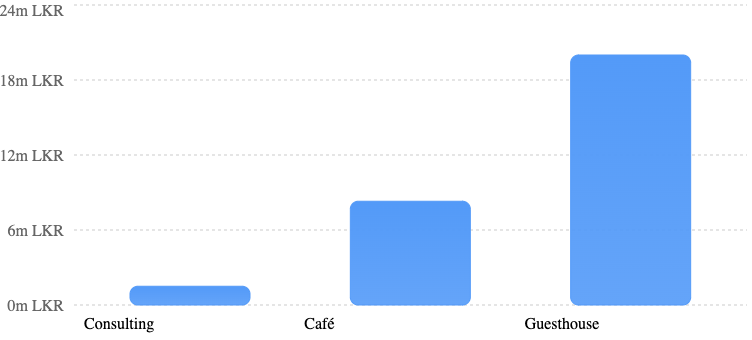
The main lesson is not that a particular type of business always costs a specific amount.
It is that the financial model matters much more than the incorporation fee.
An entrepreneur should calculate the business’s actual needs using local quotations and expected operating costs.
14. How Much Working Capital Should You Have?
Working capital is the money available to meet everyday financial obligations while the business establishes itself.
This includes expenses such as rent, salaries, utilities, accounting, insurance, marketing and stock.
Many new entrepreneurs focus heavily on how much money they need to open their business but underestimate how much they will need to keep it operating.
A restaurant may be fully fitted out and ready to welcome customers, yet still experience several months of disappointing sales.
Likewise, a guesthouse may perform well during the tourist season but generate substantially less revenue at other times.
How to calculate your operating reserve
A practical starting point is to estimate your monthly cash outgoings and then calculate how much reserve capital you want to maintain.
For example, consider a small business with monthly expenditure of LKR 500,000.
3-month reserve
1.5m
LKR
6-month reserve
3m
LKR
12-month reserve
6m
LKR
These are planning examples, not mandatory capital levels.
The appropriate reserve depends on risk, seasonality, how quickly you expect revenue to grow and your access to additional funding.
For a business with unpredictable demand, lengthy renovation work or substantial fixed expenses, a larger reserve may be necessary.
It is also important to distinguish between monthly expenses and net cash burn. If the business generates some revenue, the reserve may last longer, but this should be supported by realistic sales forecasts.
15. How to Calculate Your Own Startup Budget
Before transferring money or registering a business, create a detailed financial plan.
The following calculator can be used to explore the difference between startup expenses and operating capital. Amounts are in Sri Lankan rupees.
Startup Budget Calculator
Adjust the illustrative amounts to reflect quotations for your proposed business.Legal setup and registration (LKR)Premises and deposits (LKR)Renovation and equipment (LKR)Other initial costs (LKR)Monthly operating costs (LKR)Months of operating reserve
6 months
Estimated total funding needed
LKR 5,700,000
Initial setup
LKR 3,300,000
Operating reserve
LKR 2,400,000
Copy my budgetThis calculator is for planning only. It does not verify market prices, legal eligibility, investment thresholds or whether the business will generate sufficient revenue.
Once you know the estimated capital needed, compare it with the amount you are prepared to invest.
You should also consider how much of your personal savings will remain available if the business takes longer than expected to become profitable.
16. Common Financial Mistakes Foreign Entrepreneurs Make
One of the biggest risks when starting a business overseas is treating familiar assumptions as if they apply in a new market.
Several mistakes are particularly relevant in Sri Lanka.
Underestimating professional and regulatory expenses. Cheap incorporation does not mean the entire legal setup will be inexpensive. Foreign ownership checks, licensing and specialist advice can add costs.
Paying for renovation before confirming property rights. Significant investment in leased premises should not take place without checking the lease, permitted business use and the necessary approvals.
Assuming imported goods will be affordable. Equipment, furniture, building materials or specialist products may carry considerable transport, customs and tax costs.
Ignoring the slower months. Tourism businesses should calculate operating costs across the entire year rather than relying on revenue projections based on peak visitor periods.
Using all available cash to open. A business may be fully equipped but unable to pay suppliers or employees if it starts without sufficient working capital.
Failing to account for foreign currency movements. Exchange rates can affect imported equipment costs, foreign investment transfers and any obligations payable in another currency.
Choosing a partner without financial controls. Shared bank access, financial reporting, spending authority and documented agreements are important when several people manage business funds.
Assuming that living costs and business costs are the same. An entrepreneur moving to Sri Lanka should maintain a separate personal budget covering housing, food, transport, healthcare, family needs and other living expenses.
A well-prepared budget should show what will happen if sales are lower, expenses are higher or the opening date is delayed.
17. Frequently Asked Questions
Is it expensive to start a business in Sri Lanka?
It depends on the business. Government incorporation fees are relatively low, but commercial premises, equipment, staffing and working capital can make the total investment substantial.
What is the company registration fee in Sri Lanka in 2026?
The revised base registration fee for a private limited company is LKR 5,200, while company name approval costs LKR 2,600. VAT and additional applicable filing and professional fees are separate.
Can a foreigner start a business with USD 5,000?
Some permitted service-based ventures may have relatively low startup costs, but there is no guarantee that USD 5,000 is sufficient. The amount required depends on the business activity, ownership structure, professional expenses and operating requirements. Certain sectors have much higher foreign investment thresholds.
Do foreigners need USD 100,000 to open a company?
No. USD 100,000 is the minimum qualifying investment for the five-year Investor Visa programme. It is not the universal minimum capital requirement for incorporating a Sri Lankan company.
Do I need a Sri Lankan partner to reduce startup costs?
Not necessarily. Many permitted businesses allow 100% foreign ownership. A local partner should be selected for genuine commercial reasons, not simply as a way to avoid legal requirements or registration expenses.
How much does it cost to open a café in Sri Lanka?
The amount depends on the premises, lease terms, kitchen equipment, staff, licences and renovation requirements. Foreign investors must also confirm that the proposed business and ownership structure comply with applicable rules, including any retail trading restrictions.
How much does it cost to open a guesthouse?
Costs vary with the size and condition of the property, lease or purchase arrangements, renovations, furniture, tourism licensing and operating reserve. A properly itemised budget is essential before committing funds.
Are BOI fees compulsory for every foreign business?
No. BOI arrangements and fees depend on the type of investment and applicable approval requirements. Different Section 16 and Section 17 charges may apply to qualifying projects.
What are the main annual costs after registration?
Recurring expenses may include annual return filings, company secretary services, accounting, tax compliance, business licences, employees, rent, utilities, insurance and maintenance.
Can I save money by registering the company myself?
Using eROC may reduce some professional administration costs, but foreign investors still need to ensure compliance with ownership, filing and other legal requirements. Skipping specialist advice where it is necessary can create greater costs later.
Final Thoughts: What Does It Really Cost to Start a Business in Sri Lanka?
Starting a business in Sri Lanka can involve relatively modest incorporation charges, but the actual investment required depends on the business model.
A company providing digital services may need limited infrastructure. A café, hotel or other premises-based venture may require considerably more capital before it generates revenue.
For foreign entrepreneurs, budgeting must also account for legal eligibility, potential investment approvals, banking arrangements, professional services, taxation and immigration requirements.
The most important financial decision is not how to minimise the company registration fee.
It is whether you have enough capital to establish the business correctly, operate it through its early stages and withstand unexpected expenses.
Before investing, prepare a realistic budget, obtain quotations, confirm the legal requirements and examine whether the proposed business is financially viable.
A business that is affordable to register is not necessarily affordable to operate.
With careful planning and appropriate professional advice, foreign entrepreneurs can make better-informed decisions about where and how to invest in Sri Lanka.
Official Government Resources
For current costs and regulatory requirements, consult:
- Registrar of Companies — Official incorporation fees and filings.
- eROC Portal — Company registration and online payment requirements.
- Board of Investment Fees and Charges — Application, agreement and annual BOI fees.
- Department of Foreign Exchange — Foreign investment restrictions and banking requirements.
- Inland Revenue Department — Tax rates, registration and compliance.
- Investor Visa Programme — Investment thresholds and visa charges.
- Employees’ Provident Fund — Employer and employee contributions.
- Employees’ Trust Fund — Employer contributions.
Disclaimer: This article is based on information reviewed on 6 November 2026 and provides general financial and regulatory guidance. Government charges, investment requirements and tax regulations may change. The illustrative budgets are hypothetical scenarios, not verified market quotations or financial advice. Obtain current pricing and appropriate professional advice before making investment decisions.
SEO and Publishing Details
Article category: Business & Investment
SEO title: Cost of Starting a Business in Sri Lanka (2026): Complete Guide
Suggested URL: /cost-starting-business-sri-lanka/
Meta description: How much does it cost to start a business in Sri Lanka in 2026? Explore registration fees, foreign investment requirements, licences, staffing and startup budgets.
Article tags: Cost of Starting a Business in Sri Lanka, Sri Lanka Business Costs, Company Registration Fees Sri Lanka, Foreign Investment Sri Lanka, Business Startup Budget, Sri Lanka Entrepreneurship, Starting a Business in Sri Lanka, BOI Sri Lanka, Expat Business Sri Lanka, Sri Lanka Business Guide
Suggested internal links: How to Start a Business in Sri Lanka as a Foreigner: Complete Guide (2026), Can Foreigners Own 100% of a Sri Lankan Company?, and Company Registration: Step-by-Step Guide.
Editorial recommendation: Once published, review the government fee tables whenever the Registrar or BOI announces new charges. The hypothetical business budgets should remain clearly labelled until replaced with genuinely sourced quotations or independently verified cost surveys.