


Sri Lanka has an employment problem that at first seems difficult to explain.

Businesses reportedly have around 400,000 vacancies, yet people are still unemployed and millions of working-age Sri Lankans remain outside the labour force.
So why aren’t those jobs being filled?
According to Minister of Industry and Entrepreneurship Development Sunil Handunnetti, the problem is increasingly about skills – and whether the people available for work have the qualifications that employers actually need.
It is an important issue for Sri Lanka’s economic recovery.
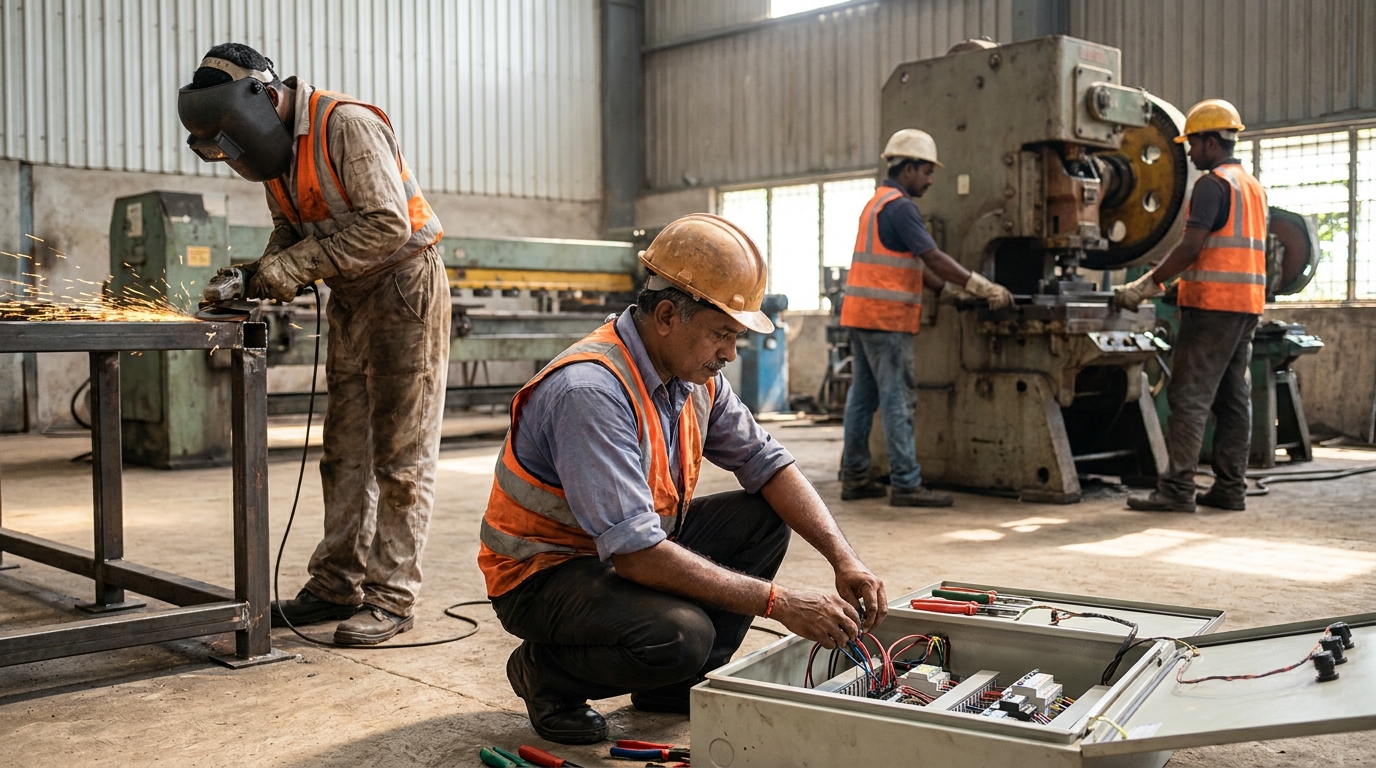
Businesses cannot expand simply because demand exists. They also need electricians, mechanics, machine operators, technicians, construction workers and other employees capable of doing the work.
And in some industries, Sri Lankan companies are already looking overseas because they cannot find enough workers locally.
For foreign business owners and investors, this is worth watching. Sri Lanka may have relatively low labour costs compared with many Western economies, but that does not necessarily mean the right workers are easy to find.
What happened?
Speaking at a media briefing on 20 August, Handunnetti said Sri Lankan industries currently have around 400,000 unfilled jobs.
He described shortages of technical specialists and difficulties finding service providers as a growing obstacle to industrial development.
His argument was not that Sri Lanka lacks people altogether.
Instead, employers are struggling to match vacancies with people who have the necessary skills and qualifications.
The Government’s preferred response is to improve training rather than immediately rely on large numbers of foreign workers.
Handunnetti said discussions are taking place with universities and vocational training institutions, with providers being encouraged to develop courses around the actual requirements of industry rather than simply continuing with their existing programmes.
Finance Minister Prof. Anil Jayantha also told Parliament on 20 August that Sri Lanka wants to improve workforce competencies so that Sri Lankan workers can meet international standards.
In simple terms, the Government wants education and vocational training to become much more closely connected to the jobs businesses are actually trying to fill.
Sri Lanka’s Tourism Expansion: What expats need to know
ExpatsLanka checked the numbers – and there is an important distinction
The figure of 400,000 vacancies is striking.
But it needs context.
ExpatsLanka checked the latest official Labour Force Survey from Sri Lanka’s Department of Census and Statistics.
In the first quarter of 2026, Sri Lanka’s unemployment rate was 3.7%, while labour force participation stood at 49.2%.
That participation figure is particularly interesting.
It means fewer than half of Sri Lanka’s population aged 15 and over were either working or actively looking for work under the survey definition.
The country’s total labour force was approximately 8.4 million people.
So Sri Lanka’s problem is more complicated than simply having “400,000 jobs and 400,000 people who need work”.
Some people are outside the labour market altogether.
Others may live in the wrong part of the country, lack the necessary qualifications or be unwilling to take particular jobs at the wages and conditions offered.
And some of the workers Sri Lankan companies need may already have left the country.
Sri Lanka’s Tourism Expansion: What expats need to know
What jobs are actually going unfilled?
In June, Handunnetti identified labour shortages in sectors including:
- construction
- tiles and related products
- footwear
- leather products
- the automobile industry
He also said the shortages involved both skilled and unskilled workers.
That distinction matters.
Sri Lanka’s labour problem is therefore not simply a shortage of university graduates or highly qualified professionals.
Businesses also need tradespeople, technicians, production workers and people prepared to work in industrial occupations.
What skills are Sri Lankan businesses looking for?
The exact requirements vary enormously by sector, but the industries identified by the Minister give a useful indication.
Construction
Sri Lanka’s construction industry needs practical trades and technical capabilities.
That can include electricians, plumbers, welders, masons, carpenters, tilers, machine operators and site supervisors.
The relevant skills range from electrical installation and plumbing to welding, fabrication, carpentry, reading construction drawings and operating machinery safely.
For developers and foreign property investors, shortages in these occupations can have a very practical consequence: projects may take longer or contractors may compete for experienced tradespeople.
Automotive
The automobile industry increasingly requires more than traditional mechanical skills.
Businesses need mechanics and technicians who understand engine servicing, electrical systems, diagnostics, brakes, suspension and increasingly hybrid and electric vehicle technology.
Auto electricians and diagnostic technicians may become particularly valuable as vehicles become more electronically complex.
Manufacturing
Factories need machine operators, electricians, maintenance technicians, welders, fabricators and people capable of keeping production equipment running.
These jobs require practical technical training rather than necessarily a university degree.
Skills such as machinery operation, mechanical maintenance, electrical fault finding, welding, quality control and workplace safety can therefore be extremely important.
Footwear and leather
These industries require another set of specialist skills, including industrial sewing, cutting, pattern making, machine operation, assembly, finishing and quality control.
Again, these are skills normally developed through vocational or workplace training rather than conventional academic education.
This helps explain why simply having unemployed people does not automatically solve the problem.
A vacancy and an available worker only match when the worker can actually perform the job.
Sri Lanka is already bringing in some foreign workers
Speaking in June about the same labour shortage, Handunnetti said businesses had recruited workers from countries including India and China because they were unable to find sufficient skilled and unskilled labour locally.
That creates an interesting policy dilemma.
The Government says it would prefer to develop Sri Lanka’s own workforce first.
That makes economic sense. Training Sri Lankan workers keeps more employment and income within the country.
But businesses cannot necessarily wait several years for the education system to produce the workers they need.
A factory, construction company or automotive business with orders today needs employees today.
If domestic recruitment cannot meet that demand, pressure to recruit internationally is likely to continue.
Sri Lanka secures $200m ADB loan to boost investment
Why has Sri Lanka ended up with a worker shortage?
Skills are only one part of the explanation.
Migration matters too.
Sri Lanka lost significant numbers of workers overseas during and following the economic crisis, when many people sought better salaries and greater financial security abroad.
Handunnetti acknowledged this problem directly, saying Sri Lankans who leave for overseas employment are not returning at the rate policymakers had hoped.
There is also a broader labour-force issue.
Official statistics show labour force participation at 49.2% in the first quarter of 2026.
That means Sri Lanka does not simply need to train unemployed workers. It also needs to understand why such a large proportion of the working-age population remains outside the labour market.
Those reasons can include education, caring responsibilities, retirement, household responsibilities and other factors.
This is why describing the problem purely as a “skills gap” risks oversimplifying it.
Sri Lanka appears to be dealing with several issues simultaneously:
skills mismatches, outward migration, relatively low labour-force participation and shortages in occupations that employers are struggling to fill.
What does this mean for foreign businesses in Sri Lanka?
For foreigners considering opening or expanding a business in Sri Lanka, the headline contains an important warning.
Do not assume that lower wages automatically mean easy recruitment.
A business plan might look attractive on paper because labour costs are considerably lower than in Britain, Europe, Australia or the United States.
But the more important question is whether the people with the skills you need are actually available in the location where you intend to operate.
A foreign investor planning a manufacturing operation, hotel, construction project or specialist service business should investigate recruitment before committing significant capital.
Ask:
What skills will the business need?
How many suitably trained workers are available locally?
What are experienced workers actually being paid?
How quickly can replacements be found?
Will employees require additional training?
Could skilled-worker shortages delay expansion?
Labour availability should be part of investment due diligence just like rent, electricity, taxes and regulation.
Healthcare in Sri Lanka: The Complete Expat Guide
Does this mean foreigners can apply for these jobs?
Not automatically.
This is probably the most important distinction for foreign readers.
A country having a labour shortage does not mean its labour market suddenly becomes open to anyone who wants to move there.
Foreign nationals still need the appropriate immigration and employment permissions to work legally in Sri Lanka.
And the Government’s stated preference is currently to train Sri Lankan workers to meet domestic demand rather than simply replacing the shortage with overseas recruitment.
However, the fact that companies are already bringing in workers from India and China shows that foreign labour can become part of the solution where domestic recruitment is insufficient.
For foreigners with specialist technical or management expertise, that is a development worth watching.
But nobody should interpret the 400,000-vacancy headline as an invitation to arrive in Sri Lanka and start looking for work.
The bigger issue: education and jobs need to match
Perhaps the most important part of the Government’s response is its conversation with universities and vocational training providers.
For years, countries around the world have struggled with the same problem: education systems can produce qualifications without necessarily producing the skills employers need.
Sri Lanka now wants training providers to work backwards from actual labour demand.
If industry needs automotive technicians, train automotive technicians.
If manufacturers need machine operators and maintenance specialists, build programmes around those jobs.
If construction companies cannot find electricians or welders, expand training in those trades.
That sounds obvious.
In practice, it requires much better communication between government, employers, universities and vocational institutions.
It also requires young people to see technical and vocational careers as worthwhile options.
If Sri Lanka can make that connection successfully, the benefit would extend beyond reducing unemployment.
Businesses could expand more easily, productivity could improve and the country could become more attractive to investors.