

For many years, choosing where to live in Sri Lanka meant balancing proximity to employment, international schools, hospitals and other essential services with the desire for more space and a better quality of life.

Colombo was often the most practical choice for foreign residents, particularly those running businesses or relocating with children. However, the expansion of Sri Lanka’s expressway network is gradually changing this equation.
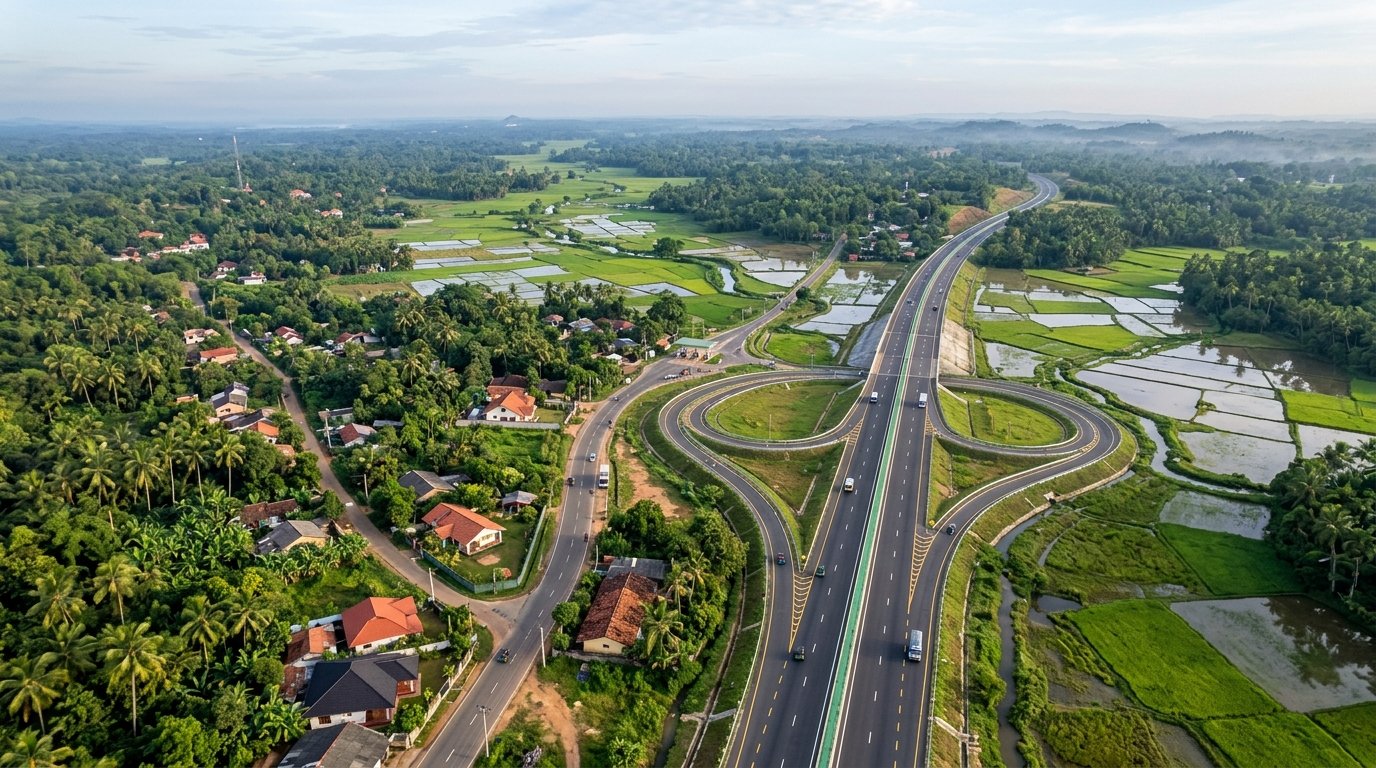
Improved connectivity is making suburban neighbourhoods, coastal towns and previously less accessible inland locations more attractive places to live, work and invest.
For expatriates, retirees, digital nomads and foreign property investors, these developments are creating new opportunities to establish a home outside the capital without becoming entirely disconnected from its facilities.
However, better road infrastructure does not automatically make every location suitable for residential living. Understanding the difference between regional connectivity and everyday accessibility remains essential.
Sri Lanka’s expanding expressway network
According to the Road Development Authority (RDA), Sri Lanka had approximately 312.6 kilometres of operational expressways as of June 2026.
The network connects several important economic, commercial, residential and tourism regions, with further expansion planned over the coming years.
| Expressway | Main connections | Significance for residents |
|---|---|---|
| Southern Expressway (E01) | Kottawa, Galle, Matara and Mattala | Improved access to the southern coast and residential areas outside Colombo |
| Outer Circular Highway (E02) | Kottawa, Kaduwela, Kadawatha and Kerawalapitiya | Connections between suburban areas without crossing central Colombo |
| Colombo–Katunayake Expressway (E03) | Peliyagoda and Katunayake | Improved access to the international airport and surrounding commercial areas |
| Central Expressway (E04) | Operational section between Mirigama and Kurunegala | Improved regional connectivity, with further sections under development |
| Hambantota expressway connection | Andarawewa and Hambantota | Improved access to the southeastern region and its commercial infrastructure |
Sources: Road Development Authority and Expressway Operation, Maintenance and Management Division.
The significance of these developments extends beyond reducing journey times. Expressways can influence residential development, employment opportunities, business operating costs, tourism demand and the geographical distribution of property investment.
How expressways are changing the concept of living near Colombo
Traditionally, living close to Colombo meant paying a premium for accommodation while accepting smaller properties, traffic congestion and the limitations of urban living.
Improved road connections are allowing some households to consider a different arrangement: living further away from the city while maintaining access to its employment opportunities and services.
This is particularly relevant to people who:
- Work remotely or follow a hybrid working arrangement.
- Run businesses that do not require a daily presence in Colombo.
- Prefer detached houses with gardens rather than city apartments.
- Travel internationally on a regular basis.
- Want to reduce housing expenditure without becoming geographically isolated.
- Are considering long-term property investment outside established urban centres.
For foreign residents, the ability to access Colombo when necessary, rather than living there permanently, can significantly expand the range of suitable residential locations.
Nevertheless, expressway access alone does not eliminate congestion on ordinary roads leading into the capital.
Colombo’s suburbs are becoming increasingly attractive
Areas surrounding major expressway interchanges are becoming more relevant to residential development.
Locations such as Kottawa, Homagama, Pannipitiya, Kaduwela and Kadawatha offer varying combinations of suburban housing, educational facilities, commercial services and regional road connectivity.
Kottawa and Homagama
Kottawa occupies a strategically important position where the Southern Expressway connects with the Outer Circular Highway.
Nearby Homagama offers residential neighbourhoods, educational institutions and commercial facilities, with opportunities to find larger properties than might be available within central Colombo for a comparable budget.
The Makumbura Multimodal Transport Centre also brings together railway, bus and expressway coach services, providing additional transport alternatives.
For families seeking a house with a garden while maintaining access to Colombo, these areas may offer a practical compromise.
Kaduwela and Kadawatha
Access to the Outer Circular Highway makes these areas relevant to residents who need to travel between different parts of the Colombo metropolitan region.
The ability to bypass central Colombo for certain journeys may be particularly useful for business owners, frequent travellers and households with commitments in multiple suburban locations.
Kadawatha could also benefit from the completion of the currently unfinished section of the Central Expressway towards Mirigama.
However, buyers should distinguish between accessibility that exists today and improvements that depend on future construction.
Bandaragama and surrounding areas
The Gelanigama interchange provides access to the Southern Expressway from the Bandaragama area.
For households looking for quieter residential surroundings, larger plots of land and access to both Colombo and the southern coast, this part of the Western Province may warrant consideration.
The development potential of such locations depends not only on expressway access but also on local roads, healthcare facilities, schools, drainage and commercial services.
The Southern Expressway and the growing appeal of coastal living
Perhaps the most visible example of how road infrastructure can transform residential and investment opportunities in Sri Lanka is the Southern Expressway.
The opening of its first section between Kottawa and Galle in 2011 changed the relationship between Colombo and the Southern Province. Subsequent extensions improved access to Matara, Hambantota and surrounding areas.
The Asian Development Bank has documented economic benefits associated with the Southern Expressway, including improved movement of goods and opportunities for tourism-related businesses around Galle. Development Asia
For foreign residents, the expressway has made coastal living a more practical long-term option rather than simply a holiday experience.
Galle and surrounding areas
Galle offers a combination of historical architecture, coastal living, private healthcare, international education options, restaurants and an established international community.
Its expressway connection makes travelling to Colombo considerably more practical than relying exclusively on the traditional coastal road.
For remote workers, entrepreneurs and families who only need to visit the capital occasionally, living in or around Galle can provide an alternative to Colombo’s urban lifestyle.
The surrounding inland areas may also attract residents seeking larger gardens, privacy and more space while remaining within reach of the coast.
Ahangama, Weligama and Mirissa
These coastal destinations have become increasingly attractive to digital nomads, international entrepreneurs, seasonal residents and people operating tourism-related businesses.
Although the expressway does not run directly through these coastal towns, access through nearby interchanges improves their regional connectivity.
For residents who work remotely, the combination of coastal living and relatively convenient access to Colombo and the international airport can be particularly appealing.
However, the growth of tourism and international demand may also contribute to rising rents, increased construction and pressure on local infrastructure.
Living slightly inland may offer better value, provided that access to the coast and essential services remains practical.
Matara and Tangalle
The extension of the Southern Expressway has improved connectivity further east along the southern coast.
Matara offers the advantages of an established regional city, including hospitals, educational institutions, supermarkets and commercial services.
Tangalle presents a different residential proposition, attracting people looking for quieter surroundings, larger properties and a less urbanised coastal lifestyle.
Improved regional access may make these areas more appealing to foreign residents who previously considered them too distant from Colombo or the international airport.
Nevertheless, neither should be considered an uncomplicated base for a daily commute to central Colombo. Their appeal is stronger for residents whose professional and personal commitments are primarily local or flexible.
Living closer to the international airport
For foreigners who regularly travel between Sri Lanka and other countries, the Colombo–Katunayake Expressway and its connection with the Outer Circular Highway are particularly important.
Airport accessibility can influence residential choices for:
- Seasonal residents dividing their time between Sri Lanka and another country.
- International business owners.
- Families with children studying overseas.
- Remote workers who travel frequently.
- Foreign property owners managing international commitments.
Areas such as Negombo, Seeduwa, Ja-Ela and other parts of the Gampaha District may offer an alternative to living in central Colombo.
Residents can benefit from proximity to Bandaranaike International Airport while maintaining access to the capital and other regions through the expressway network.
However, proximity to the airport also comes with potential disadvantages, including aircraft noise, traffic around commercial centres and varying levels of residential development.
For frequent international travellers, actual door-to-terminal journey times may be a more useful measure than the distance between a property and the airport.
The Central Expressway: Could central Sri Lanka become more attractive to foreign residents?
While the Southern Expressway has already demonstrated the benefits of improved regional connectivity, the Central Expressway could create further changes in residential and commercial development over the coming years.
The Mirigama–Kurunegala section, which opened on 15 January 2022, currently provides approximately 41 kilometres of operational expressway. Kurunegala section of Central Expressway+1
However, the network is not yet fully connected to Colombo through the planned Kadawatha–Mirigama section, nor does it provide a continuous expressway journey to Kandy.
The completion of these missing sections could improve accessibility to inland towns and create new opportunities for residential development, logistics, tourism and regional businesses.
What does the 2027 budget propose?
Sri Lanka’s national budget for 2027, presented in November 2026, includes further funding for major expressway development projects.
The government has announced the following construction targets:
| Expressway project | Announced completion target |
|---|---|
| Pothuhera–Rambukkana | May 2027 |
| Kadawatha–Mirigama | September 2028 |
| Rambukkana–Galagedara | July 2029 |
In addition, Cabinet approval has been granted for the Kurunegala–Galewela section, forming part of the proposed expressway connection towards Dambulla.
These are announced construction targets, not guaranteed public opening dates. Infrastructure projects can experience delays due to funding arrangements, land acquisition, engineering challenges and procurement processes.
Kurunegala and surrounding areas
Kurunegala is already an established regional commercial centre with healthcare, educational and retail facilities.
Improved expressway connectivity could make it more attractive to households and businesses that require access to both Colombo and central Sri Lanka.
For foreign residents who do not prioritise coastal living, Kurunegala may eventually warrant greater consideration as a residential base.
Its potential appeal includes larger residential properties, access to regional services and a location between several important economic centres.
Kandy and the hill country
Improved road connections towards Kandy could make central Sri Lanka more accessible to people who prefer cooler surroundings, mountainous landscapes and a different pace of life.
Kandy already offers established educational institutions, healthcare facilities and commercial services.
However, the planned Central Expressway connection towards Galagedara should not be confused with a direct expressway into Kandy city.
Local road conditions, mountainous terrain and congestion on the final approach to Kandy will remain important factors when assessing residential accessibility.
How expressway access is influencing Sri Lanka’s property market
Transport infrastructure is one of the factors that can influence residential property demand.
When a new expressway opens, locations previously considered inconvenient may become more attractive to households, developers and businesses. This can gradually change how land is used and where residential communities develop.
Research from the University of Moratuwa examining land-use changes between 2001 and 2021 around the Kottawa and Gelanigama interchanges identified significant changes in landscape fragmentation associated with the Southern Expressway.
Earlier property market analysis by PwC also highlighted the emergence of residential land developments and apartment projects along expressway corridors.
Potential developments around established and future interchanges include:
- Gated residential communities and housing developments.
- New apartment complexes.
- Supermarkets, restaurants and shopping centres.
- Private healthcare and educational facilities.
- Warehouses and distribution centres.
- Hotels and tourism-related businesses.
- Commercial offices and coworking spaces.
As these facilities develop, some locations may become increasingly self-sufficient, reducing the need for residents to travel to Colombo for everyday services.
However, there is no guarantee that every property near an expressway will increase in value. Property performance depends on local demand, development quality, planning regulations, environmental conditions and the availability of supporting infrastructure.
Could inland properties become an alternative to beachfront homes?
Foreign property buyers in Sri Lanka often focus on beachfront villas, ocean-view apartments and properties within established coastal communities.
However, improved transport connectivity may encourage some buyers to consider inland locations.
A property situated several kilometres from the coast could offer:
- A lower purchase price than a comparable beachfront property.
- Larger gardens and outdoor areas.
- Greater privacy.
- Less exposure to coastal corrosion.
- Reduced exposure to some of the risks associated with beachfront development.
- Access to coastal attractions without paying a beachfront premium.
For example, a residential property inland from Galle or Weligama may provide a quieter living environment while maintaining reasonable access to beaches, restaurants and the Southern Expressway.
For long-term residents, this could represent better overall value than purchasing property directly within a popular tourism destination.
Nevertheless, buyers should consider access roads, flooding, drainage, utilities and legal restrictions on foreign land ownership before committing to a purchase.
Read more: How development is reshaping Sri Lanka’s property market.
How realistic is commuting from outside Colombo?
Expressways can significantly improve regional travel, but one of the most common mistakes when choosing a residential location is focusing exclusively on the time spent on the expressway itself.
A daily journey typically consists of three separate stages:
Faster expressway travel does not necessarily eliminate congestion at either end of a journey.
A property advertised as being only ten minutes from an expressway interchange may still involve a lengthy commute once urban congestion is included.
The Road Development Authority has acknowledged peak-hour congestion around several expressway exits, including Kadawatha, Kaduwela, Athurugiriya, Kottawa, Peliyagoda and Ja-Ela.
For people working in Colombo five days a week, living in an accessible suburb may be more practical than relocating to the southern coast.
For remote workers who only visit Colombo once or twice a month, however, the geographical possibilities are considerably wider.
The financial cost of expressway commuting
Moving outside Colombo may reduce housing costs, but residents should consider whether these savings could be offset by higher transport expenditure.
Regular expressway commuting involves fuel, toll charges, vehicle maintenance, depreciation and potentially parking expenses.
The following example illustrates how commuting costs might differ depending on the frequency of travel.
Assume a return journey of 100 kilometres, fuel efficiency of 15 kilometres per litre, petrol costing an illustrative LKR 300 per litre and combined return expressway tolls of LKR 800.
| Expense | Daily commuter | Hybrid worker | Remote worker |
|---|---|---|---|
| Return journeys per month | 22 | 8 | 2 |
| Monthly distance | 2,200 km | 800 km | 200 km |
| Monthly fuel costs | LKR 44,000 | LKR 16,000 | LKR 4,000 |
| Monthly toll charges | LKR 17,600 | LKR 6,400 | LKR 1,600 |
| Total monthly expenditure | LKR 61,600 | LKR 22,400 | LKR 5,600 |
| Annual expenditure | LKR 739,200 | LKR 268,800 | LKR 67,200 |
LKR 0LKR 200KLKR 400KLKR 600KLKR 800KDaily commuterHybrid workerRemote worker
These calculations are hypothetical and do not represent a specific expressway route or current fuel and toll prices. Vehicle maintenance, depreciation, insurance and parking are excluded.
The example demonstrates why expressway connectivity may be particularly valuable to remote and hybrid workers rather than daily commuters.
Current toll charges can be checked through the official RDA expressway toll schedule.
Can you benefit from expressways without owning a car?
Improved expressway connectivity is not exclusively beneficial to private vehicle owners.
Expressway bus services connect several major towns and transport centres, providing alternatives for residents who prefer not to drive.
These services can be particularly useful for occasional journeys between Colombo and the Southern Province.
However, expressways are controlled-access roads. Passengers must still reach the relevant bus station or transport terminal before beginning their journey.
For residents living in remote properties, the challenge may therefore be reaching the transport hub rather than completing the longer journey itself.
Further investment in integrated transport services, connecting local buses, railways and expressway coaches, could make suburban and regional living more accessible to households without private vehicles.
Read more: Sri Lanka is modernising its bus network: What it means for expats, residents and travellers.
What improved connectivity means for foreign businesses
Sri Lanka’s expressway network also has implications for foreigners establishing or operating businesses on the island.
Historically, proximity to Colombo was particularly important for businesses relying on suppliers, professional services, international customers and airport access.
Improved regional connectivity may allow some businesses to operate successfully from alternative locations.
Hospitality and tourism
Hotels, boutique guesthouses, holiday villas and wellness retreats may benefit from improved accessibility.
International visitors may be more willing to consider destinations further from the airport if transfers are convenient and reasonably predictable.
This could support tourism development in locations outside the most established coastal resorts.
Property management
Businesses managing holiday villas and residential properties may be able to cover larger geographical areas more efficiently.
Improved road connections could make it easier to coordinate maintenance, cleaning, inspections and property viewings across multiple locations.
Retail and distribution
Improved transport infrastructure can support the movement of products between commercial centres and regional markets.
Businesses operating outside Colombo may benefit from more efficient deliveries, improved access to suppliers and potentially greater flexibility when choosing commercial premises.
Remote businesses and professional services
Entrepreneurs running online businesses may no longer need to base themselves in Colombo simply to maintain occasional access to the capital.
A residential or commercial property on the southern coast or in a well-connected suburban area may offer a more attractive combination of lifestyle and operating expenses.
However, reliable internet, electricity, banking services and other business infrastructure remain essential.
How expressways could influence where expat families choose to live
For families relocating to Sri Lanka, residential decisions are frequently determined by the location of schools rather than the availability of attractive properties.
Improved road connections may expand the number of residential neighbourhoods within reach of international schools and educational institutions.
Nevertheless, parents should consider the full school journey, including peak-hour traffic and the time children spend travelling each day.
A larger house with a garden may offer excellent value, but its benefits could be reduced if children spend several hours commuting.
Families should also investigate whether school transport services cover their preferred residential area.
Expressway access should complement educational accessibility rather than replace it as a consideration.
Read more: Best places to live in Sri Lanka for expat families with children.
What improved connectivity means for retirees
Retirees may be among the groups that benefit most from improved regional connectivity because they are generally less dependent on daily commuting.
The possibility of living in quieter surroundings while maintaining occasional access to Colombo’s specialist healthcare, international airport and commercial facilities can make regional living more attractive.
However, access to healthcare should remain a priority.
Being connected to Colombo by an expressway is not a substitute for having suitable emergency medical facilities nearby.
Retirees should assess local hospitals, pharmacies, ambulance availability and routine medical services before choosing an isolated or rural property.
A well-connected regional town may offer a better long-term residential solution than a remote property that relies entirely on expressway access.
The disadvantages of living near an expressway
Although improved connectivity offers significant advantages, residential development near major transport infrastructure can also create problems.
Potential disadvantages include traffic noise, increased commercial activity, construction disturbance, air pollution, congestion around interchanges and the loss of agricultural or green spaces.
Rapid development can also place pressure on water supplies, drainage systems, waste collection and other public services.
Research examining the Southern Expressway has identified changes in land cover and landscape fragmentation, highlighting the importance of managing development around transport corridors. dl.lib.uom.lk
For property buyers, proximity to an expressway interchange may be desirable, but proximity to the expressway itself is not necessarily an advantage.
A property located a short drive from an interchange may offer a better balance between accessibility and residential comfort than one situated directly alongside the motorway.
Which areas could benefit from improved expressway connectivity?
The following table identifies locations worth monitoring from a residential and infrastructure perspective. It is not a property investment ranking or a prediction of future capital appreciation.
| Area | Main connectivity advantage | Potential residential appeal |
|---|---|---|
| Kottawa | Southern Expressway and Outer Circular Highway | Families and suburban professionals |
| Homagama | Access to the Kottawa interchange | Larger homes and suburban living |
| Bandaragama | Southern Expressway access | Quieter residential surroundings |
| Kaduwela | Outer Circular Highway | Access to multiple commercial areas |
| Kadawatha | Outer Circular Highway and future Central Expressway connections | Long-term suburban development |
| Ja-Ela | Colombo–Katunayake Expressway | Airport accessibility and family living |
| Seeduwa | Airport and regional road connections | Frequent international travellers |
| Galle | Established Southern Expressway connection | Coastal and regional city living |
| Weligama | Regional access through nearby interchanges | Remote workers and seasonal residents |
| Matara | Southern Expressway and established regional services | Long-term residents and businesses |
| Tangalle | Improved southern regional connectivity | Retirees and lifestyle-oriented residents |
| Kurunegala | Operational Central Expressway section | Regional residential and commercial development |
| Galagedara | Future Central Expressway connection | Potential longer-term development opportunities |
Established connectivity provides immediate practical benefits. Future connectivity represents potential benefits that remain dependent on project completion.
What property buyers should check before investing near an expressway
Foreigners considering buying or renting property near existing or proposed expressway infrastructure should investigate several factors before making a commitment.
- Actual driving time to the nearest operational interchange.
- Peak-hour journey times to schools, hospitals and workplaces.
- Legal access rights to the property.
- Local road quality and accessibility during monsoon rainfall.
- Flooding, landslide and drainage risks.
- Existing and proposed land-use regulations.
- Noise levels from expressways and commercial traffic.
- Availability of electricity, water, internet and waste collection.
- Potential future road widening or land acquisition.
- Local residential rental demand.
- Applicable foreign property ownership restrictions.
- Whether nearby infrastructure projects are funded, under construction or simply proposed.
One particularly important consideration is whether the property’s asking price already reflects the anticipated benefits of future infrastructure.
Buying property near a proposed expressway does not automatically mean purchasing before prices increase. Sellers may already be incorporating expected future development into their prices, even when construction remains several years away.
Will Colombo remain the main destination for foreign residents?
Colombo is likely to remain a major residential and commercial centre due to its concentration of employment opportunities, international schools, specialist healthcare, professional services and diplomatic institutions.
However, improved regional connectivity could gradually reduce the need for certain groups of foreign residents to live permanently in the capital.
Rather than replacing Colombo, expressway development may support a more geographically distributed model of residential living.
Foreigners could increasingly choose locations based on lifestyle, property affordability, climate and personal preferences while maintaining access to Colombo whenever necessary.
This may be particularly relevant to remote workers, retirees, seasonal residents and entrepreneurs whose businesses do not require a daily presence in the capital.
Sri Lanka’s expressway network is doing more than connecting cities. It is changing the relationship between geography, employment, residential development and lifestyle.
For foreign residents, improved connectivity creates opportunities to consider locations that may previously have appeared impractical.
A family may choose a suburban house with a garden rather than a city apartment. A remote worker may establish a home on the southern coast. A retiree may prefer a regional town, while an entrepreneur may operate a business outside Colombo without becoming disconnected from its commercial infrastructure.
However, an expressway cannot compensate for inadequate local roads, limited healthcare, unreliable utilities or unsuitable residential development.
The most important consideration is not simply how close a property is to an expressway, but how effectively its location supports everyday life.
As Sri Lanka continues investing in transport infrastructure, the most attractive residential locations may increasingly be those that combine regional connectivity with reliable local services, affordable housing and a good quality of life.
Disclaimer: This article is provided for general informational purposes only and does not constitute financial, legal, property investment or professional relocation advice. Infrastructure projects, completion targets, transport costs and development plans may change. References to potential residential demand and property market development represent editorial analysis rather than guaranteed investment outcomes. Readers should undertake independent due diligence and consult the relevant Sri Lankan authorities before making property or investment decisions. Information is current as of 28 November 2026.